
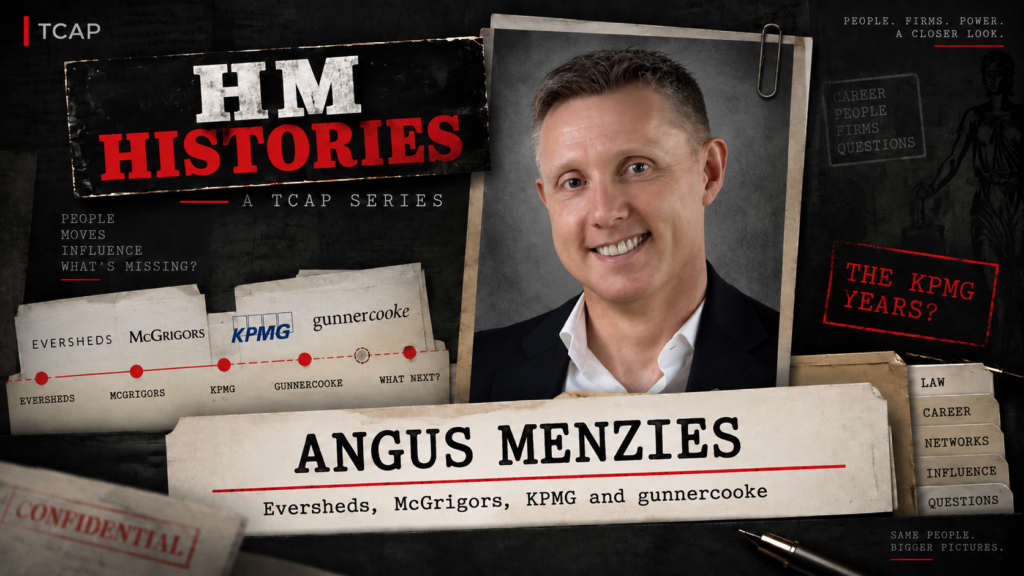
Angus Menzies’s McGrigors history takes us into a professional-services romance where even the fucking wedding vows need a compliance review. There was a KPMG connection, a separation under US regulatory pressure, then a Pinsent Masons merger advertised as a match made in heaven. Redundancies followed. Fuck me, even the wedding presents needed an exit strategy. Before Angus became a KPMG director, McGrigors was already part of this expensive experiment in joining things together and taking them apart.
Readers of Jiten’s Jobs have met both firms. Simon Horsfield’s HM Histories chapter brought us back to Pinsent too. Now Angus supplies the McGrigors connection, and the argument is simple: corporate scale gets sold as a benefit, while the people making up that scale remain expendable. At the launch, employees help demonstrate how impressive the business has become. Later, some discover that the impressive business would prefer fewer of the bastards on its payroll.
Angus Menzies At McGrigors
On 25 April 2011, City AM reported that Angus Menzies was joining KPMG from McGrigors as a director to lead a new employment-law team. That fixes the order: McGrigors before KPMG. Today, Horsfield Menzies presents him as an employment-law partner advising employers on people strategies. His practice includes employment status, restrictive covenants and team moves. In other words, he works where an employer’s commercial wishes meet the awkward business of other people having rights.
That professional history deserves a proper look. A biography gives you the polished version: experience accumulated, expertise acquired, seniority achieved. However, I have no interest in standing outside the careers department applauding somebody’s fucking lanyard. HM Histories follows the institutions behind those credentials. McGrigors brings us to a recurring question: how much of the professional promise survives when independence becomes inconvenient or a member of staff becomes an expense?
2002: The Partners Find A Bigger Bed
In March 2002, the Law Society Gazette reported that McGrigor Donald had merged with KLegal, the legal practice associated with KPMG. The arrangement created three associated law firms with 71 partners. Their London operations combined under KLegal, while the Scottish and Northern Irish practices retained McGrigor Donald. Expansion in London and access to the international network were explicit attractions. Naturally, the relationship arrived carrying a business case rather than a bunch of petrol-station flowers.
You can see the commercial appeal without pretending it is a spiritual awakening. More offices mean more reach; more specialists mean more work the organisation can take on. Meanwhile, a client with several problems represents several opportunities to provide advice. The prospect of all those potential instructions could give a partnership calculator a hard-on. Every firm loves a complicated corporate life, provided somebody else is paying to have it explained.
2004: The Rules Become A Pain In The Arse
By February 2004, the romance required fresh paperwork. The Gazette reported that the UK operation would become McGrigors nationwide, replacing KLegal in London and McGrigor Donald in Scotland. Its report connected the separation from KPMG to regulatory pressure in the United States. The international legal network was also being disbanded. An informal arrangement would operate while discussions continued about a future structure. So much for putting the wedding stationery on a permanent order.
There is a useful dose of cold water in that history. Commercial closeness had helped sell the earlier arrangement; now the structure needed separation. Independence had become a practical question requiring more than everyone agreeing they were terribly professional. Who controls the business, and where does its money go? Those are the questions that matter. The brand can lose a letter; the financial relationship needs rather more than a bloody spellcheck.
Independence Needs More Than Good Manners
The SEC’s May 2004 correspondence sets out the wider conditions for separating legal practices from KPMG firms. These included distinct branding, separate governance, restrictions on financial support and no revenue or profit sharing. Its staff’s assurance against recommending an independence enforcement action depended on the stated conditions being met. Those conditions demanded substantive boundaries. A fresh reception sign could announce the separation, but it could not do the whole job.
Bollocks to the idea that a prestigious name should spare anyone that examination. The clever cunts don’t get an exemption because the business card is thick enough to tile a bathroom. Independence concerns the connections underneath the presentation, including who benefits and who can exert control. Professional confidence is easy to manufacture. However, confidence does bugger all to answer a question about money. For that, somebody has to open the accounts and explain the arrangement.
Divorced, But Still Best Fucking Friends
Nevertheless, the Gazette’s February 2004 report also said the underlying relationships between the legal firms would remain. Work across jurisdictions would continue, and the new grouping would have a “best friends” relationship with KPMG. What a wonderfully cuddly description of a commercial connection. It makes professional networking sound like two people sharing a packet of crisps, instead of organisations preserving relationships through which business can continue to flow.
Bless their commercially affectionate little arses. A client asking about independence needs to know which connections remain, what they permit and how they are controlled. Yet “best friends” offers a cuddle where the questions need a document. The fuckers are running professional businesses, not organising a school reunion. Put the friendship bracelet down and explain the terms on which the relationship continues.
2011: Angus Moves Towards KPMG
Seven years after the rebranding, Angus Menzies’s career announcement takes us from McGrigors to KPMG. He arrives as a director charged with building an employment-law team. The personal move and the firm’s earlier institutional relationship are different events, but together they explain why these names keep appearing in the same history. The legal and accountancy worlds have considerably more connecting doors than the average careers paragraph bothers to show.
This also brings us back to Jiten’s Jobs : KPMG – Mind The Fucking Gap and KPMG II – £29 Million To Never Say No. Those chapters examined the firm’s pay-gap record and Carillion audit relationship. We already have reasons to look past the commercial polish. Consequently, another senior lawyer’s route through KPMG adds context rather than a reason to start bowing. The size of the name has never been a satisfactory answer to what happened underneath it.
2012: Heaven Has A Headcount
McGrigors merged with Pinsent Masons on 1 May 2012, after Angus’s move to KPMG had been reported the previous year. The launch promoted access to more than 2,500 staff across 15 international locations. McGrigors’ company profile called it “a match made in heaven.” Christ, they really do make you work to avoid taking the piss. Apparently, a commercial merger can acquire divine approval before anybody has seen what happens to the seating plan.
The February management announcement gave the heavenly arrangement some earthly detail. McGrigors managing partner Richard Masters would become head of client operations, with responsibilities covering operational efficiency and pricing strategies. Clients would remain “at the heart of the new firm.” Meanwhile, somebody had to make the enlarged business work. A bigger map makes lovely promotional material; deciding who stays on the payroll is a less photogenic part of the same commercial world.
The Honeymoon Meets The Redundancy Letter
On 11 April 2013, Legal Business reported that Pinsent Masons would cut 13 fee-earners from its employment practice. It described this as the third redundancy round since the McGrigors merger. The firm attributed the employment exercise to departmental restructuring and distinguished it from the 62 support roles lost the previous year. There were separate explanations for the different cuts. Nevertheless, none of them converted the loss of a job into a fucking wedding favour.
Less than a year after the launch promoted the combined workforce, another group faced the exit. Readers will recognise the episode from Jiten’s Jobs : Pinsent Masons – When The Employment Lawyers Get Made Redundant. Here is the McGrigors background to that story. The business celebrated its enlarged capability, then employment specialists found their own roles in the calculation. Knowing what a redundancy exercise involves is a piss-poor consolation when your income is involved.
Expertise Does Not Pay The Mortgage After You Leave
The ugly joke is that the employment lawyers would understand the vocabulary. They could recognise the distinction between a role and a person, appreciate the commercial explanation and still have an entirely human response to losing work. Expertise does not make uncertainty pleasant. Nor does it pay the mortgage. You can understand the process perfectly and still think the people delivering the news are a bunch of self-satisfied shits.
That is why the redundancy reporting belongs beside the merger announcement. The launch counts people as evidence of strength. Later coverage counts some of them leaving. Read together, those documents give a fuller account of the business than the celebration alone. Staff help make the larger organisation impressive, but that supplies no promise of lasting security. Meanwhile, the corporate language can remain serenely optimistic. A press release has no rent to find.
The Same Names, With The Uncomfortable Pages Attached
Angus Menzies’s McGrigors history now connects several parts of the TCAP record. KLegal takes us towards KPMG; the later merger takes us into Pinsent. The employment cuts return us to Jiten’s Jobs, while Simon Horsfield’s HM Histories chapter examined Pinsent’s later AI correspondence failures. These are different events in different years. Keeping them attached to the relevant institutions stops the professional pedigree arriving with only its flattering pages intact.
I am tired of the implied instruction to be impressed. A large former employer can tell us something about experience, but it cannot settle questions about judgment or standards. Likewise, a merger announcement tells us what management wants to build, while the subsequent record shows what happened along the way. The professional sales pitch would like the name to finish the argument. Tough shit. Around here, the name tells us where to start reading.
Next Stop: KPMG
McGrigors’ institutional history runs through the KLegal combination, the KPMG separation and the Pinsent merger. Angus’s departure for KPMG came after the separation and before the merger. His next chapter takes us into the Silentnight record, where the consequences become far more severe than a painful contrast between promotional language and employment cuts. There, the promises made to workers become part of the deal itself.
For now, the McGrigors story leaves a useful collection of documents on the table: the courtship, the separation terms, the wedding announcement and the redundancy report. All belong in the history. Meanwhile, the people whose jobs helped advertise the enlarged firm deserve attention when the business decides it needs fewer of them. The happy couple can keep the fucking album. TCAP will keep the pages showing who was asked to leave after the speeches.
Lee Thompson – Founder, The Cummins Accountability Project
Sources
- City AM – City Moves, 25 April 2011: Angus Menzies joins KPMG from McGrigors as a director leading a new employment-law team.
- Horsfield Menzies – Angus Menzies: employment-law partner profile.
- Law Society Gazette – KLegal And McGrigor Unite To Broaden Their Horizons, March 2002.
- Law Society Gazette – KLegal Intensifies Split From KPMG With Name Change, February 2004.
- US Securities and Exchange Commission – Letter to KPMG LLP (UK), 14 May 2004, including KPMG’s incoming letter: conditions for separating legal practices.
- Pinsent Masons – Pinsent Masons And McGrigors Announce New Management Structure, 10 February 2012.
- Scottish Lifesciences Association – McGrigors And Pinsent Masons Merge, 1 May 2012: the firms’ announcement.
- McGrigors – Company profile: the merger described as “a match made in heaven”
- Legal Business – Redundancies: Pinsent Masons To Lose 13 Fee-Earners In Employment Reshuffle, 11 April 2013.
- TCAP – Jiten’s Jobs : Pinsent Masons – When The Employment Lawyers Get Made Redundant, 9 September 2026.
- TCAP – Jiten’s Jobs : KPMG – Mind The Fucking Gap, 9 September 2026.
- TCAP – Jiten’s Jobs : KPMG II – £29 Million To Never Say No, 17 September 2026.
- TCAP – HM Histories : Simon Horsfield – Pinsent Masons And The Bullshit Correction Department, 23 September 2026.