
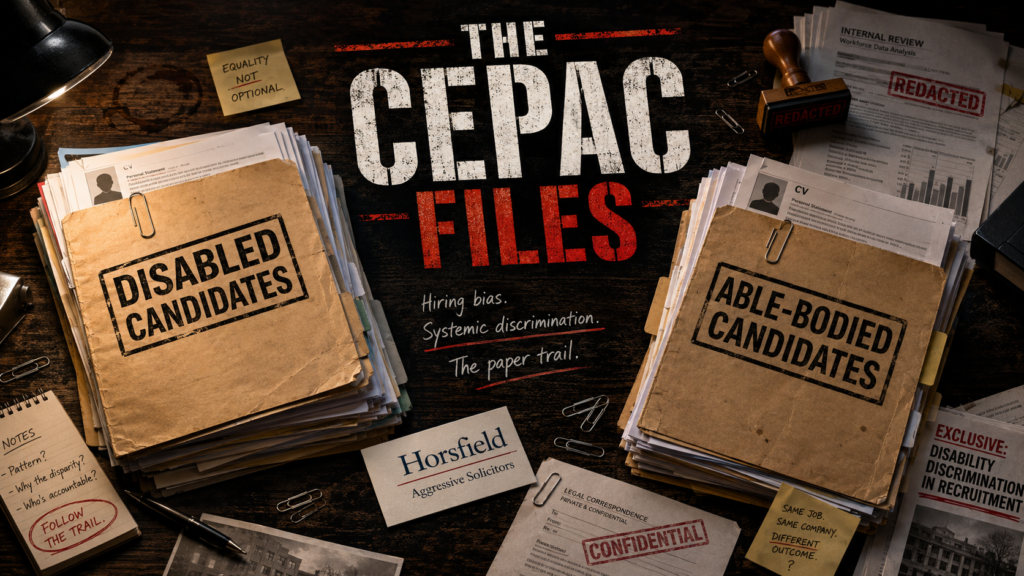
Hotel Chocolat Cepac display work appears in the packaging company’s 2026 portfolio. The chocolate brand promises respect, equality and inclusive recruitment, while its published supplier process includes cultural fit, ethical assessment and director-level approval. Now the ET3, Maria Walker’s email and two same-day WhatsApp lines arrive beneath the ribbon. Somebody approved the packaging. Who examines the people behind it?
Hotel Chocolat Cepac Displays: Welcome To The Gift Department
Luxury chocolate comes with a reassuring amount of ceremony. Alongside the presentation, there is also the language of care and the suggestion that somebody has considered every little detail. Meanwhile, page six of Cepac’s 2026 POS portfolio shows the less romantic apparatus underneath: a Hotel Chocolat display carrying its Premium Liqueur Trio Selection. The photograph includes a £10 ticket. Apparently, even affordable indulgence needs somewhere to park its principles.
That is Cepac’s own showcase, with Hotel Chocolat branding on the display. Consequently, the connection needs no creative guesswork. The next questions concern who commissioned it, which purchasing route brought Cepac in, and what arrangements continue today. Hotel Chocolat and its parent can supply those records. A buyer who can specify the finish on a gift box should also manage the fucking supplier’s name.
There is another familiar detail here: alcohol. HSA Group lists Cepac among its companies, and Cepac uses another drinks-branded installation to advertise its work. This time the booze arrives in the gift department, wearing chocolate’s respectable little jacket. However, the recruitment file travels just as easily. Behind the display sit an interview offer, a health disclosure and a later explanation that needs checking against the dates.
Be Brave, Be Kind, Open The File
Hotel Chocolat calls its commitment the People Pledge. Its people page promises “respect, equality and grace” and offers the mantra “Be brave. Be kind.” It also describes employment decisions based on merit, freedom from discrimination and harassment, and changes intended to reduce bias in recruitment. Alongside those promises, the page discusses support for employees’ mental health. The relevant vocabulary is therefore already familiar to the brand.
Those commitments concern its own workforce. Therefore, the question for this series is whether the same expectations reach the businesses behind its displays. How does a supplier’s handling of a disabled applicant sit beside that pledge? What happens when the supporting documents concern health information, a disputed interview offer and the treatment of the person who complained? Surely the answer should also contain something more substantial than reassurance.
Otherwise, kindness becomes another decorative fucking flourish: lovely on the customer-facing surface, mysteriously unavailable once procurement opens the back door. Hotel Chocolat knows how to discuss inclusion when it describes itself. Now it can also explain what inclusion requires when another company’s conduct enters the purchasing file. Nobody needs a ceremonial tasting spoon for that conversation. They need the original records and somebody prepared to read them.
A Director Signs Off The Supplier
The company’s published modern-slavery statement supplies a useful description of its purchasing machinery. Supplier selection considers compatibility with its scale, culture and capabilities. Formal approval then covers risk assessment, quality requirements, code-of-conduct assessment and commercial feasibility. The statement also describes director-level oversight and approval before new supply partnerships begin. Responsibility therefore sits somewhere more definite than the usual mist of corporate goodwill.
Its subject is modern slavery, but the supplier-approval process it describes includes an ethical assessment. Hotel Chocolat has therefore already explained that price and print quality do not exhaust the selection criteria. Applied to the Hotel Chocolat Cepac connection, the obvious questions concern the purchasing route, the assessment and the person who approved it. After all, those details belong in an ordinary commercial file.
So, what would make the brand revisit that assessment? A conflicting recruitment account should at least earn a closer look. Otherwise, cultural fit becomes a wonderfully accommodating phrase: the supplier fits because the box fits, the invoice fits and nobody has pushed the awkward paperwork across the desk. That would be a piss-poor substitute for the scrutiny the company describes. Procurement can demonstrate something better by answering the questions.
Mars Already Named The Documents
Mars completed its acquisition of Hotel Chocolat on 25 January 2024. The parent already appears in this series through Mars II and the Galaxy and Maltesers evidence. Its September 2024 Supplier Code covers active supply relationships and relevant subcontractors. It prohibits disability discrimination in hiring, bullying and psychological abuse, requires effective grievance handling, and protects personal information. Hotel Chocolat’s ownership therefore adds a second set of published expectations.
More specifically, Mars’s June 2025 implementation guide identifies candidate interview records, hiring decisions and discrimination complaints as relevant documentation. It also describes applying non-discriminatory recruitment practices through third-party labour providers. Here is the parent’s practical guide pointing towards exactly the material this case needs. Page made the call, Cepac received the candidate information, and the records should therefore explain the handover.
That gives the inquiry a direction. Start with the recruitment system and the inboxes, then compare them with the account Cepac supplied afterwards. The guide even identifies a failure to investigate media reports about worker exploitation as a due-diligence problem. Mars understands that published concerns can demand a response. Consequently, nobody needs another workshop on the importance of listening while the relevant email sits there like an unwanted raisin in the ganache.
The WhatsApp Came Before The Litigation
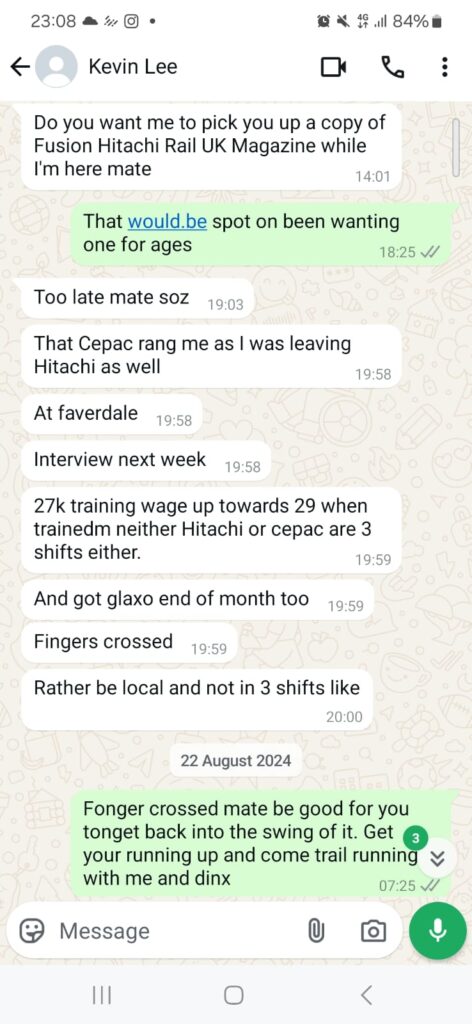
On 21 August 2024, Page Outsourcing called me about a production role at Cepac. During that conversation, the recruiter offered an interview for after the bank holiday and discussed pay. I also explained that my employment gap related to my mental health. Page said another call would settle an exact interview time. However, the promised confirmation never arrived.
Later that day, I told a friend what had happened. The WhatsApp exchange records “Interview next week” and “27k training wage up towards 29”. These are my messages immediately after the recruitment conversation. The recipient retained the exchange and also supplied a supporting witness statement later. At that point, I was discussing a job prospect and the money. No tribunal claim or public campaign existed.
The timing matters because the later dispute concerned whether Page had offered an interview at all. My message therefore preserves a specific account before there was a dispute to argue about. It also records the salary discussion, so an investigator has more than a vague recollection to examine. Next, compare those lines with the call notes and candidate history. An ordinary conversation with a mate may lack corporate stationery, but it does not become disposable because it inconveniences the bastards holding the stationery.
Maria Walker Supplies A Different Filling
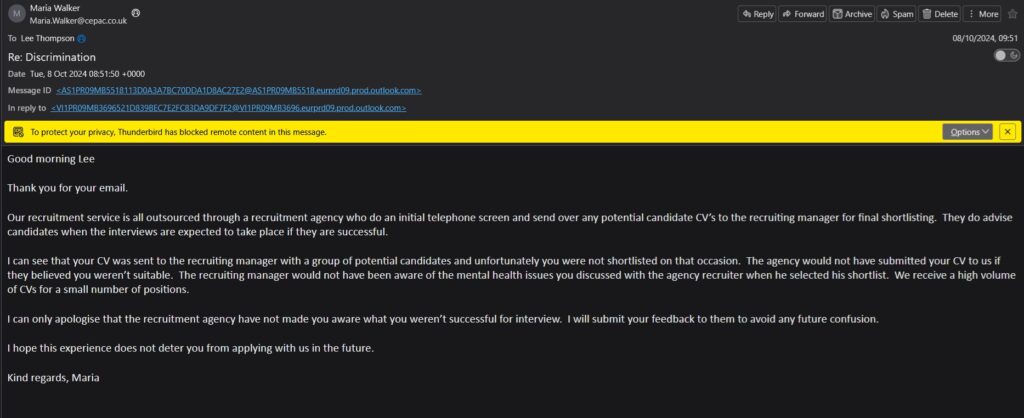
At 04:35 on 8 October 2024, I complained directly to Cepac. My email described the interview offer, the proposed timing, the promised confirmation and the mental-health disclosure. Maria Walker, Cepac’s HR Business Partner, then replied that morning. Her email displays 09:51. She explained the recruitment process in terms of Page screening candidates and the recruiting manager deciding whom to interview.
According to Walker, my CV reached the manager, but I was “not shortlisted on that occasion”. She also said the manager would not have known about the mental-health information discussed with Page. Meanwhile, her apology concerned the agency’s failure to explain that I had not secured an interview. The account I had given became a communication problem, with confusion doing the heavy lifting.
Yet Walker had not seen the WhatsApp receipt when she replied. Her explanation therefore needs testing against the contemporaneous account and the agency records. What had she checked, and whom had she asked? A polite email cannot resolve that disagreement by itself. Hotel Chocolat’s people page also talks about reducing bias in recruitment; here is an actual recruitment sequence to examine. The apology is the wrapping. Somebody still needs to inspect the bloody contents.
The ET3 Puts Health Information In August
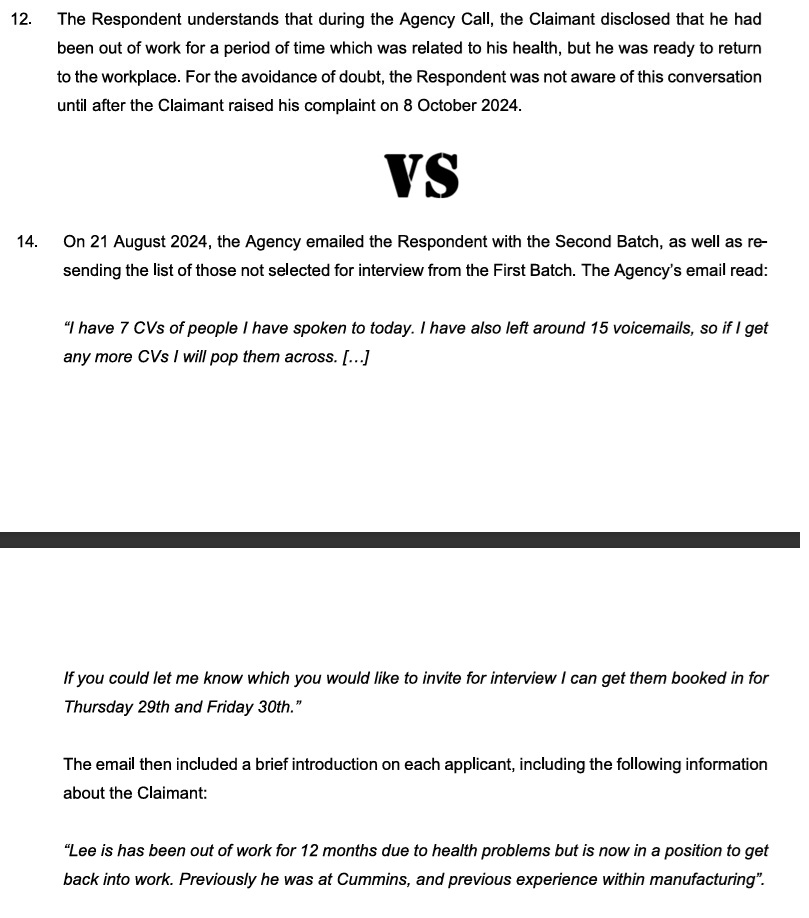
Cepac’s own ET3 also supplies a dated route for health information. Paragraph 12 places its awareness of the agency conversation about my health-related absence after the October complaint. However, paragraph 14 describes an email that Page sent Cepac on 21 August. That introduction includes information that I had spent twelve months out of work because of health problems and could now return.
Consequently, the company needs to reconcile its account of knowledge with the August email. What exactly did paragraph 12 mean it had not known? Who received the introduction, and what reached the recruiting manager before the shortlist decision? Those questions also bear on Walker’s explanation. The KFC II account sets out the wider chronology, but the key dates already sit inside Cepac’s defence.
For the Hotel Chocolat Cepac inquiry, this is a practical records exercise. Obtain the original message, identify its recipients and compare the candidate-status history with the later account. Then explain what happened. The paragraph numbers are convenient little dividers, rather like the compartments in an expensive selection box. Unfortunately for anyone hoping to keep the contents apart, both sit in the same fucking document.
Michael Page Adds The Black Centre
Meanwhile, Michael Page’s response to my data subject access request made reconstructing that trail harder. Internal correspondence concerning the discrimination complaint arrived with names and parts of exchanges obscured. Page also relied on third-party personal data when explaining redactions. The earlier disclosure account examines the material. Here, its relevance is the restricted view of who discussed the complaint and how information moved.
A proper inquiry can protect other people’s personal information while still examining recruitment decisions. Therefore, ask Page to explain the sequence, the candidate-status changes and the basis for its account. Ask Cepac what it received. The organisations holding those systems can investigate the trail; a black rectangle on my copy does not abolish their records. Neither company needs to turn privacy into a permanent excuse for an unintelligible answer.
After all, ingredient tracing is hardly an exotic idea in this part of retail. Who put what into the process, and when? The same attention to provenance should survive contact with an applicant’s health information. Page’s blackout disclosure makes that examination more necessary, while the corporate reassurance melts into a sticky little puddle of trust-us horseshit.
The Lawyers Acquired A Taste For My Reactions
Cepac instructed Horsfield Menzies, and the dispute developed a second focus: my conduct under pressure. The firm also contacted my medical centre about appointment availability and used the resulting information to oppose postponement. Meanwhile, correspondence, complaints and social-media material accumulated around the argument that the proceedings should end. My healthcare arrangements became another item in the respondent’s procedural kitchen.
My disability includes emotional dysregulation under stress. The pressure of the proceedings affected my ability to participate, yet my reactions became material for the case against continuing them. That is the bullying at the heart of my criticism. The person complaining about discrimination increasingly became the problem the process wanted to remove, while the recruitment evidence remained unanswered. What an efficient little bastard of a production line.
Mars’s supplier code treats privacy as a human right and prohibits retaliation against workers who raise grievances. Those standards give procurement reason to examine how a supplier handles complaints and personal information. Hotel Chocolat can ask about the medical-centre correspondence and the use of distressed responses. Its own talk of mental-health support makes that scrutiny especially relevant. Kindness should retain some meaning when the person concerned is difficult, distressed and refusing to shut up.
The Bill Bought No Recruitment Verdict
Cepac’s combined costs schedules exceeded £50,000. Following the hearing on 24 April 2026, which proceeded without me, the Tribunal struck out the claims and ordered me to pay £20,000 to Cepac. Specifically, the judgment made findings about my conduct of the proceedings, including unreasonable, scandalous and vexatious conduct. I dispute how the Tribunal treated my disability and the process that produced those findings.
Crucially, the judgment acknowledges that strike-out denies a hearing on the merits. It therefore leaves the recruitment allegations without a merits determination. The offered interview, the missing confirmation, Walker’s explanation and the August health-information email did not receive that hearing. A supplier review must therefore still examine those questions. Filing the order under satisfactory recruitment practice would answer a question the judgment did not decide.
The Newcastle maladministration account sets out the wider institutional failures I challenge. For Hotel Chocolat, the immediate point is simpler. Cepac secured a procedural end through conduct findings, while the original recruitment dispute remained untried. Consequently, the expensive legal finish cannot substitute for an explanation of the evidence. You can put a gold ribbon around a missing answer, but it remains a missing answer with a sodding ribbon.
The Supplier Approval Needs A Second Look
The Hotel Chocolat Cepac display gives the brand a starting point. First, identify the commissioning business, the dates and the current commercial route. Then establish which supplier standards and approval process applied. That will also identify who owns the assessment and what records they should examine. A photograph starts the enquiry; the purchasing file should complete the commercial picture.
Mars’s code permits requests for relevant policies, assessments and announced or unannounced audits. It also requires notification of actual or suspected legal infractions and reserves commercial options where suppliers refuse the code or appropriate compliance steps. Its published machinery therefore extends beyond asking whether a delivery arrived on time. The parent can use that machinery to establish facts and assess the response.
Next, put the original recruitment documents together. Compare Page’s records with the August email, Walker’s reply, the WhatsApp exchange and the supporting statement. Also examine the handling of medical information and the complaint. Finally, explain the findings and any corrective action. Hotel Chocolat says director-level approval sits behind new supply partnerships. Surely that degree of seniority can also cope with reading the file again when somebody points out the unpleasant bits.
A Voice Is More Than A Thank-You Email
Hotel Chocolat’s people page promises an employee voice that reaches its boardroom. The practical question here is whether the business will listen beyond its own payroll when the concern involves branded display work. Procurement can start by identifying an accountable reviewer and the documents needed. Whoever examines the matter should also address the competing accounts and give reasons for the conclusion.
Otherwise, the process risks becoming another hospitality routine for complaints: welcome them warmly, hand them a number, then leave them waiting somewhere quiet. Acknowledgement has its place, but it cannot establish what Page said or what Cepac knew. Nor can a supplier’s assurance replace examination of the underlying material. Mars’s own guide names the relevant recruitment records, so the group already knows where an investigation should begin.
The company can demonstrate its standards through the substance of its answer. It can explain the commercial relationship, assess the evidence and identify any necessary response. These are, after all, ordinary acts of corporate responsibility. The alternative is to keep displaying the language of courage while hoping nobody asks the awkward question twice. That would make “Be brave” a strangely timid piece of merchandising.
Hotel Chocolat Cepac: Unwrap The Decision
This chapter begins with a branded display and ends at the desk of whoever approves the businesses behind it. Between those points sit three documents that deserve examination: the WhatsApp exchange, Walker’s email and Cepac’s ET3. The chronology also leads into the handling of my health information and the legal campaign over my reactions. None of that becomes less relevant because the product at the front looks like a thoughtful gift.
Hotel Chocolat’s contribution is especially useful because it has described its own expectations. Respect, inclusive recruitment and ethical supplier assessment feature in the brand’s public account of itself. Meanwhile, Mars has published both a code and a guide to the records needed. The paperwork exists on both sides: corporate promises on one side, evidence requiring an answer on the other. Bring them together in the same room.
So, Hotel Chocolat, identify the route and examine the file. Let the People Pledge do some work outside the marketing department. Explain how the supplier assessment deals with the recruitment chronology and the response to the complaint. Premium presentation takes care of the surface; accountability requires somebody to get underneath it. The ribbon has had its turn. Now open the bastard.
Lee Thompson – Founder, The Cummins Accountability Project
Sources
- Cepac: POS Portfolio 2026, physical page 6, Hotel Chocolat Premium Liqueur Trio Selection display.
- Hotel Chocolat: Our People, Our Culture and the People Pledge
- Hotel Chocolat: Published modern-slavery statement and supplier-approval process
- Mars: Completion of Hotel Chocolat acquisition, 25 January 2024
- Mars: Supplier Code of Conduct, September 2024, printed pages 1–2, 7 and 11–12.
- Mars: Supplier Code of Conduct Guidebook, June 2025, printed pages 5 and 10–11.
- HSA Group: Cepac company profile
- TCAP: Mars II, Maria Walker, two WhatsApp lines and a £50,000 escape route
- TCAP: KFC II, Maria Walker and the interview receipt
- TCAP: Page, Cepac and the redacted data-access correspondence
- TCAP: Newcastle Employment Tribunal, deliberate maladministration
- Employment Tribunal: Thompson v Cepac Limited and Page Outsourcing UK Limited, judgment
- TCAP case records: WhatsApp exchange dated 21 August 2024; supporting witness statement dated 20 February 2025; complaint and Maria Walker reply dated 8 October 2024; Cepac ET3; Page data-access correspondence; respondent costs schedules and medical-centre correspondence.