
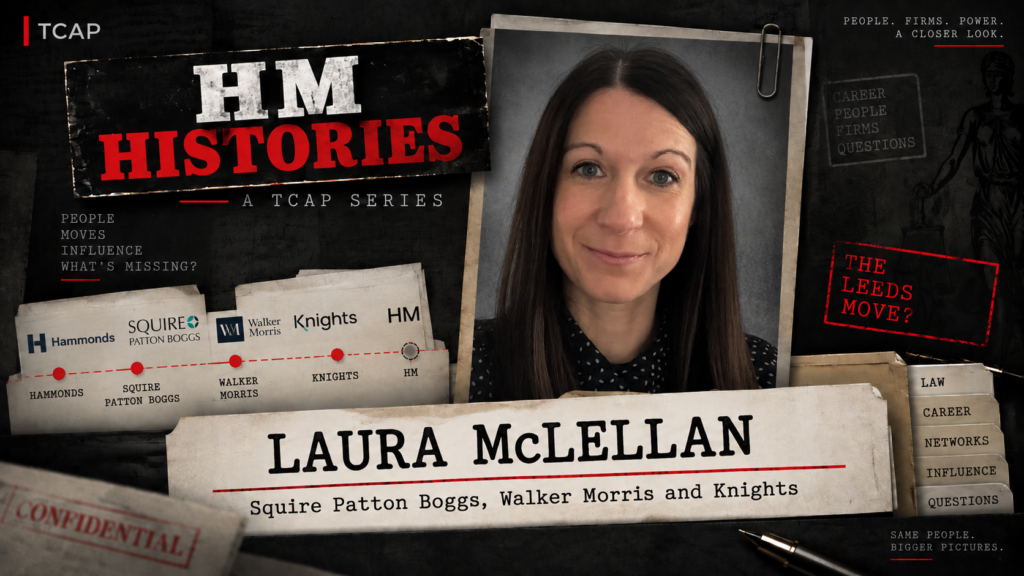
Laura McLellan at Knights takes HM Histories into a business where “one team” comes with some vicious small print. Our first Laura chapter examined Walker Morris and its unlawful partner retirement policy. Now we move forward to a listed legal business whose acquisitions delivered substantial purchase prices while support workers discovered their place in the growth story: somewhere between “integration” and the fucking exit. In June 2025, Knights confirmed 65 job losses following its £16.6 million Birkett Long deal. The corporate family photograph suddenly needed fewer chairs.
Meanwhile, Laura’s Horsfield Menzies profile describes her style as “calm, concise and commercial”. It advertises advice on closures, reorganisations, investigations and tribunal litigation. Those credentials make a useful introduction to Knights’ record. Acquisition announcements promised growth and people development; redundancy reports described what happened to people whose work the buyer could absorb elsewhere. Elsewhere, a departing partner fought a demand for unrecoverable costs, and a judge condemned the conduct of a case Knights defended. Commercial? Absolutely. The question is who enjoys the proceeds and who gets shafted by the arithmetic.
Laura McLellan At Knights: The Next Stop
HM’s own joining interview supplies the sequence: fourteen years at Hammonds and its successor firm, two at Walker Morris, then four as a Knights partner before joining HM in March 2026. A Knights employment update dated 21 March 2022 already carries her name among its authors. This chapter therefore examines the next employer on her CV and its wider history, including acquisitions before her arrival and a judgment after her departure. The dates tell us where each episode belongs.
Professional biographies turn former employers into credentials. Their names confer experience, authority and the reassuring impression that somebody has spent years learning how serious institutions operate. Fair enough. However, the public record gets to accompany the prestige. HM celebrates Laura’s ability to interview people, review evidence and prepare outcomes. An excellent professional habit. Let’s apply it to Knights, whose paperwork contains rather more than the polished promise of a happy team. Once the redundancy figures arrive, the brochure starts looking like a piss-taking exercise in selective editing.
£16.6 Million And 65 Exits
Knights announced its Birkett Long agreement in May 2025. The purchase covered the Essex law firm and its financial advisory business: £10 million upfront, followed by £6.6 million over three years, subject to conditions. By 16 June, the Gazette reported Knights’ confirmation that 65 jobs had gone. Support functions moved into its central operation. Meanwhile, the acquisition machinery rolled on. The people losing their jobs supplied the human cost of the integration.
Knights said none of the lawyers had faced redundancy. It also said it retained 11 colleagues previously at risk and created 10 additional fee-earning roles. Those details show where the protection fell. The business preserved legal capacity while removing support posts. Consequently, the same deal could expand a lawyer’s commercial platform and end a colleague’s livelihood. Calling the resulting arrangement “one team” takes some brass fucking neck. Once the spreadsheet decides whose work duplicates an existing function, the team spirit becomes remarkably conditional.
The Birkett Long name, with roots stretching back more than 200 years, disappeared into the acquisition. Former marketing manager Sarah Humphryes publicly described losing the firm and its culture as heartbreaking. Yet the integration language makes the operation sound tidier than the experience she described. “Overheads” is a wonderfully convenient word: it strips out mortgages, loyalties and years spent keeping the place working. Afterwards, the corporate story can celebrate a larger business while the discarded colleagues work out how to pay the next bill. What a shite bargain for the people excluded from its upside.
Before Laura: The Leeds Acquisition
The pattern had an earlier Leeds chapter. In March 2020, RollOnFriday reported that approximately 100 Shulmans roles faced redundancy risk as Knights moved to acquire the firm. The announced price reached up to £20.1 million. Knights anticipated improved profitability following integration and synergies, while its spokesperson pointed to the operational infrastructure already available to support expansion. Therefore, the friction between acquiring firms and consolidating support work existed before Laura joined.
“Synergies” is business bollocks with an extraordinary laundering capacity. It takes threatened livelihoods and returns a phrase fit for an investor presentation. Two photocopiers discovering common interests sounds almost charming; a room full of people wondering whether they can still pay their rent rather spoils the mood. Nevertheless, both belong to the same transaction. Management gets the language of efficiency. Employees get a consultation about whether the new owner still needs them. The euphemism earns its keep by making one experience easier to sell than the other.
Baines Wilson: The Team Meets The Margin
During Laura McLellan’s Knights years, Baines Wilson supplied another example. In 2023, Knights agreed to buy the firm from five equity partners for £3.37 million. Its announcement anticipated raising the acquired business’s profit margin from around 20% to 25% after synergy savings. Alongside the acquisition publicity, Knights promoted investment in people, development, retention and its “one team” culture. Thus, the margin target and the people promise arrived together. Somebody should have asked which promise would survive the integration.
After completion that June, founder John Wilson publicly said all the support staff had lost their jobs. His wife, who had worked on compliance and quality, was among them. By then a consultant, Wilson had resigned after learning about the sale. Knights acknowledged redundancies and explained that its existing infrastructure created duplicated support roles. Meanwhile, the founder’s account supplied the part of the transaction that the cheerful expansion narrative could never make attractive.
This is where the rhetoric deserves a proper kicking. Fee earners generate revenue; central infrastructure can absorb support functions. That explains the calculation. However, “one team” invites employees to imagine a commitment that stretches beyond their immediate usefulness to the margin. At Baines Wilson, the reported outcome exposed how brittle that invitation could be. All the support staff gone, while the buyer advertised its people culture. The acquisition announcement and the farewell card belonged to the same business, yet read like messages from organisations that would quite reasonably tell each other to piss off.
A Departing Partner Gets The Bill
Katie Brassington’s exit supplied a different version of the Knights experience. She joined its Chester office in 2016 and acted as a professional deputy for people lacking mental capacity. In December 2022, after she had given notice, Knights requested proposals for paying £211,632.76 in recorded work in progress. Of that total, £166,468.97 represented costs the Senior Courts Costs Office had disallowed and which the firm could not bill to the protected client.
Knights had left those disallowed costs on its system rather than writing them off. It argued that Brassington’s deputyship engagement letters made her personally responsible. Therefore, a departing employee had to contest whether signing documents in her professional capacity had turned her into the customer. What an audacious little bastard of an argument. Finish your work, hand in your notice, and discover that the accounts department has apparently rewritten your role to include paying the firm. The exit interview comes with a disputed bill large enough to require its own chair.
The High Court rejected Knights’ position in June 2023. Brassington had contracted as deputy and agent for the protected person and assumed no personal liability of this kind. Knights also could not assert a lien against her for those unrecoverable costs. Meanwhile, HM’s profile advertises Laura’s experience investigating employment status and reviewing documentation. Her former employer supplies a vivid reminder of why documents need scrutiny: a commercial argument can sound confidently expensive and still fail when a judge works out who actually contracted with whom. Confidence does not make the bollocks legally binding.
The Pay Rise That Was A Trap
In June 2023, RollOnFriday reported that Knights employees received emails promising substantial salary increases, only to discover that the messages formed part of a phishing test. Staff reactions included anger and incredulity. Knights explained that an external provider ran the campaign using current cyber-threat scenarios, including scams about pay rises. Consequently, the firm had a security rationale for dangling welcome financial news and then revealing the hook.
What a contemptibly clumsy way to handle workplace trust. An employee sees what appears to be good news about their salary; the organisation turns that hope into a lesson about being fooled. Cybersecurity training involves choices, and this choice made staff optimism the bait. Meanwhile, the next genuine pay announcement has to compete with the memory of the prank. You have protected the network by making your own messages look suspect. Congratulations, you clever sods: the security exercise has also demonstrated why a colleague might think the employer is taking the piss.
Mental Health And Grievances Change Desks
Later that year, RollOnFriday reported that Knights had removed its HR manager posts: one manager resigned and the other three became redundant. According to the November report, Client Services Directors would take responsibility for matters including mental health and grievances. Sources questioned their experience and the wisdom of taking sensitive concerns to managers whose commercial responsibilities included revenue and costs. Knights declined to comment on the report.
HM’s description of Laura’s grievance investigations makes an uncomfortable companion to that account. It recognises the value of interviews, evidence and considered outcomes when a client needs sensitive complaints examined. Meanwhile, the reported Knights arrangement raised concerns about where its own employees could take their problems. That distinction deserves scrutiny. Selling employment expertise creates an expectation that the seller understands why workers need credible routes for raising concerns. A grievance system that leaves employees worrying about commercial conflicts inspires about as much confidence as a fire exit that opens into the bloody accounts department.
Golden Turd, Twice
Knights finished bottom in RollOnFriday’s staff satisfaction surveys in 2022 and 2024, collecting its “Golden Turd” designation twice. Respondents assessed subjects including pay, management, career development, culture and work-life balance. Therefore, the criticism extended beyond individual acquisition stories. A second turd is a fairly emphatic review of the workplace experience respondents described. Perhaps the first one lacked sufficient commercial impact. Still, the repeat result leaves the PR department with a difficult polishing assignment and very little room for the usual congratulatory LinkedIn wank.
Reports continued around Laura’s departure. On 6 March 2026, RollOnFriday published staff accounts of Leeds lawyers receiving abrupt redundancy news, surrendering equipment and losing access before they could say goodbye. Knights declined comment. Meanwhile, the public language of professional ambition carried on. Equipment returned, access gone, colleagues describing an impersonal exit: that is a grimly efficient punctuation mark on a working relationship. After enough growth announcements, the employee experience starts sounding like someone has mistaken people management for cancelling software subscriptions. What a thoroughly shit way to leave a job.
Car-Wizard: Aggression Gets An Invoice
The sharpest litigation material comes from Car-Wizard v Vixen Surface Treatments. Knights represented Vixen, the supplier in a dispute with a small vehicle repair business about a lathe. Proceedings began in December 2023 and reached trial in October and November 2025. In August 2026, after Laura had joined HM, HHJ Paul Matthews issued a costs judgment criticising the defendant and its legal team. The judgment therefore assessed litigation that had begun and reached trial during her Knights years.
Matthews described poor co-operation and an unusually prolonged, aggressive and expensive process. He placed the main responsibility on the defendant and its lawyers. Defence points included “very many of them either bad or irrelevant”. Vixen had also destroyed relevant records after the dispute arose; disclosure reports omitted that fact, and the judge placed the main responsibility for that disclosure failure on its lawyers. Furthermore, he criticised interference with expert evidence after someone in the defendant’s legal team suggested the expert reconsider his report. That is a damning account of how this defence operated.
Matthews ordered Vixen to pay indemnity costs and enhanced interest. Knights disputed his observations and told the Gazette it would raise them through appropriate professional channels. However, the published judgment remains a judicial assessment of the conduct before the court. Matthews compared the approach to practice in the 1980s. For fuck’s sake, a small business trying to resolve a lathe dispute should not have to finance a legal tribute act with shoulder pads and an appetite for procedural aggression. The court’s criticism gives the expensive performance a much less flattering name.
Calm, Concise And Commercial For Whom?
Laura’s HM profile now celebrates a more people-focused boutique approach. Her career takes this series to Knights; the firm’s announcements, staff reporting and court records provide the institutional history. Across these episodes, the distribution of benefit looks painfully familiar. Sellers receive acquisition consideration. Support workers face consolidation. A departing partner contests personal liability. Meanwhile, a successful claimant seeks the costs of fighting a defence the judge criticised. The reassuring adjectives sit comfortably in the biography because the consequences live elsewhere, in somebody else’s redundancy meeting, disputed invoice or court bundle.
“One team” deserves to face that record. Birkett Long supplies 65 confirmed job losses; Baines Wilson and Shulmans show earlier acquisition pressures. Brassington defeated the attempt to make her personally liable, while Car-Wizard produced judicial criticism of the litigation itself. These episodes give us ample reason to distrust the sentimental wrapping around the commercial machine. Calm can describe the voice delivering the news. Concise can describe how quickly the explanation ends. Commercial tells us whose interests command attention. Before swallowing the people-focused sales pitch, ask who the business protects when the arithmetic turns ugly. Then ask who gets told to clear their fucking desk.
Lee Thompson – Founder, The Cummins Accountability Project
Sources
- TCAP – Laura McLellan: Walker Morris And The Partner Expiry Date
- TCAP – HM Histories
- Horsfield Menzies – Welcome To Laura McLellan
- Horsfield Menzies – Laura McLellan
- Knights – Top Fortnightly Facts, 21 March 2022
- Knights – Acquisition Of Birkett Long LLP And Birkett Long IFA LLP, 6 May 2025
- Law Society Gazette – Knights Reveals Dozens Of Redundancies From Latest Acquisition, 16 June 2025
- Knights – Enters Leeds With Acquisition Of Shulmans
- RollOnFriday – 100 Staff In Redundancy Talks As Knights Acquire Shulmans, 13 March 2020
- Knights – Acquisitions Of St James Law And Baines Wilson, 2 May 2023
- Knights – Promotes Over 75 Colleagues
- Law Society Gazette – Ex-Owner’s Heartfelt Message As Entire Support Staff Made Redundant, 8 June 2023
- Brassington v Knights Professional Services Ltd, [2023] EWHC 1568 (Ch), 30 June 2023
- 39 Essex Chambers – Brassington v Knights
- RollOnFriday – Incredulity As Firm Sends Lawyers Fake Pay Rise Emails, 9 June 2023
- RollOnFriday – Knights Axes All Its HR Managers, 10 November 2023
- RollOnFriday – Knights PLC Is The New Golden Turd Of UK Law, 2022
- RollOnFriday – Knights Lands The Golden Turd, 2024
- RollOnFriday – Knights Axes Lawyers In “Impersonal” Layoffs, 6 March 2026
- Car-Wizard Ltd v Vixen Surface Treatments Ltd, [2026] EWHC 2177 (Ch), 17 August 2026
- Law Society Gazette – Lawyers’ Aggression “Like Going Back To The 1980s”, Says Judge, 20 August 2026
- Team Lincolnshire – Knights Professional Services Limited
- London Stock Exchange – Knights Group Holdings plc