
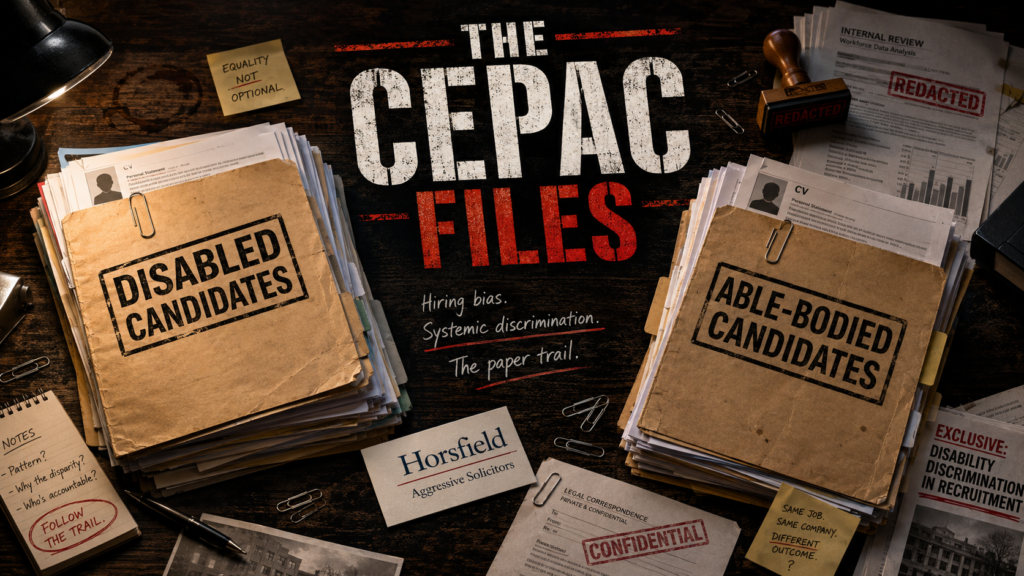
The Westons Cepac connection sits on page six of the packaging company’s 2026 portfolio: a Henry Westons Vintage display. Meanwhile, Westons promises supplier scrutiny and ethical recruitment. Here come the WhatsApp exchange, Maria Walker’s denial and Cepac’s contradictory recruitment chronology. HSA’s wider family supplies another contrast: Qur’an-printing philanthropy alongside a commercial subsidiary marketing its ability to help sell booze. Somebody needs to explain what happens when the principles reach the purchasing desk.
Westons Cepac Displays: A Sobering Introduction
I enjoy a Henry Westons in the summer. It is the sort of drink where you get up to use the toilet and discover you have forgotten how to fucking walk. The bladder has submitted a perfectly reasonable request, but the transport department has ceased trading. Nevertheless, affection for the contents does not mean the cardboard underneath gets a free pass.
On physical page six of Cepac’s 2026 POS portfolio, a Henry Westons Vintage promotional display appears among its pallet bins. Bottles, branded packs and a Nectar price ticket sit in a unit that Cepac has chosen to showcase. The company supplies the commercial connection itself. Next comes the purchasing trail: who commissioned the work, which agency or buyer placed it, and what arrangements continue today?
Westons can establish those details from its records. However, the more interesting question concerns the standards attached to that work. Behind the attractive cider display sits a supplier whose recruitment account deserves examination against three existing documents. A summer drink may temporarily interfere with my ability to stand up. Corporate values should have rather better balance when somebody asks them to support a real complaint.
Westons Cepac Standards: What Travels With The Family Name?
Westons’ published modern-slavery statement covers the financial year ending 31 March 2026. Managing director Helen Thomas and the board approved it on 14 July. Alongside its statutory subject, the statement describes broader ethical expectations: supplier due diligence, ethical employment practices and compliance with a Supplier Responsible Sourcing Code. The business also presents dignity and fair treatment as principles that extend through its operations and supply chains.
That gives procurement something more useful than a smiling photograph beside an orchard. A responsible-sourcing code ought to tell a buyer how to respond when a supplier’s records raise difficult questions. Therefore, Westons should identify the requirements that applied to this display work and explain how recruitment concerns enter its assessment. The fucking point of a standard is that it still works after somebody presents inconvenient material.
Otherwise, the family name becomes a very handsome label on a bottle of diluted reassurance. Heritage can tell us how long a business has existed; it cannot inspect another company’s inbox. Nor does a page about ethical conduct settle a complaint merely by existing. The Westons Cepac enquiry needs someone to connect the public commitments to the actual purchasing file, then follow the evidence wherever it leads.
The Agency Audit Has An Obvious Follow-Up
Westons says it audits every employment agency it engages at least annually, including their commitments to ethical recruitment and worker welfare. It also states that it complies with the Ethical Trading Initiative’s Base Code. These are useful reference points because the Cepac story begins with an agency call. Westons already recognises recruitment as a process that needs checking, rather than a service whose assurances should disappear straight down the hatch.
The ETI code is specific. Clause 7.1 prohibits disability discrimination in hiring, while clause 9.1 prohibits harassment, verbal abuse and other intimidation. Accordingly, the next question is how Westons carries comparable expectations into its supplier relationships. Its own agency audits offer a practical benchmark. What should it expect when an agency recruits for the packaging business whose work carries the Westons name?
That is where Page Outsourcing and Cepac enter the same discussion. One handled the candidate call; the other received recruitment information and later answered the complaint. Together, their records should explain the sequence. Procurement does not need to invent some magnificent new discipline called giving a shit. It needs to ask what happened, compare the accounts and decide whether the response meets the standards it expects.
The WhatsApp Was About A Job
On 21 August 2024, Page Outsourcing called me about a production role at Cepac. During that conversation, the recruiter offered an interview for after the bank holiday and discussed the salary. I also explained that my employment gap related to my mental health. Page said another call would confirm an exact interview time. However, that confirmation never arrived.
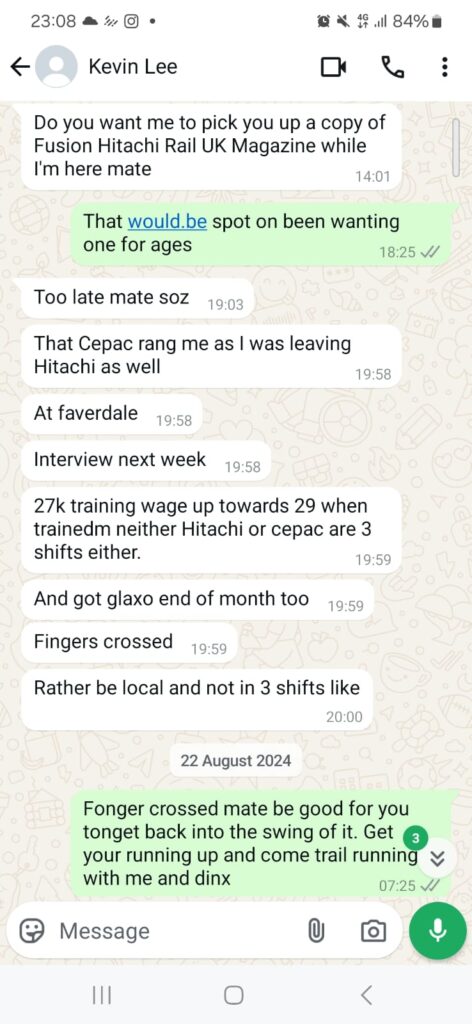
Later the same day, I told a friend about the conversation. The WhatsApp exchange records “Interview next week” and “27k training wage up towards 29”. Those are my messages to my friend, written while the job prospect was fresh. The recipient retained the exchange and subsequently provided a supporting witness statement. At that point, there was no complaint, tribunal claim or TCAP campaign.
Consequently, the timing gives the message its importance. Before anybody started denying an interview offer, I had already recorded one, together with the pay discussion. That gives an investigator a specific account to compare with Page’s notes and candidate history. Ordinary people tell their mates when they think they have an interview. They rarely pause to commission a solicitor’s commemorative fucking affidavit before mentioning the training wage.
Maria Walker’s Answer Arrives At 09:51
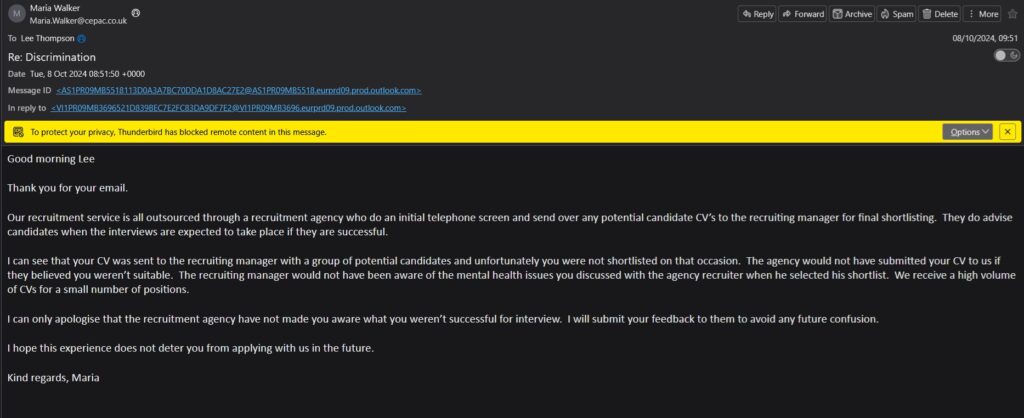
At 04:35 on 8 October 2024, I complained directly to Cepac. My email described the offered interview, the promised confirmation and the mental-health disclosure. Maria Walker, Cepac’s HR Business Partner, replied that morning; the screenshot displays 09:51. She explained that Page screened candidates, sent CVs to the recruiting manager and discussed expected interview dates with candidates if they succeeded.
According to Walker, my CV reached the manager, but I was “not shortlisted on that occasion”. She also said the manager would not have known about the mental-health information I discussed with the recruiter. Her apology concerned Page’s failure to tell me that I had not secured an interview. Meanwhile, the account I had supplied became a matter of confusion.
Yet Walker had not seen the WhatsApp exchange when she answered. Her explanation therefore needs testing against the earlier message and the underlying recruitment records. What did she inspect, and whose account did she accept? The KFC II chronology sets out the same evidential problem. A tidy HR reply cannot strain the inconvenient pieces out of a complaint and serve the remainder as clarity. That is administrative bullshit with a courteous sign-off.
Two Paragraphs That Need To Meet
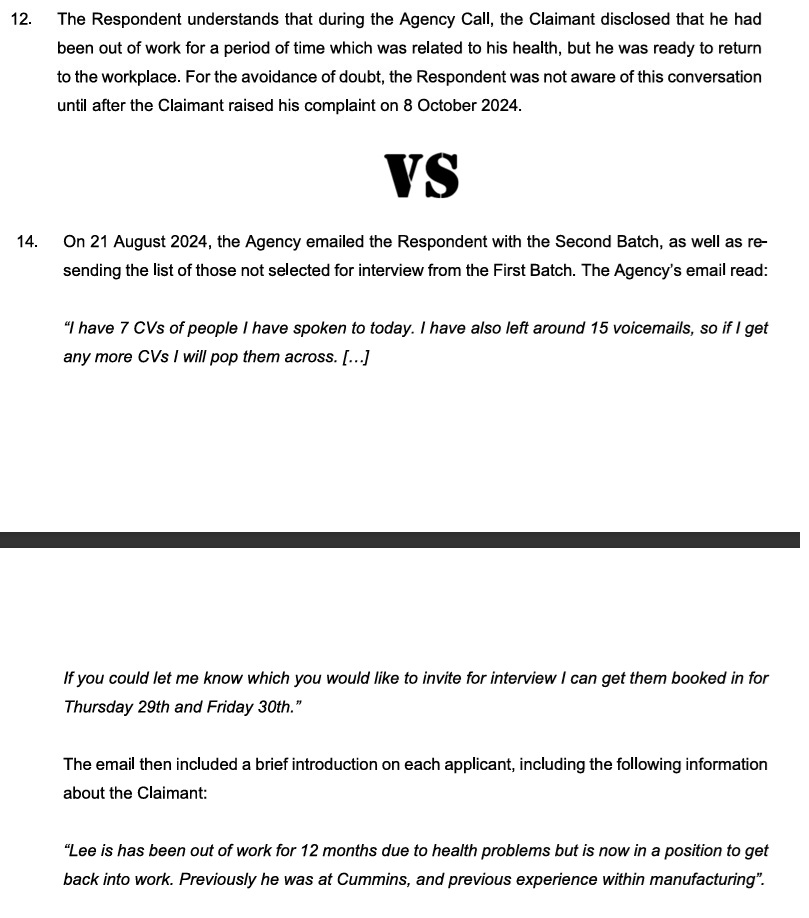
Cepac’s ET3 makes the chronology more awkward. Paragraph 12 says the company did not know about the agency conversation concerning my health-related employment gap until after my October complaint. However, paragraph 14 describes an email Page sent Cepac on 21 August. That message included an introduction explaining that I had spent twelve months out of work because of health problems and could now return.
The August email therefore belongs in the same enquiry as Walker’s October explanation. Who received it, what reached the recruiting manager, and when did the shortlist decision occur? Cepac should also explain precisely what knowledge paragraph 12 denies, given the information paragraph 14 places in its inbox. Both accounts appear in the company’s own defence. Somebody needs to reconcile the bastards before treating either as a complete answer.
For Westons, the practical task is straightforward: seek the original message and the candidate-status history, then compare them with the later account. The ET3 supplies dates and a route for health information. Meanwhile, the WhatsApp preserves my account of the call. Read them together. Keeping related documents in separate piles may improve the appearance of a desk, but it does sod all for understanding a recruitment decision.
Michael Page Brings The Black Rectangles
Michael Page’s data-access response adds another obstruction. Internal correspondence concerning the discrimination complaint arrived with names and parts of exchanges obscured. Page relied on third-party personal data when explaining redactions. As the earlier DSAR account shows, that left me with a restricted view of who discussed the complaint and how information travelled.
Nevertheless, Page and Cepac can investigate their own records. They can identify the sequence, explain the decisions and account for the handover while protecting other people’s information appropriately. A black rectangle on my copy does not erase an email from their systems. Therefore, any supplier enquiry should ask for a meaningful explanation of the trail, rather than accept a blackout followed by a cheerful invitation to trust the process.
Horsfield Menzies Turned Up The Pressure
Cepac instructed Horsfield Menzies, and the litigation increasingly revolved around my reactions under pressure. The firm contacted my medical centre about appointment availability and used the resulting information to oppose postponement. Meanwhile, correspondence, complaints and social-media material accumulated around the respondents’ efforts to end the proceedings. The missing interview confirmation remained beneath an expanding argument about the person asking for it.
My disability includes emotional dysregulation under stress. Consequently, the pressure and my ability to participate belonged in the same account as the reactions the respondents highlighted. Instead, the conduct case presented my responses as reasons to bring the claim to an end. This is the bullying at the centre of my criticism: intensify the pressure, catalogue the fallout, then complain about the noise. What a miserable little bastard of a system to build around a discrimination complaint.
Westons can examine that handling alongside the original recruitment sequence. The medical-centre correspondence, postponement dispute and use of distressed responses all deserve scrutiny. After all, ethical treatment has to survive a complainant becoming upset, angry or inconvenient. Otherwise, respect is merely a hospitality package available to people who never challenge the business. Nobody should have to arrive gift-wrapped in perfect composure before their evidence earns a hearing.
Fifty Thousand Pounds And No Recruitment Verdict
Cepac’s combined costs schedules exceeded £50,000. The hearing on 24 April 2026 proceeded without me; the subsequent judgment struck out the claims and ordered me to pay £20,000 to Cepac. It made findings about my conduct of the proceedings, including unreasonable, scandalous and vexatious conduct. I challenge the process and the treatment of my disability that produced those findings.
Crucially, the Tribunal did not determine the recruitment allegations at a merits hearing. The interview offer, the vanished confirmation, Walker’s explanation and the August email therefore remain matters that a supplier review can investigate. A costs order cannot tell Westons what Page said during the call. Nor can the strike-out establish why the promised confirmation never came. Those questions require the recruitment evidence.
The Newcastle maladministration account explains the wider administrative and procedural failures I contest. For this enquiry, however, the central point is plain: Cepac secured the end of the proceedings through conduct findings, without a decision on the recruitment merits. Presenting that outcome as a satisfactory recruitment audit would be a bloody conjuring trick. The legal bill is substantial; the answer to the original complaint is still missing.
HSA’s Scripture And Cider Departments
There is another reason this display belongs in the series. HSA Group’s own company directory identifies Cepac as one of its businesses. Meanwhile, the Hayel Saeed Anam charitable foundation describes its programme for printing and distributing the Qur’an. Its account of the foundation also places Qur’anic education and dissemination within the family’s charitable work. These are activities the organisations themselves have chosen to describe publicly.
Alongside that religious philanthropy, the group’s commercial packaging business showcases work promoting alcohol. Henry Westons adds another example to the drinks displays already examined in HSA Group : Big Cardboard Haram?. Cepac is selling its ability to make booze conspicuous and attractive at the point of purchase. HSA has a commercial stake in that business: the profit opportunity lies in helping someone else’s bottles move. Apparently, the commercial imagination can find its way to the cider aisle without stumbling over the family values on the way.
So how does HSA reconcile the two parts of that public identity? The charitable foundation has the scripture-printing programme; the subsidiary has the alcohol-promotion portfolio. What a versatile fucking family stationery cupboard. The point is the moral compartmentalisation: principles occupy one presentation, commercial opportunity occupies another, and the reader must supply the connecting door. Westons now joins that corporate picture with a pallet of vintage cider. Somebody at HSA should explain how the ethics travel between departments.
The Westons Cepac Enquiry Starts With The Records
The Westons Cepac enquiry should begin with the commissioning route and dates. Establish who purchased the display, which supplier requirements applied and whether the relationship continues. Next, identify the person responsible for reviewing the recruitment concerns. That gives the process an owner, a scope and a set of records to obtain. Procurement should manage those basics without needing an inspirational retreat among the apple trees.
Then put Page’s candidate records beside the 21 August email, the WhatsApp exchange and Walker’s reply. Seek the basis for the no-shortlist explanation and examine the handling of the complaint. The medical-centre correspondence and the redacted disclosure trail also need answers from the organisations holding them. Finally, explain the findings and any response under the applicable standards. A supplier’s preferred summary should be the beginning of the check, rather than its substitute.
Westons has already described machinery for examining suppliers and recruitment agencies. Therefore, this is an opportunity to show what that machinery achieves when an awkward file arrives from outside the business. An acknowledgement alone will not do the work. Neither will forwarding everything to the supplier and treating its reassurance as an independent conclusion. That would turn scrutiny into a piss-poor game of pass the parcel, with the complaint permanently inside the wrapping.
Westons Cepac: Let The Cider Mature, Not The Complaint
I can like the drink and still expect an answer about the business beneath the label. The Westons Cepac connection comes from Cepac’s own portfolio, while the recruitment questions come from contemporaneous messages, an HR reply and a pleaded defence. Together, those materials give Westons something concrete to examine. Its public ethical commitments supply the reason to take the enquiry seriously.
The documents also resist the comfortable explanation that this all began with an angry blogger. First came a job application and an interview offer. Then came the missing confirmation, the complaint and the account that needs reconciling with the evidence. The blog followed. Reversing that chronology may make life easier for the people answering questions, but it leaves the original recruitment sequence untouched.
So, Westons, follow the purchasing route and put the three documents together. Explain what your standards require and how you assess the answers. HSA can also explain its preferred distance between the scripture-printing programme and the subsidiary’s booze-promotion business. Meanwhile, Cepac and Page can account for what happened to the interview. I may occasionally need a moment to remember how my legs work after a Henry Westons. The companies in this file have had considerably longer to find their footing.
Lee Thompson – Founder, The Cummins Accountability Project
Sources
- Cepac: POS Portfolio 2026
- Westons Cider: Published Modern Slavery Statement And Supplier Standards
- Ethical Trading Initiative: ETI Base Code
- HSA Group: Cepac Company Profile
- HSA Charity: Printing The Holy Qur’an
- HSA Charity: About The Foundation
- TCAP : HSA Group, Big Cardboard Haram?
- TCAP : KFC II, Maria Walker And The Interview Receipt
- TCAP : Page, Cepac And The Redacted Data-Access Correspondence
- TCAP : Newcastle Employment Tribunal, Deliberate Maladministration
- Employment Tribunal : Thompson v Cepac Limited And Page Outsourcing UK Limited
- TCAP case records: WhatsApp exchange dated 21 August 2024; supporting witness statement dated 20 February 2025; complaint and Maria Walker reply dated 8 October 2024; Cepac ET3; Page data-access correspondence; respondent costs schedules and medical-centre correspondence.