
Robinsons appears in Cepac’s 2026 display portfolio. Its owner, Carlsberg, tells suppliers to protect people who report suspected misconduct. The Robinsons Cepac file now adds Maria Walker’s email to the same-day WhatsApp exchange and the ET3. A vanished interview, a denial and a costly conduct case put a simple question to the drinks group: what protection survives when the person speaking up becomes inconvenient?
The Robinsons Cepac Complaint Is The Test
Corporate Britain adores a complaint before anybody makes one. Put the reporting channel in a policy, give it a reassuring name and photograph somebody listening. Then a disabled applicant arrives with dates, documents and a question that requires more than a sympathetic head tilt. Suddenly, the invitation to speak up starts resembling a pub promotion with the useful terms printed underneath the drip tray.
Part One, Robinsons, Cepac And The Disability Discrimination Concentrate, showed the WhatsApp exchange and Cepac’s ET3. However, it did not show Maria Walker’s email alongside them. That missing document matters because it fixes Cepac’s explanation before Walker knew about the contemporaneous message. The Robinsons Cepac sequel can now compare my account from the day with the answer Cepac supplied when I complained.
Meanwhile, Carlsberg’s supplier code contains a specific protection against retaliation. The useful question therefore extends beyond the recruitment decision. What happened after I challenged it, and who will examine that sequence? A reporting system deserves scrutiny at the moment somebody actually reports something. Otherwise, all that carefully typeset reassurance amounts to management bollocks with a contact address.
Robinsons Now Comes With A Brewer
Carlsberg completed its acquisition of Britvic on 16 January 2025. The combined UK business launched as Carlsberg Britvic the following day, bringing Robinsons into the brewer’s wider group. Consequently, the route for this article runs from the squash brand to Carlsberg Britvic and its parent. Buying the business also bought a collection of supplier relationships worth understanding.
The Robinsons Cepac trail starts in the packaging company’s own 2026 portfolio, which showcases the brand in its theatrical-displays section. The branding invites shoppers to make the unboring choice. Conveniently, somebody in procurement could start by making the inquisitive one. Cepac selected that work to advertise its capabilities; Carlsberg Britvic can identify the commissioning route, the dates and the present commercial position. A purchase-order history should not require an archaeological expedition through the orange aisle.
The current code took effect in June 2025. Its relevance here is the review Carlsberg can undertake now, alongside the standards and contracts that applied at each stage. First establish when Cepac produced the display and through whom. Then identify the rules governing that work and any continuing relationship. Corporate integration ought to include knowing who supplied the bloody cardboard, rather than stopping once somebody has changed the stationery.
The Robinsons Cepac Policy Test
Section 2.4 of Carlsberg’s supplier code requires safe, confidential grievance routes and policies prohibiting retaliation. Its protection expressly covers employees and stakeholders reporting suspected misconduct or code breaches. Section 2.2 includes recruitment agencies in suppliers’ compliance responsibilities. Meanwhile, section 1.4 requires reporting of suspected or confirmed misconduct involving or affecting Carlsberg.
Those provisions give this sequel its purpose. Page conducted the recruitment call; Cepac supplied the subsequent explanation. Later, solicitors and the Tribunal became central to the dispute. A proper review needs to follow those handovers and examine how the companies treated the complaint. Stopping at the employer’s final answer would simply let the subject of the complaint mark its own homework.
Carlsberg also provides for audits and corrective action, with termination available where standards remain unmet. Its code prohibits disability discrimination in employment decisions. Therefore, the group already has a published basis for asking difficult questions. Whether those powers apply to particular contracts is a matter for its records, which procurement holds. The miserable alternative is an ethics department that can produce a polished rulebook but needs smelling salts when somebody opens it at the relevant page.
Before The Lawyers, There Was A Call
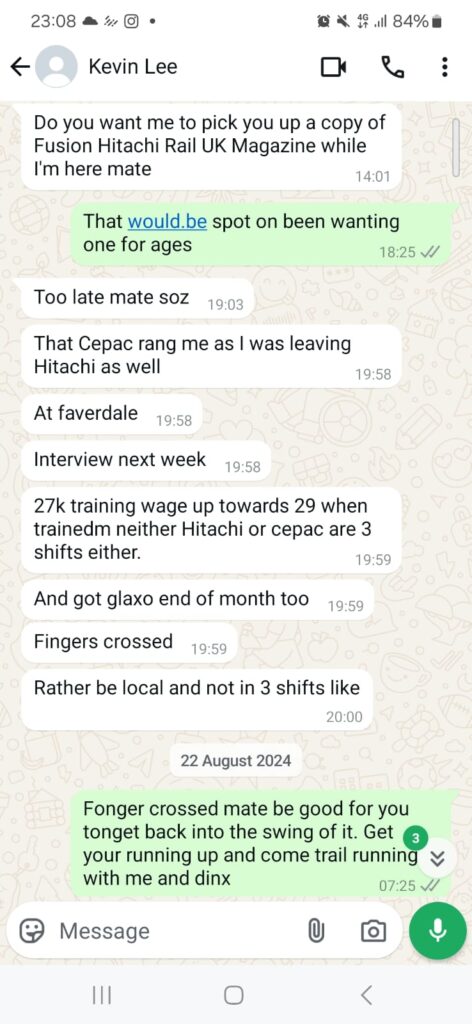
On 21 August 2024, Page Outsourcing called me about a production role at Cepac. During that conversation, Page offered an interview for the week after the bank holiday. We discussed a £27,000 training wage rising towards £29,000. I also explained that my employment gap involved treatment for my mental health. Page would pass my details on and call again to agree the exact interview time.
Afterwards, I told a friend what had happened. My WhatsApp messages recorded “Interview next week” and “27k training wage up towards 29”. The recipient retained the conversation and later provided a witness statement. At that point, I expected an interview. There was no discrimination claim, no tribunal bundle and no reason to imagine that a casual exchange would need to survive years of corporate argument.
However, the promised confirmation never arrived. That is why the message matters: it records my understanding immediately after the call, including the interview and the money. It gives an investigator something contemporaneous to compare with the later accounts and the agency’s original records. Instead of another exquisitely polished explanation of the company’s process, we have the ordinary words of somebody who thought he might have a job coming.
Maria Walker Supplies The Replacement Version
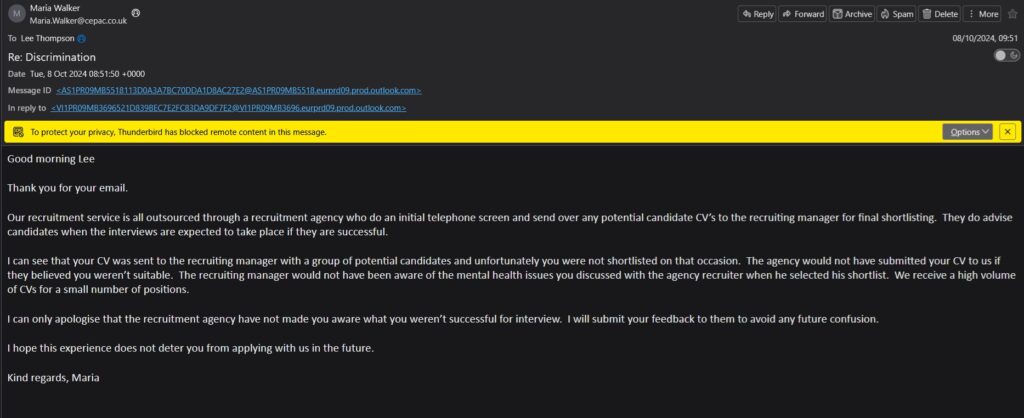
At 04:35 on 8 October 2024, I complained directly to Cepac. My email described the interview offer, the proposed timing after the bank holiday and the missing confirmation. It also explained the questions about my employment gap and the mental-health disclosure. Cepac therefore received a specific chronology that somebody could check against the recruitment records.
Maria Walker, Cepac’s HR Business Partner, replied at 09:51. She explained that the agency screened candidates and sent CVs to the recruiting manager for final shortlisting. My CV had gone over, she said, but I had not made that shortlist. Moreover, she stated that the manager would not have known about the mental-health issues discussed with the recruiter. Her apology concerned the agency’s failure to tell me that I had not secured an interview.
In that answer, an offered interview became an unsuccessful shortlist and the problem became “confusion”. Walker had not seen the WhatsApp exchange. Consequently, her explanation now sits beside a record she did not have when she supplied it. What did she review before answering? Who checked the call, the candidate history and the information sent to Cepac? Corporate complaint handling cannot consist of selecting the most comfortable version and sending the applicant home with a little bag of fuck-all.
Paragraph Fourteen Keeps The Date
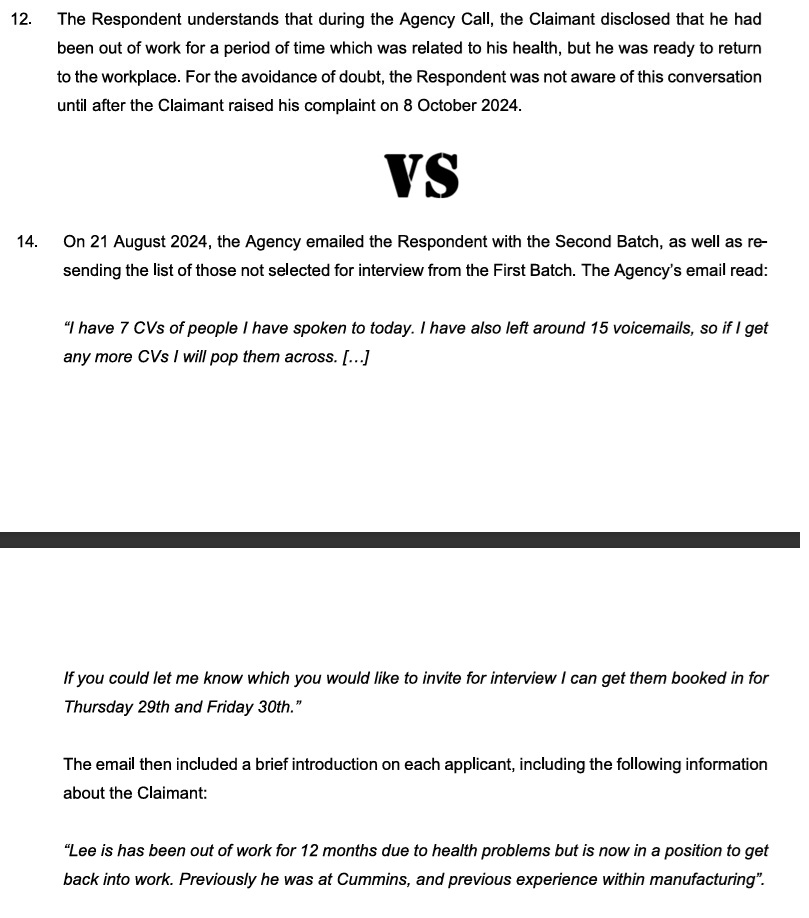
Cepac’s ET3 adds a dated document to that comparison. Paragraph 12 says the company did not know about the agency conversation concerning my health-related employment gap until after my complaint on 8 October. However, paragraph 14 describes an email that Page sent to Cepac on 21 August, the day of the recruitment call.
That email included candidate introductions. The entry about me said I had been out of work for twelve months because of health problems and was ready to return. It also mentioned my previous employment at Cummins and manufacturing experience. In other words, Cepac’s own pleading places health-related information in an August communication to the company, alongside its account of learning about the conversation in October.
The obvious next step is to trace the information properly. Who received the August email, and what did the recruiting manager see? Which records supported Walker’s answer, and when did the shortlist decision occur? Likewise, Page can explain the words used during its call. These are specific questions about access, timing and decision-making. No amount of solemn arse-covering changes the dates printed on the documents. Put them together, follow the route and require an answer that accounts for all three.
Michael Page Brings The Blackout Blinds
The agency also holds a substantial part of that route. My data-access request sought the application records, screening notes, internal emails, call information and exchanges with Cepac. However, Page’s response removed names and sections of correspondence, explaining that it had redacted third-party information. Those blacked-out passages made it harder to follow who said what around my complaint.
As documented in Page Partners : Cepac Limited, the disclosed material also recorded internal advice and searches concerning my earlier tribunal case. That gives the review another concrete task: examine the complete recruitment and complaint records through an appropriate confidential process. Otherwise, the brand risks accepting a tidy supplier explanation while the applicant receives the version with the useful plumbing painted black. That is a piss-poor foundation for establishing what happened.
When The Complaint Reaches The Medical Centre
After the dispute entered litigation, Horsfield Menzies contacted my medical centre about appointment availability. Acting for Cepac, the firm used the information to oppose a postponement. My healthcare arrangements had become material for the other side’s argument about when and how the case should proceed. Meanwhile, I was trying to explain the adjustments necessary for safe participation.
That episode belongs in any serious review of the complaint’s handling. It concerns the choices Cepac’s representatives made while dealing with a disabled litigant in person. A reviewer can inspect the correspondence, establish precisely what information the firm sought and examine how it used the answer. There is actual conduct to assess, with dates and documents. Procurement need not guess what happened from the loudest person’s preferred adjective.
For me, the intrusion increased the pressure around an already difficult process. My disability includes emotional dysregulation under stress; the surrounding events therefore matter when assessing my reactions. Yet the litigation repeatedly made those reactions the main attraction. A recruitment question became a production about the applicant’s behaviour. The professionals had their bundles; I had the experience of watching my attempt to obtain an answer turn into a case against me. What a bastard of a complaints journey.
Newcastle Bottled The Reaction
The institutional part of that journey appears in TCAP’s Newcastle maladministration investigation. It documents misrouted correspondence, disputes about what the Tribunal file contained and failures to deal adequately with my participation concerns. Those events supply the context for my criticism of the process. Administrative decisions affected the conditions in which I could pursue the claim.
Meanwhile, Cepac’s conduct case gathered correspondence, complaints, blog material and social-media posts around the original recruitment dispute. The focus shifted towards my language, persistence and criticism of those involved. However, the question that brought me there remained remarkably simple: what happened to the interview after the health disclosure? Each additional argument about my behaviour moved attention further from the call and the records behind it.
That is why a supplier review needs its own method. Read the complaint alongside the responses that preceded each escalation. Consider the medical context and the requests for adjustment. Then examine the recruitment evidence separately. Otherwise, the process becomes a fucking fruit press, extracting every angry sentence while discarding the events around it. A collection of my worst moments still cannot explain who received Page’s August email or what Walker checked in October.
The Bill Does Not Answer The Interview
On 24 April 2026, the Tribunal proceeded in my absence. Its judgment found that my conduct of the proceedings had been unreasonable, scandalous and vexatious, struck out the claims and ordered me to pay Cepac £20,000. I challenge the handling and reasoning of that outcome. The judgment itself acknowledges that strike-out denied me a hearing on the merits of the underlying claims.
The respondents’ combined costs schedules exceeded £50,000. Those schedules and the £20,000 order describe different figures: the legal costs presented and the amount the Tribunal ordered me to pay. Together, they show the scale the dispute reached while the recruitment questions remained unresolved on their merits. There was plenty of machinery for arguing about the claimant. The original call never received the corresponding examination at a merits hearing.
Consequently, Carlsberg Britvic should read the result for what it decided. The supplier still has recruitment records to explain, and the applicant still has contemporaneous evidence. A costs order cannot tell procurement what Page said during the call. Nor can it identify which recipient opened the August email. Treating the bill as the answer would be an expensive piece of corporate sleight of hand, however smartly somebody presents the invoice.
Give The Reviewer The Whole Batch
A useful Robinsons Cepac review starts with the commercial route. Carlsberg Britvic can identify the display project, the commissioning party, the relevant Cepac operation and the dates. It can also establish whether the relationship continues and which contractual standards govern it. From there, somebody can take responsibility for examining the complaint without relying solely on the people whose decisions it challenges.
The evidence request is equally practical. Obtain Page’s original call notes, any retained recording, the candidate-status history and the August email with its recipients. Ask Cepac for the shortlist records and the material Walker considered before replying. Then compare those records with the WhatsApp exchange and the witness statement. Where access requires confidentiality protections, organise them. A multinational drinks group should manage that without developing a sudden allergy to paperwork.
Finally, examine the medical-centre correspondence and the way the companies handled the complaint as it escalated. Set out what the review establishes, what remains unresolved and what action follows. Such an exercise would give substance to Carlsberg’s published commitments. By contrast, asking the supplier whether everything is all right and filing its reassurance would achieve precisely bugger all. Cepac already supplied an answer in October 2024. The point is to test it.
Add Water To The Squash
Robinsons Cepac scrutiny now has a clearer sequence. My same-day message records an interview and a wage discussion. Walker’s later email supplies the failed-shortlist explanation. The ET3 describes an August email containing health information while placing knowledge of the agency conversation after the October complaint. Those documents deserve a connected account from the companies that created the recruitment process.
Carlsberg’s non-retaliation commitment raises a further question about the journey from complaint to conduct case. What would a protected route to an answer have looked like, and how does this sequence compare? That question remains worth asking even when the complainant swears, publishes criticism and refuses to accept the supplier’s first explanation. An investigator can assess behaviour without allowing it to swallow every other issue in the file.
So put the documents on the desk and give somebody the responsibility to read them together. A famous drinks brand can surely withstand the administrative exertion of asking its display supplier awkward questions. The instructions to dilute belong on the squash bottle. If Carlsberg wants its ethical promises taken seriously, this is an opportunity to show what happens after somebody speaks up. Otherwise, the invitation is just another cheerful bit of packaging around a thoroughly shitty experience.
Lee Thompson – Founder, The Cummins Accountability Project
Sources
- TCAP : Robinsons, Cepac And The Disability Discrimination Concentrate, Part One
- Cepac: POS Portfolio 2026
- Carlsberg Group: Acquisition Of Britvic Completed
- Carlsberg Britvic: Launch Of The Combined UK Business
- Carlsberg: Supplier And Licensee Code Of Conduct, June 2025
- TCAP : KFC II, Maria Walker And The Interview Receipt
- TCAP : Page, Cepac And The Redacted Data-Access Correspondence
- TCAP : Newcastle Employment Tribunal, Deliberate Maladministration
- Employment Tribunal: Thompson v Cepac Limited And Page Outsourcing UK Limited
- TCAP case records: WhatsApp exchange dated 21 August 2024; supporting witness statement dated 20 February 2025; complaint and Maria Walker reply dated 8 October 2024; Cepac ET3; Page data-access correspondence; respondent costs schedules and medical-centre correspondence.