
The Unilever Cepac connection has two dated display projects behind it. Now the laundry activation and Liquid I.V. stands meet a different set of documents: my same-day WhatsApp exchange, Maria Walker’s reply and Cepac’s ET3. Unilever says suppliers that fail its compliance requirements cannot receive new purchase orders. So who will examine the recruitment file, follow the commissioning chain and decide what its rules require?
The Unilever Cepac File Reaches The Laundry Aisle
Laundry advertising promises a remarkable range of miracles. Whites recover their innocence, stains surrender and families emerge from the spin cycle looking suspiciously pleased with themselves. However, some awkward marks need somebody to read a document. That is where this particular wash becomes interesting. Cepac helped build displays for Unilever products, and Cepac also supplied the recruitment explanation now sitting beside my WhatsApp messages and its own tribunal pleading.
The commercial connection comes from published project accounts, including Cepac’s own corporate post. Meanwhile, Unilever has a supplier system that connects ethical compliance with the ability to place orders. Put those two things together and the question becomes practical. What happens when somebody gives procurement evidence that deserves checking against the standards behind the purchasing decision?
This is an opportunity to find out whether the machinery does anything when the paperwork becomes inconvenient. After all, a multinational can commission a shop-floor display across a supermarket estate. Surely it can commission an answer about the company making it. Otherwise, the entire responsible-business performance starts looking like an expensive cardboard washing machine: impressive controls, cheerful instructions and an entirely decorative drum.
Two Projects Give The Connection Dates
On 27 February 2024, Cepac’s corporate LinkedIn account celebrated display work involving Unilever and Sainsbury’s. The accompanying project account, shared from Anna James, described months of development with Indicia Worldwide and Unilever. It identified a laundry point-of-sale activation across Sainsbury’s main UK estate. That gives the Unilever Cepac trail a named agency, a retailer, a product category and a publication date.
A second post, published by Martyn Kidner on 12 August 2024, described Cepac working with Indicia Worldwide and Unilever on Liquid I.V. theatre displays for Sainsbury’s stores across the UK. Therefore, the connection appears in two separate project accounts, covering laundry and hydration. Cepac was sufficiently happy with the first association to promote it publicly. The second account supplies another piece of work for the companies’ records to identify.
Those posts document 2024 projects. Unilever and Indicia can establish the contracts, the commissioning route and whether further work followed. Procurement can also give the date of any relationship ending. That is an ordinary commercial-records exercise, requiring considerably less imagination than a supermarket theatre display. The cardboard has already taken its bow. Now somebody can identify who ordered it, who made it and which standards governed the arrangement.
The Unilever Cepac Test Starts With The Order
Unilever’s current supplier page describes its qualification system, USQS, and the RSPFirst purchasing control launched in June 2021. New suppliers that cannot meet the requirements cannot complete onboarding or receive purchase orders. Existing suppliers that fail compliance cannot receive new orders until they meet the requirements again. This is a commercial consequence written into Unilever’s account of its own process.
That makes the Unilever Cepac question more specific than whether a famous brand feels vaguely disappointed. Somebody needs to assess the evidence and determine whether it reveals a compliance failure. The company’s rule then has something concrete to operate on. An allegation starts the need for examination; the examination establishes what action the findings require. Competent procurement should understand that sequence without suffering a catastrophic systems failure.
The interesting object here is the switch. Unilever says it has one. A company that builds a control into purchasing should be able to explain how it responds when relevant evidence arrives. Otherwise, the control becomes another piece of corporate bullshit with a very respectable name. The order keeps moving, the policy keeps smiling and nobody can explain what the expensive assurance system actually assured.
Indicia Is Part Of The Route
Unilever’s Responsible Partner Policy extends to companies at any tier doing work contracted through a first-tier partner. Its scope includes agencies and subcontracted work. It also expects relevant sourcing standards to reach subcontractors. Consequently, the presence of Indicia in the project accounts gives the review a route to follow, rather than a reason to stop at the first invoice.
First establish the actual arrangement. Did Indicia commission Cepac, and which Unilever entity commissioned the agency? What supplier assessments applied to the manufacturer? Which operation produced the work? Those answers would identify the obligations attaching to each stage. A display can pass through several commercial hands without its production history evaporating into a fragrant mist of procurement jargon.
This distinction matters because brands often buy the finished campaign while agencies organise its components. Here, the published accounts identify the companies involved. Unilever can establish how its requirements reached them and who checked compliance. The relevant dates and contracts belong in that answer. Chasing a subcontract lacks the glamour of the usual purpose-and-values bollocks, but it might actually reveal who checked the manufacturer.
Page Offered An Interview. Then The Call Stopped
On 21 August 2024, Page Outsourcing called me about a production role at Cepac. During the call, Page offered an interview for the week after the bank holiday. We discussed a £27,000 training wage rising towards £29,000. I also explained that my employment gap involved treatment for my mental health. Page would pass my details on and call again to agree the exact interview time.
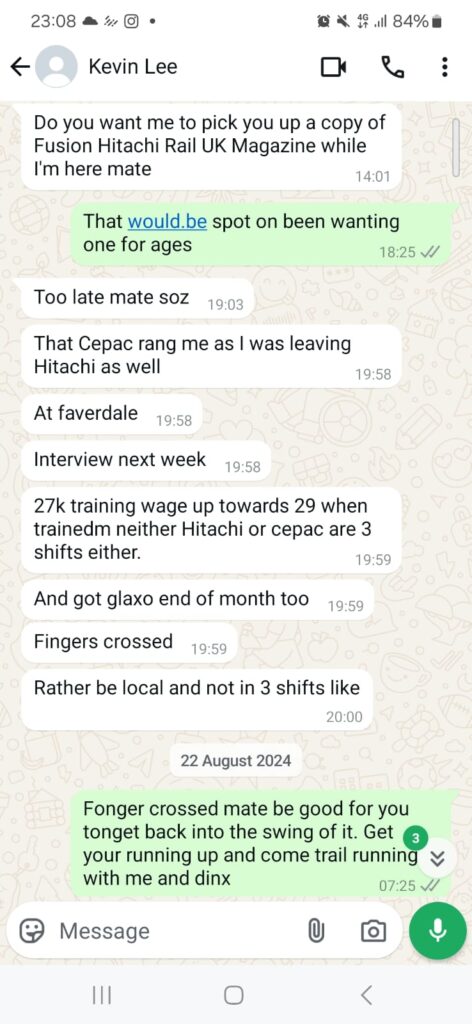
Afterwards, I messaged a friend: “Interview next week” and “27k training wage up towards 29”. The recipient retained the exchange and later provided a supporting witness statement. Those were my words immediately after the conversation. They recorded what I understood Page had offered, before a complaint or tribunal claim existed. At that stage, I was thinking about an interview, not assembling an evidential monument to corporate arse-covering.
However, the promised confirmation never arrived. The same-day message therefore gives a reviewer a contemporaneous account to compare with Page’s call records and candidate history. It preserves both the interview and the money. An agency can explain its process in polished paragraphs afterwards; the useful question remains what its representative actually said to me that day.
Maria Walker Selects The Shortlist Explanation
At 04:35 on 8 October 2024, I complained directly to Cepac. My email described the offer, the timing after the bank holiday, the missing confirmation and the mental-health disclosure. Cepac therefore had a clear sequence to investigate. Somebody could ask the recruiter what happened, examine the candidate record and establish why the expected follow-up never came.
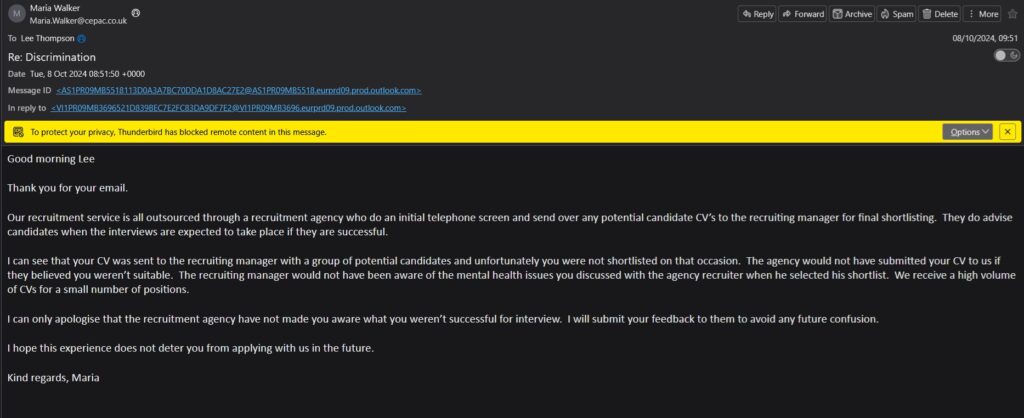
Maria Walker, Cepac’s HR Business Partner, replied at 09:51. She explained that the agency screened candidates before sending CVs to the recruiting manager for final shortlisting. My CV had gone across, but I had not made the shortlist. Moreover, her answer said the manager would not have known about the mental-health issues discussed with Page. The apology concerned Page’s failure to tell me that I had not secured an interview.
Walker described the discrepancy as “confusion”. She had not seen the WhatsApp exchange. Consequently, her answer now sits beside evidence she did not have when she supplied it. Which records supported that answer? Who checked the words used in the call? A failed shortlist and an offered interview require reconciliation. Meanwhile, filing the difference under applicant confusion gives the company a wonderfully convenient wash programme, provided nobody opens the drum.
Paragraph Fourteen Spoils The Wash
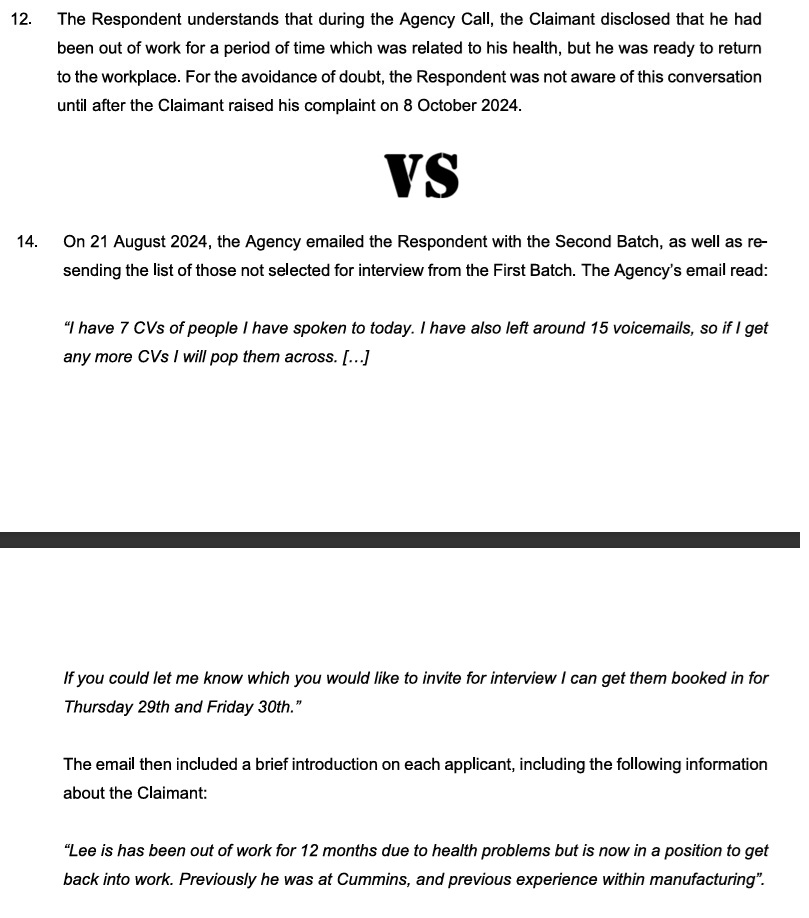
Cepac’s ET3 introduces another dated record. Paragraph 12 places its awareness of the agency conversation about my health-related employment gap after the October complaint. However, paragraph 14 describes an email that Page sent to Cepac on 21 August, the day of the recruitment call. That email contained candidate introductions, including mine.
My entry said I had been out of work for twelve months because of health problems and was ready to return. It also mentioned my Cummins employment and manufacturing experience. Therefore, the company’s own pleading places health information in an August email to Cepac, alongside its account of learning about the conversation in October. The document supplies the date and the communication. A reviewer now needs to follow its recipients and use.
Who received that email, and what reached the recruiting manager? When did the shortlist decision happen? Which information supported it? Together, those questions distinguish company receipt, individual knowledge and the selection decision. They also stop a general assurance doing work that only the underlying records can perform. There is a trail to investigate, however inconvenient that makes the comforting story about confusion. Read the email history before selecting the spin speed.
Health Status Is Already In The Rulebook
Unilever’s currently linked Responsible Partner Policy dates from 2022. Principle 5 prohibits recruitment discrimination including disability, disease and health status. It also requires objective, transparent selection criteria and controls. Consequently, the policy provides a direct basis for examining the Page-Cepac handover, rather than wandering through another inspirational discussion about inclusion.
Now apply that question to the actual sequence. Page discussed an interview and salary with me. I also disclosed my health-related employment gap. An August email carried health information to Cepac. Later, Walker supplied the unsuccessful-shortlist explanation and an assurance about the manager’s knowledge. The Unilever Cepac review therefore needs to establish the decision, its timing and its grounds. Each company holds a different part of the evidence needed to do that.
The awkwardness belongs in the records. For example, which criteria did the decision-maker apply, and where did they record the result? Was the account given to me consistent with the agency’s candidate status? A supplier can answer those questions with documents. An investigator can then compare the answer with the three exhibits. Enough of the scented-candle bullshit: an inclusion statement burning gently beside an unopened file produces atmosphere, not an explanation.
Michael Page Supplies The Blackout Edition
Page holds the recruitment records from the other end. My data-access request sought application material, call information and correspondence with Cepac. However, its response removed names and sections of correspondence, citing third-party information. The resulting gaps made it harder to establish who said what. TCAP’s Page Partners investigation sets out that disclosure and the internal material concerning my complaint and earlier tribunal case.
Unilever’s policy includes responsible handling of personal information. Meanwhile, its implementation guidance asks whether complainants can obtain the information and advice needed to pursue a grievance fairly. Those principles make the complete records relevant to a properly authorised review. Confidential examination can protect other people’s data while still establishing what happened. A blackout copy is a piss-poor substitute for that examination. Otherwise, the investigation is trying to inspect the plumbing through a sheet of black plastic and congratulating itself on finding no leaks.
The Complaint Reaches My Medical Centre
During the litigation, Horsfield Menzies contacted my medical centre about appointment availability. Acting for Cepac, the firm used that information to oppose a postponement. My efforts to obtain support for participation had become material for the other side’s procedural argument. For me, that intervention intensified the pressure around an already difficult process.
The correspondence allows a reviewer to examine the purpose, scope and use of the contact. Meanwhile, my disability includes emotional dysregulation under stress. The surrounding events therefore matter when assessing the reactions that followed. Cepac’s litigation case increasingly focused on those reactions, drawing on correspondence, complaints and published criticism. I experienced that process as pressure followed by the collection of the resulting anger for use against me. It was a bastard of a position to occupy while trying to pursue the original complaint.
Unilever’s policy requires dignified treatment, prohibits intimidation and bullying, and calls for fair grievance handling without retaliation. Its guidance also asks how reporting systems address fear of reprisals. Therefore, the medical-centre episode and the handling of my complaint warrant examination alongside the recruitment evidence. An ethical review needs the sequence, including what preceded each escalation. Taking the angriest paragraph in isolation tells the reviewer very little about how anybody reached it.
Newcastle Changed The Question
TCAP’s Newcastle Tribunal investigation documents my complaints about misdirected correspondence, the visibility of the case file and the handling of participation concerns. Those events form part of my challenge to the process. Administrative choices affected the circumstances in which I tried to pursue the discrimination claim, including the pressure surrounding the hearing.
Meanwhile, the recruitment dispute acquired a second life as a case about my behaviour. My language, persistence, complaints and publications became central material. However, a dossier of angry correspondence still cannot establish what Page offered during its call. Nor does it identify what the recruiting manager saw before selecting candidates. Those questions require their own evidence and their own findings.
This is why Unilever would need to read more than a supplier’s preferred account of the litigation. Follow the recruitment decision separately from the later conduct dispute, then examine how the two became entangled. Otherwise, a review risks reproducing the very problem I describe: the person asking the question becomes so thoroughly fucking examined that nobody gets around to answering it. The call disappears beneath a mountain of commentary about the caller.
The Costs Order Leaves The Recruitment Questions Open
The Tribunal proceeded in my absence on 24 April 2026. Its judgment found my conduct of the proceedings unreasonable, scandalous and vexatious, struck out the claims and ordered me to pay Cepac £20,000. I challenge the process and reasoning behind that outcome. The judgment also acknowledges that strike-out denied me a hearing on the merits of the underlying claims.
The respondents’ combined costs schedules exceeded £50,000. That is the total presented across those schedules; the amount ordered payable to Cepac was £20,000. Both figures show how substantial the litigation became. Yet neither supplies a merits determination about the interview, the health disclosure or the selection decision. The procedural outcome and the unresolved recruitment questions therefore occupy different parts of the record.
Consequently, procurement still has work to do. A judgment about conduct cannot tell Unilever what the agency said on the phone. Likewise, the costs order cannot reconcile Walker’s explanation with the contemporary message or trace the August email. Treating the outcome as a universal cleaning agent would turn a specific tribunal decision into a product with wildly exaggerated claims. The recruitment records still need their own examination.
Ask For The File Behind The Display
The Unilever Cepac review can start with a short, concrete request. Obtain Page’s call notes, any retained recording, candidate-status history and the August email with its recipients. Secure Cepac’s shortlist records and the material Walker considered before replying. Then compare those documents with the WhatsApp exchange and the witness statement. Establish what the companies recorded at the time and what later explanations added.
Next, examine the complaint correspondence, the medical-centre contact and the handling of personal information. Unilever’s policy says it will investigate reported concerns and expects partners to assist. Its March 2026 statement also confirms reporting routes for business partners, workers, communities and other stakeholders. There is already a published route through which the evidence can reach somebody responsible for assessing it.
The useful response would identify the findings, any remaining gaps and the action required. First give the review an owner and a timetable. Where confidentiality limits publication, explain what can be disclosed. A compliance exercise that achieves fuck-all except forwarding the supplier’s reassurance would hardly justify the machinery. After all, Cepac already gave me an answer in October 2024. The purpose of a review is to test it.
Make The Purchase-Order Switch Mean Something
The Unilever Cepac file now puts the commercial evidence and the recruitment documents on the same desk. Two published project accounts identify work involving Cepac, Indicia and Unilever. My same-day message records an interview and a wage discussion. Walker’s answer supplies the failed-shortlist account. The ET3 identifies an August email containing health information. Together, they provide specific questions that the companies’ original records can answer.
Unilever’s purchasing rule makes the result matter. If a review establishes non-compliance in a relationship subject to that control, the company should explain how it applies the rule and what must change. If the relevant work has ended, it can establish the dates and still account for the standards governing those projects. Either way, the response needs facts, a reasoned assessment and a responsible decision-maker.
So open the file and follow the information. Somebody managed to turn a creative brief into cardboard displays across supermarket aisles. The same commercial chain can manage a documented answer about recruitment and complaint handling. Ethical standards deserve at least the effort devoted to selling the detergent. Otherwise, all that talk about responsible partners risks becoming a very polished display of sod-all.
Lee Thompson – Founder, The Cummins Accountability Project
Sources
- Cepac: Unilever And Sainsbury’s Laundry Display Project, 27 February 2024
- Martyn Kidner: Cepac, Indicia Worldwide And Unilever Liquid I.V. Displays, 12 August 2024
- Unilever: Becoming A Supplier, USQS And RSPFirst
- Unilever: Responsible Partner Policy, 2022
- Unilever: Responsible Partner Policy Implementation Guidance, 2023
- Unilever: Modern Slavery Statement, March 2026, Including Supply-Chain Grievance Routes
- TCAP: KFC II, Maria Walker And The Interview Evidence
- TCAP: Page, Cepac And The Redacted Data-Access Correspondence
- TCAP: Newcastle Employment Tribunal, Deliberate Maladministration
- Employment Tribunal: Thompson v Cepac Limited And Page Outsourcing UK Limited
- TCAP case records: WhatsApp exchange dated 21 August 2024; supporting witness statement dated 20 February 2025; complaint and Maria Walker reply dated 8 October 2024; Cepac ET3; Page data-access correspondence; respondent costs schedules and medical-centre correspondence.