
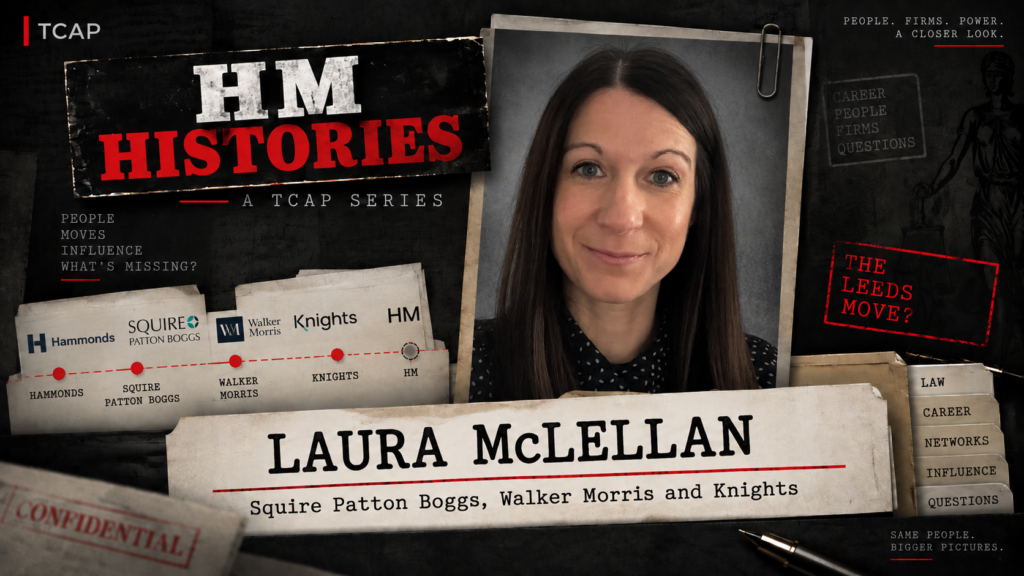
HM Histories was supposed to follow these careers in chronological order. Instead, we covered Walker Morris, then Knights, and are now going back to Laura McLellan at Hammonds, like a fucked up Star Wars prequel. We missed the opening chapter: fourteen years at Hammonds and its successors, beginning with her training contract in 2005. That is a substantial chunk of the biography to leave on the cutting-room floor. So our third McLellan instalment returns to her first firm, whose history takes us further back still: to 1989, when it was known as Hammond Suddards, and its work for South Yorkshire Police after Hillsborough.
The journey also brings us to a late dismissal letter and a Brussels managing partner whose family holidays acquired client billing codes. I came looking for the opening chapter of a career; the files supplied a much less flattering institutional tour. There is an entire species of professional bullshit that relies on nobody looking beyond the name on the door. Let’s see how it survives a little reading.
Laura McLellan At Hammonds: The Missing First Chapter
Horsfield Menzies supplies the itinerary in McLellan’s own joining interview. She started at Hammonds in 2005 and stayed for fourteen years, before spending two years at Walker Morris and four at Knights. Along the way, Hammonds combined with Squire Sanders in January 2011. The Patton Boggs combination followed in June 2014. By the time Walker Morris announced her appointment in January 2020, it described her as arriving from Squire Patton Boggs. The names changed around a continuous stretch of her career.
Those names do useful work in a professional biography. They suggest scale, experience and a long apprenticeship in knowing how things ought to be done. Meanwhile, HM’s current profile advertises McLellan’s investigations work: interviewing people, reviewing evidence and preparing reports. That makes the history of her first firm an appropriate place to examine the handling of documents. Our earliest file begins sixteen years before she joined, when Hammond Suddards was advising a police force whose conduct would face decades of scrutiny.
Hillsborough: First, Put The Accounts Through Legal
Following the disaster, South Yorkshire Police officers produced accounts of what they had witnessed. Hammond Suddards reviewed hundreds of them. The IOPC’s December 2025 report records that 426 accounts went to the firm and that its lawyers, predominantly Peter Metcalf, suggested amendments to 172. Senior police officers then implemented changes through a process involving marked-up accounts, retyping and signatures. An officer’s recollection could therefore pass through several other people’s hands before reaching the investigators.
The first batch alone produced proposed changes to 28 of 68 accounts. These included ordinary corrections, but also requests to reconsider passages about the apparent absence of an organised police effort. According to the IOPC, the police team treated the lawyers’ suggestions as instructions. There is a world of power in that small administrative journey. A witness writes down what happened; the institution under examination gets a say in how the account should sound. By the time the paper reaches its destination, the handwriting has gone and authority has acquired a clean typescript.
The Missing Words Were Doing A Job
The detailed findings show why this deserves more than a passing reference to “edited statements”. In five accounts, references to closing the tunnel to the central pens, or to contingency plans for doing so, were removed. All eight accounts containing references to police responsibility for monitoring safety in the pens lost those references. Inspector White’s account lost a substantial passage describing how he had monitored the pens and controlled access in the past. These were practical recollections about crowd safety, with obvious significance for understanding what happened.
Elsewhere, changes narrowed descriptions of radio problems from a wider communications failure to an individual officer’s experience. The IOPC records communication-related amendments in 40 accounts, 31 following suggestions from Hammond Suddards. Consider the difference in the picture each version creates. A system that fails its officers raises questions about the organisation. A single officer with a troublesome radio can look like an isolated inconvenience. The scale of the problem changes with the grammar. What a useful little bastard a possessive pronoun can be.
The 2012 Hillsborough Independent Panel had already identified 164 statements marked for substantive amendment. Of those, 116 were changed to remove or alter material unfavourable to South Yorkshire Police. Its report distinguishes those alterations from routine corrections and the removal of coarse language. A polished sentence can still carry a damaged account. Indeed, tidiness becomes part of the problem when it gives the reader confidence that the difficult work has already been done.
Take Out The Swearing, Then The Criticism
PC Gary Cammock’s account supplies a particularly revealing encounter with this machinery. The IOPC records that he accepted removing swear words but resisted changing his criticism of the pre-match briefing. He had described a microphone system that barely allowed him and nearby officers to hear the instructions. A handwritten note recorded that “he is not inclined to alter his criticism of the briefing”. The following day, another note instructed that his account be retyped as amended. The report identifies no intervening discussion with him.
There is something exquisitely bureaucratic about getting the profanity out while the substantive complaint remains under negotiation. An officer can surrender a few swear words and still want his experience preserved. For fuck’s sake, the microphone either let him hear the briefing or it did not. Respectability on the page does nothing to improve the equipment on the day. The idea that an account improves merely by becoming more palatable is bollocks. His difficulty hearing the briefing was the useful evidence, however inconvenient that became for the people preparing the institutional response.
Other officers told investigators that they signed amended accounts without checking them closely, or without being told that changes had been made. Some were later surprised by their extent. A signature can look wonderfully conclusive to someone reading the finished document. The IOPC’s account shows why the route to that signature matters too. Put a neat page in front of a witness and the resulting autograph does not explain who selected the words.
A Consistent Story, An Incomplete Record
Metcalf told the IOPC that his purpose was to keep accounts factual, clarify ambiguity and remove unsuitable material. He accepted that factual content might occasionally have been removed inadvertently. The IOPC concluded that his explanation significantly understated his role. It identified repeated removal of facts in a consistent pattern, particularly concerning earlier action to control access to the central pens. An institution can make its account easier to present while making the underlying events harder to understand. Here, the report places that tension directly inside the review process.
The separate proof of evidence shows another extraordinary contraction. Hammond Suddards helped prepare South Yorkshire Police’s submission to the Taylor Inquiry. After extensive legal editing, the section covering the events of the day shrank from more than 100 pages to seven and stopped at noon, when the turnstiles opened. The submitted version also removed the officer accounts and much of the comparison between policing arrangements in 1988 and 1989. References to supporter behaviour that day were cut too. The result was a background document that stopped before the disaster it was accompanying.
The stated reason was to avoid prejudicing the inquiry. Even so, the effect is startling: a history of the day with the defining hours outside the frame. Imagine buying the director’s cut and discovering that the director has removed the fucking film. That is the editorial choice worth examining here. Whoever controls the selection can make a document internally coherent while leaving the reader dependent on material that has been put somewhere else.
The Acquittals Belong In The Story
In May 2021, Metcalf and former police officers Donald Denton and Alan Foster were acquitted after Mr Justice William Davis ruled that they had no case to answer. The Taylor Inquiry was a non-statutory departmental inquiry and did not constitute a course of public justice for the offence charged. The prosecution also failed to establish the required tendency to pervert other proceedings. In considering criminal investigations, the judge noted that the original accounts had been retained and were accessible to West Midlands Police. He found insufficient evidence to put the charges to a jury.
The later IOPC report nevertheless sets out what the amendment process did to the material routinely supplied to investigators. West Midlands Police received amended accounts; relevant information in originals was therefore missing from the versions on which the investigation and inquiry worked. Keeping the first version in a file and sending the second version onwards are two separate acts. An archive can preserve material without ensuring that it reaches the people who need to consider it.
That distinction gives this history its continuing force. The criminal case ended in acquittals. The documented editing process remains available for scrutiny, including the alterations the IOPC found had removed factual material. Anyone selling professional judgement should be comfortable with both parts of that record receiving daylight. Otherwise, public accountability becomes an expensive reading exercise in which the institution chooses the extract and everybody else is expected to admire the binding.
Back In Leeds: Your Dismissal Has Already Happened
By 2008, Hammonds had a different paperwork problem involving its own employee, solicitor Ms Mwitta. The firm brought her termination date forward from 15 December to 1 December without agreement. Its dismissal letter reached her on 13 December. The tribunal accepted that sending it was an innocent mistake, but the shortened timetable breached collective consultation requirements. She received a protective award of thirty days’ remuneration. A letter telling you that your employment ended twelve days ago is an impressively shite way to discover that somebody else has been rearranging your calendar.
Hammonds subsequently won its appeal against the findings of unfair dismissal and race discrimination. In October 2010, the Employment Appeal Tribunal dismissed the unfair-dismissal claim and sent the discrimination claim for a fresh hearing. The consultation breach and protective award were recorded separately. Meanwhile, the letter remained an embarrassing example of administrative incompetence. Dates are basic equipment in employment practice. Here, a firm capable of arguing the law on appeal had managed to make a routine termination letter arrive with its own time-travel problem.
Brussels: Wish You Were Paying
In 2009 and 2010, the Brussels office supplied another, rather more scenic, accounting problem. Its managing partner, Konstantinos Adamantopoulos, allocated €7,000 of family holiday accommodation in Greece to clients, who were billed and paid. He also allocated €16,000 from a family skiing holiday in Zermatt to client matters, although those charges were never sent to clients. Thus a Swiss hotel stay briefly acquired the administrative costume of a legal expense. A ski resort had apparently opened a branch in the disbursements ledger. Marvellous service, provided you were the person on holiday.
The Solicitors Disciplinary Tribunal found serious misconduct and lack of integrity. Applying the dishonesty test then used, it found the conduct objectively dishonest but did not find subjective dishonesty proved. Its order, effective from 29 October 2015, restricted his work within regulated legal practice without regulatory permission. Hammonds had commissioned KPMG’s investigation and repaid clients, with interest, for charges it considered improper. Those repayments were the necessary repair bill. The original charges remain an outrageous way to treat people who had entrusted their business to a professional adviser.
There is a peculiarly professional confidence in allowing a personal expense to travel under a client matter number. Numbers make things look authorised. A description makes them look routine. Add the reputation of a senior lawyer and the customer has another reason to assume that somebody competent has checked the bill. Yet a billing code cannot turn a family holiday into client work. All it can do is give the expenditure somewhere more respectable to sit.
New Letterhead, Old Paper Trail
Hammonds disappeared into the Squire Sanders combination in 2011, followed by the creation of Squire Patton Boggs in 2014. McLellan’s fourteen-year stretch carried her through those changes before Walker Morris, Knights and eventually HM. The missing beginning has supplied a police statement review process, a consultation breach and a senior partner’s personal expenses. A succession of mergers can make the history harder to follow. Fortunately, the files retain the old names.
That is why Laura McLellan at Hammonds deserved its place in the series. After our chronological cock-up, this is the chapter that should have come first. What keeps my attention is the small stuff: a fax, a signature, a date, a client code. Those are the places where an account acquires authority and somebody else has to live with the result. The grand name on the door can wait. I want to know what happened between the first draft and the version that landed on somebody’s desk. That is where the expensive language runs out and the fucking explanation has to begin.
Lee Thompson – Founder, The Cummins Accountability Project
Sources
- TCAP – Walker Morris Age Discrimination: HM Histories
- TCAP – Laura McLellan At Knights: HM Histories II
- Horsfield Menzies – Welcome To Laura McLellan
- Horsfield Menzies – Laura McLellan
- Walker Morris – Employment Team Expands Expertise With Appointment Of Lateral Hire
- Law Society Gazette – Hammonds Drops Names And Prepares Dutch Deal
- Squire Sanders – Completes Combination With Hammonds
- Squire Patton Boggs – Merger Notification To The US Department Of Justice
- Hillsborough Independent Panel – Report
- IOPC – The First Amendments
- IOPC – Nature And Scale Of The Amendments
- IOPC – Officers’ Awareness Of The Amendment Process
- IOPC – Explanations For The Amendment Process
- IOPC – Development Of The Proof Of Evidence
- IOPC – The Trial Of Mr Metcalf, Ch Supt Denton And DCI Foster
- R v Metcalf, Denton And Foster – Ruling On Submissions Of No Case To Answer
- Hammonds LLP And Others v Mwitta – Employment Appeal Tribunal Judgment
- Solicitors Disciplinary Tribunal – Konstantinos Adamantopoulos
- Holman Fenwick Willan – Correction To Article In The Times: Konstantinos Adamantopoulos