
The Brancott Estate Cepac connection sits in the packaging company’s 2026 portfolio. The wine brand now belongs to Vinarchy, whose supplier code covers equal opportunities, human-rights concerns and audits supported by documents. Here come three: the same-day WhatsApp, Maria Walker’s email and Cepac’s ET3. Somebody fetch the purchasing file. This tasting requires paperwork.
A Sauvignon With Supporting Documents
Wine marketing can turn a patch of dirt into a fucking genealogy. We hear about the land, the weather, the people and the particular afternoon the grape discovered its potential. Lovely. I would like to give the cardboard underneath the bottle some attention. Cepac has advertised Brancott Estate display work, and its recruitment paperwork offers considerably more to discuss than the serving temperature.
On physical page six of Cepac’s 2026 portfolio, the bottom-right photograph shows a Brancott Estate display beneath the heading “Pallet Bins”. The branding, bottles and promotional structure are visible. Therefore, the introduction comes from Cepac’s own sales material. It chose this work to demonstrate what it could produce for prospective customers.
The portfolio supplies the display; the purchasing records can supply its date and commercial route. Who commissioned it, which company placed the order and what work followed? Those details matter because Brancott has changed owners. Meanwhile, the recruitment file contains its own dates, people and communications. A business interested in provenance should find both trails worth following. We can admire the vineyard once somebody has opened the other bloody folder.
Pernod Has Moved Out Of This Bottle
On 30 April 2025, Pernod Ricard completed the sale of its strategic international wine business to Australian Wine Holdco Limited. The combination with Accolade Wines created Vinarchy. Brancott Estate was among the brands included, alongside other Australian, New Zealand and Spanish wines. Vinarchy’s current brand pages continue to identify Brancott as part of its business.
Consequently, this article reaches the present owner’s desk. Pernod’s involvement belongs in the commercial history, while Vinarchy’s current standards provide the question for its purchasing decisions. The group can establish whether the display predates the transaction, whether any arrangement transferred and whether Cepac still produces work reaching Brancott. An acquisition gives those questions particular relevance. Somebody presumably counted the bottles; the supplier records deserve a turn.
The recruitment call happened in 2024, before Vinarchy’s creation. Its present task is to examine the relationship and decide what the evidence means for its own standards today. That is a perfectly manageable distinction. Corporate history becomes unbearable only when every change of ownership turns into a luggage carousel where responsibility travels round indefinitely and nobody recognises the suitcase.
Vinarchy Has Put Its Expectations In Writing
Vinarchy’s supplier code covers suppliers and their supply chains providing goods and services to the group. Its human-rights section commits Vinarchy’s own workplace to freedom from discrimination, harassment and bullying. The supplier requirements ask for equal-opportunity and flexible-working policies, a diverse workforce and a culture where employees can raise human-rights concerns.
The ethics section also expects accountable management and respect for people’s rights. These are useful commitments because the Cepac file concerns recruitment, a health disclosure and the handling of the resulting complaint. However, the test needs to reach beyond whether a supplier can attach a respectable policy. Anyone can produce a paragraph about fairness. The awkward part begins when somebody asks what happened to a particular applicant.
A policy needs to survive contact with an actual recruitment record. Otherwise, it becomes Estate Bottled Bollocks: attractively presented, confidently described and incapable of explaining anything in the glass. Vinarchy has chosen to publish expectations about employment and human rights. So let us put an application beside them and see whether the people responsible can account for it.
Before The Complaint, There Was A Job
On 21 August 2024, Page Outsourcing called me about a production role at Cepac. The recruiter offered an interview for the week after the bank holiday. We discussed a £27,000 training wage rising towards £29,000. During that conversation, I explained that my employment gap involved my mental health. Page would pass my details on and call again to agree the exact interview time.
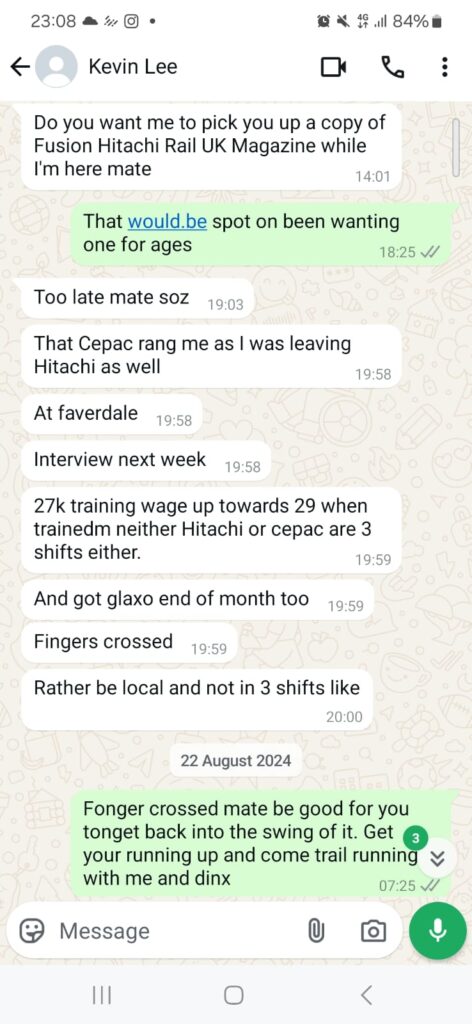
Afterwards, I sent a friend two messages: “Interview next week” and “27k training wage up towards 29”. That was the extent of my grand strategy at the time. I thought I had an interview and told somebody about it. There was no tribunal claim, no complaint and no need to imagine that an ordinary conversation might eventually require its own fucking source list.
The recipient retained the exchange and later supplied a supporting witness statement dated 20 February 2025. Meanwhile, the promised confirmation call never arrived. The WhatsApp preserves my account of the conversation on the day it happened, including the timing and the money. Page’s notes, any retained recording and its candidate history are the records against which to check it. That comparison should explain how an offered interview became the unsuccessful application Cepac subsequently described.
Maria Walker Offers The House Explanation
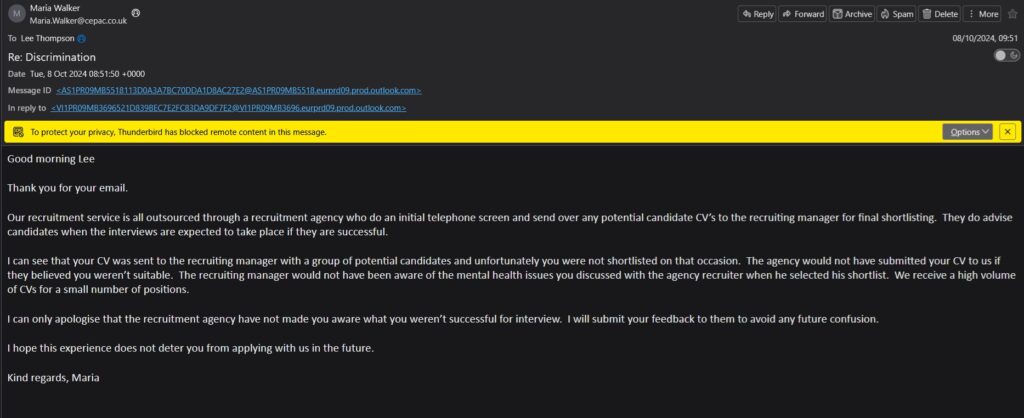
At 04:35 on 8 October 2024, I complained directly to Cepac. My email described the interview offer, the missing confirmation and the mental-health disclosure. Cepac’s HR Business Partner, Maria Walker, replied at 09:51. She explained that Page screened candidates before sending CVs to the recruiting manager for final shortlisting.
According to Walker, my CV reached the manager, but I was “not shortlisted on that occasion”. She also maintained that the manager would not have known about the mental-health discussion. Her apology concerned Page’s failure to explain that I had not secured an interview. Consequently, the account I had given became confusion surrounding an unsuccessful application.
Walker had not seen the WhatsApp exchange when she supplied that explanation. Yet the message already existed, preserving the interview and pay discussion weeks before her reply. What records supported her answer? An agency error, a premature offer and a changed selection decision would each require their own explanation. Pouring everything into “confusion” achieves a convenient blend while leaving the ingredients unidentified. It is a piss-poor way to answer a complaint whose central question is what changed after a health disclosure.
Paragraph Fourteen Spoils The Pairing
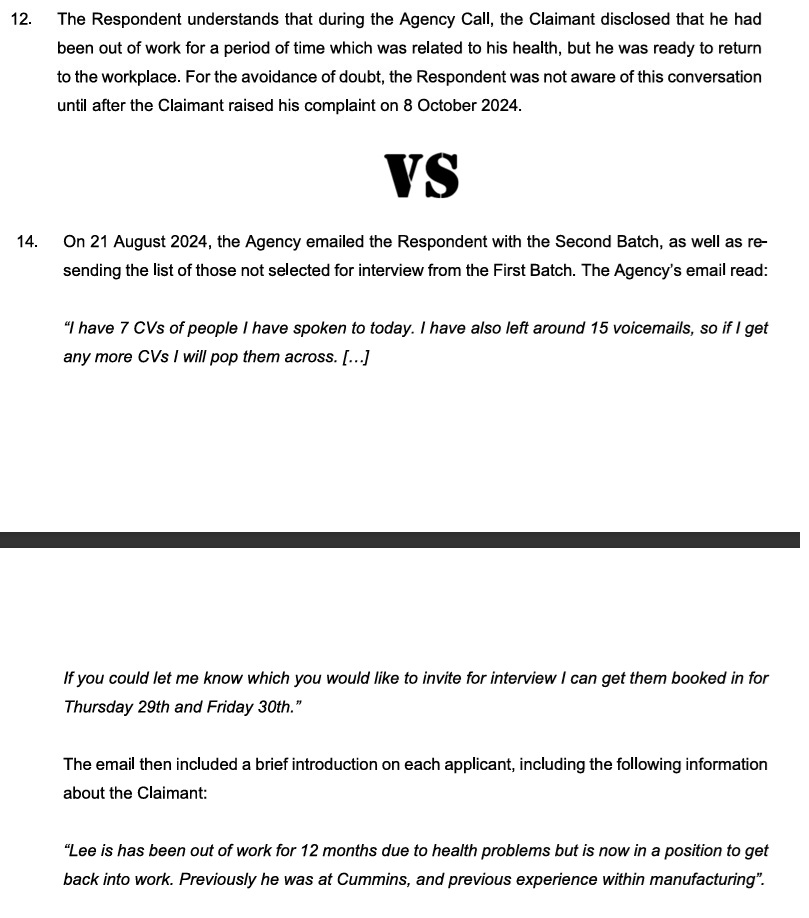
Cepac’s ET3 adds another dated communication. Paragraph 12 places its awareness of the detailed agency conversation about my health-related employment gap after the October complaint. However, paragraph 14 describes an email Page sent Cepac on 21 August, the day of the recruitment call. It included information that I had spent around twelve months out of work because of health problems and was ready to return.
That August email gives the health information a route into Cepac during recruitment. Its recipients, onward circulation and timing against the shortlist decision now matter. The manager’s knowledge needs establishing from those records. Meanwhile, Walker’s later assurance needs comparing with what the company actually received and what reached the person making the decision.
There is plenty here to investigate without guessing. Obtain the email and follow it through the system. Then compare the selection history with the account given in October. The company’s own defence has identified a document capable of answering part of the question. What a bastard of an inconvenience for an explanation that would prefer to remain pleasantly general. Paragraph fourteen has brought its own bottle to the tasting, and somebody needs to read the label.
Michael Page Supplies The Blackout
Page’s data-access disclosure made the route harder for me to follow. Names and passages appeared under redactions, with third-party information cited as the reason. The earlier Page Partners investigation examines that correspondence. Here, the practical problem is straightforward: the questions concern who handled my application, what they recorded and where the information went. A row of black rectangles contributes bugger all to that explanation.
Nevertheless, the redactions on my copy do not prevent Page and Cepac from examining their own records. A meaningful investigation can establish decisions and communications while handling other people’s information appropriately. Vinarchy should expect an intelligible account of the recruitment process if it examines this file. A data-access response and a supplier investigation serve different purposes. Neither gains much from treating the marker pen as the most authoritative person in the room.
Horsfield Menzies Check The Appointment Book
Later, Horsfield Menzies contacted my medical centre about appointment availability and used the resulting information to oppose a postponement. That intervention deserves its precise description. Solicitors acting for Cepac investigated when I could obtain an appointment while arguing about whether the proceedings should go ahead. Meanwhile, the original dispute still concerned a recruitment call, a health disclosure and an interview confirmation that never came.
Stress affects my emotional regulation. The pressure surrounding my responses therefore belongs in the account of those responses. Instead, correspondence, complaints and publications became material for the case about my conduct. The recruitment question increasingly disappeared beneath an argument about the disabled person pursuing it. That is the bullying at the centre of my criticism: apply pressure, collect the reaction and then present the reaction as the problem requiring decisive action.
Vinarchy can read the medical-centre correspondence alongside the postponement dispute and the conduct allegations. All of it belongs in a serious examination of how the complaint developed. Professional presentation can make an ugly sequence remarkably tidy on paper. However, numbered pages and a solicitor’s signature cannot turn the underlying treatment into something more palatable. There is no premium reserve designation for polished shit.
An Expensive Way To Leave Recruitment Unanswered
The respondents submitted combined costs schedules exceeding £50,000. Following the hearing on 24 April 2026, which proceeded in my absence, Employment Judge James struck out the claims and ordered me to pay Cepac £20,000. The scheduled costs and the amount awarded are separate figures. Both belong in the account.
The Tribunal found my conduct of the proceedings unreasonable, scandalous and vexatious. Those are adverse findings in its published judgment. However, the hearing did not determine the recruitment discrimination allegations on their merits. The interview conversation, missing confirmation and health-information route therefore remained without that examination.
TCAP’s Newcastle Employment Tribunal investigation sets out my challenge to the handling of my disability, participation and the surrounding pressure. Read that account beside the judgment and the case documents. A supplier review needs the whole sequence, including the outcome against me and the recruitment questions the outcome left unanswered.
Otherwise, a conduct ruling can acquire an entirely different meaning as it passes from lawyer to procurement department. Before long, a decision ending proceedings becomes a reassuring sentence about the supplier’s recruitment. That transformation deserves scrutiny. The judgment records what the Tribunal decided; attaching a more convenient interpretation would be a particularly expensive form of mislabelling. Vinarchy should read the contents before accepting the sales description.
Page Ten Contains The Corkscrew
Page ten of Vinarchy’s supplier code describes monitoring. It provides for supplier assessments, including self-assessments or audits requiring supporting documents or site visits. The group also says it will work with suppliers on improvements. Therefore, the mechanism for looking beyond a supplier’s assurances already appears in the company’s own document.
The useful part is the supporting material. A self-assessment can tell Vinarchy what a supplier thinks of its conduct. The recruitment records can show what happened. Both may contribute, but they cannot perform each other’s jobs. Asking the company that supplied Walker’s explanation whether it remains satisfied with Walker’s explanation would be a remarkably circular afternoon’s work.
Instead, somebody needs to compare the accounts and follow the dated communications. An audit gains its value from the questions it resolves, including awkward answers. Otherwise, the exercise resembles a wine competition where each entrant brings its own judge and everyone leaves with a gold medal. Very agreeable for the trade photographs. Less useful when the customer wants to know whether the contents justify the label.
Follow The Order Back To The People
The Brancott Estate Cepac enquiry starts with the display. Vinarchy should establish the commissioning date, the buyer and any agency involved, then identify the terms that applied. The current commercial position belongs in that answer too. If the work ended, give the end date. Where a relationship continues, explain how the group assesses the manufacturer.
Next comes the recruitment trail: Page’s account of the call, its candidate-status history and the August email identified in Cepac’s defence. Walker’s reply needs the material behind it, including what she checked before answering. The later medical-centre contact and litigation handling deserve examination alongside those records. Together, they show how a question about recruitment became a dispute over the person asking it.
That process should include an opportunity for me to answer any new explanation. Otherwise, procurement risks commissioning another polished account of a complaint without hearing from the complainant. We already have one of those. Vinarchy can ask for records, examine the differences and explain what its findings require. Corrections, changes to practice or commercial decisions should follow that work. The policy provides a starting point; somebody still has to do the job.
Let The Records Breathe
Brancott Estate gives this series a new owner to address and a specific display to identify. Vinarchy brings its own supplier code, including an audit process capable of reaching the underlying documents. Meanwhile, the WhatsApp, Walker email and ET3 preserve a sequence that deserves a proper answer. The evidence has dates. The commercial relationship can have dates too.
Nothing about that enquiry requires another launch event or a photographer arranging cheerful people beside a vineyard. Start with the purchasing history and follow the recruitment records. Then explain what happened and what the findings mean for the standards Vinarchy publishes. A company selling wine understands that an attractive presentation cannot settle every question about what went into the product.
Page six of Cepac’s portfolio supplies the Brancott display. Page ten of Vinarchy’s code supplies a way to investigate its producer. Between them sits a file with rather more substance than the usual corporate tasting notes. If the supplier’s explanation holds up, the records can demonstrate it. If it falls apart, the answer needs changing. Nobody needs a sommelier to recognise bullshit that has spent two years breathing.
Lee Thompson – Founder, The Cummins Accountability Project
Sources
- Cepac: Our 2026 Portfolio
- Pernod Ricard: Completion Of The Sale Of Its Strategic International Wine Portfolio
- Vinarchy: Brand Homes
- Vinarchy: Governance And Reporting
- Vinarchy: Supplier Code Of Conduct
- TCAP: KFC II, Maria Walker And The Interview Receipt
- TCAP: Page Partners, Redactions, Panic Calls And The Disabled Candidate They Googled
- TCAP: Newcastle Employment Tribunal, Deliberate Maladministration
- Employment Tribunal: Thompson v Cepac Limited And Page Outsourcing UK Limited