
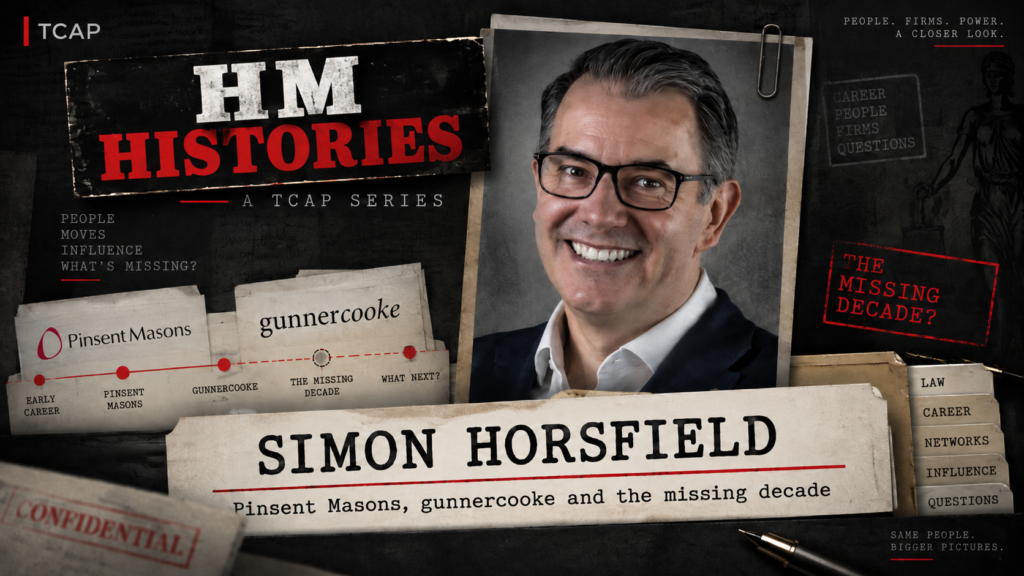
Simon Horsfield’s career takes HM Histories next to Gunnercooke. We have already visited Pinsent Masons and gone back to the Vaudreys years. This chapter opens a property file involving another solicitor at Gunnercooke: Eliot Lopian. His attempt to repair a land-transfer mistake involved forging three purchasers’ signatures. Professional problem-solving had reached the point where the people whose consent mattered could apparently dispense with the inconvenience of giving it.
There is something especially rotten about dishonesty conducted through ordinary office paperwork. Everything retains its respectable shape. A form has boxes, a transaction has a reference and a solicitor supplies the covering correspondence. Nothing needs to look sinister. The whole fucking mechanism relies on someone further down the line treating the document as evidence of something that actually happened.
Simon Horsfield’s Gunnercooke Year
In January 2014, Gunnercooke announced ten new partners, including Simon Horsfield. He arrived from Pinsent Masons, where he had led the Manchester employment team. The firm’s own September 2021 account of its Legal 500 rankings records his departure that March. Between those dates sits the disciplinary case against Lopian, a Gunnercooke principal whose practice included property transactions.
The arrival announcement sold a familiar professional promise: senior people, commercial understanding and growth. Gunnercooke had increased its partner count from 17 to 42 in a year. Co-founder Sarah Goulbourne described an approach “focusing solely on our clients’ commercial needs.” That language makes excellent recruitment copy. It also provides a useful starting point for asking what happens when keeping a client happy comes into conflict with telling the truth.
A law firm’s value should become clearest when a transaction goes wrong. Anyone can sound reassuring while the paperwork behaves. The difficult service involves admitting the cock-up, explaining its consequences and doing the uncomfortable work of putting matters right. That is when professional judgment earns its fee.
The Wrong Form, The Whole Plot
The transaction began with a mistake that transferred an entire plot of land when the sale should have covered only part. A colleague had supplied the wrong form. For readers fortunate enough to avoid spending their evenings with Land Registry documents, the distinction is straightforward: form TR1 transfers a whole registered title; TP1 deals with part.
One letter in a form’s name can therefore carry a substantial piece of land with it. The documents may look like interchangeable specimens of bureaucratic misery, but their effect depends on getting the details right. This is among the reasons people pay solicitors to handle them.
At that stage, there was an error to address. A proper repair would require dealing with the people whose interests the mistake had affected. They might ask questions, seek advice or insist on sorting out related problems. All of that takes time. Embarrassment comes with the territory. A professional service has to survive somebody discovering that the professional has fucked something up.
Three People, One Pen
In September 2017, Lopian put the three purchasers’ names onto a TR1 as signatures without their knowledge or authority. He submitted the document to the Land Registry as part of an attempt to transfer the property back to his client, representing that the purchasers had agreed to do so for no payment.
Consider what that paperwork asked the next person to believe. Three separate people had supposedly made a decision. Their signatures appeared to record that decision. In reality, one solicitor had supplied the agreement on their behalf without permission. Consent had become something he could manufacture at his desk.
The contempt sits inside that substitution. A person’s signature carries their involvement into a transaction. Forging it lets the author borrow their identity while cutting them out of the decision. It gives the document the appearance of cooperation precisely where cooperation has not occurred. What a marvellous saving in administration: remove the awkward bastards from the process, then put their names back in at the bottom.
The People Attached To Those Names
The attempted transfer encountered a practical obstacle. The Land Registry said it could not proceed because an official search was in progress, made by a company buying the remaining land. There was also a dispute over access to the smaller plot. The purchasers resisted signing corrective paperwork until that issue had been resolved.
That detail gives the forged signatures their proper weight. Actual people had concerns about an actual transaction. Their willingness to sign depended on addressing those concerns. A form bearing their names could make that unresolved position appear settled to someone reading the file.
Property paperwork is full of lines: boundaries, rights of way, signature boxes. Each one can mark a real limit on what somebody else may do. Lopian’s shortcut treated the boundary around another person’s consent as if it were an irritating pencil mark. His preferred solution could travel ahead while the people affected were still waiting for answers.
The forged document offered a tidy-looking route through a messy problem. Unfortunately for its author, the mess included people with interests of their own.
The Signature Department Develops Amnesia
Months later, asked how the transfer form had been signed, Lopian denied knowing. The solicitor who had supplied the signatures then presented himself as unable to explain their appearance. Having written other people into the paperwork, he tried to write himself out of the account.
This is where the attempted repair becomes particularly grubby. The person asking questions needs a reliable explanation so they can work out what happened. A false answer sends that enquiry in the wrong direction. It makes everyone else spend time searching around a gap that the speaker could fill immediately.
There is a sour little office farce in that performance: the man holding the answer adopts the manner of someone waiting for an update. Behind the polite correspondence sits a much simpler proposition. He knew. The others needed to know. Instead, he gave them bullshit with the benefit of a professional return address.
The Only Client In The Department
Lopian’s mitigation supplied the commercial pressure behind the attempted cover-up. He said he was the department’s only qualified solicitor, had made a similar error weeks earlier and feared losing its sole client and his job. His account also described serious family illness and considerable stress.
So does the question of whose interests the attempted fix served. Admitting the mistake threatened an important commercial relationship. Manufacturing consent offered a way to restore the position without first securing the agreement of the people involved. The attraction of a quiet solution grew around the consequences of an honest explanation.
That is an ugly bargain to make with someone else’s signature. Protecting a fee relationship becomes the urgent task; respecting the other parties becomes something to work around. Once that bargain takes hold, professional skill can help produce a more convincing false document. The knowledge that should protect a transaction supplies the means to interfere with it.
There is the arse-end of client service: everyone outside the fee relationship becomes an obstacle to be managed. A solicitor needs enough independence to tell the paying customer that other people’s consent will take as long as it fucking takes.
The Tribunal Drew The Line
On 24 July 2019, the Solicitors Disciplinary Tribunal approved an agreed outcome and struck Lopian off the roll. He admitted the allegations, including dishonesty. The Tribunal considered the admissions properly made and found the dishonesty plain: he had forged signatures on official documents and submitted them to the Land Registry. It concluded that strike-off was the appropriate and proportionate sanction.
The order also required a £2,500 contribution towards costs. The SRA’s regulatory record identifies Gunnercooke as the firm connected with the matters and confirms the strike-off date.
That outcome gives the story a firm end point. Lopian’s professional standing depended on people being able to rely on his dealings with them. His conduct attacked that reliance at its most basic level. A signature purporting to come from somebody else, followed by a false account of what happened, makes ordinary trust dangerous for the person extending it.
The Tribunal enforced a boundary that every reassuring letterhead needs behind it. There has to be a point where the title stops protecting the conduct and the conduct costs the title.
Read The Deed Before Admiring The Letterhead
For HM Histories, Simon Horsfield’s employment history brings us to Gunnercooke. Lopian’s disciplinary case opens this particular file. That is the value of following a firm’s name beyond the flattering career announcement: the public record contains the difficult material alongside the growth figures and professional credentials.
Look again at the commercial promise made when Horsfield joined. Clients wanted senior lawyers who understood their needs. Any worthwhile version of that service must include the capacity to deliver bad news. Sometimes the advice has to begin with an admission that the file contains a serious mistake. Sometimes a client has to wait while another person gets advice. Professionalism requires somebody to tolerate the inconvenience.
The alternative is a dreadful kind of service theatre. The paperwork looks complete, the transaction appears agreed and the people receiving it have every reason to assume that somebody checked. Beneath that orderly surface, the supposed agreement may consist of whatever the author needed the document to say. By then, the fucking form has become a costume.
The Name That Came Off The Roll
A mistake creates a difficult moment. The response determines how many more people must carry its consequences. Tell the truth and they can begin dealing with the real problem. Invent the missing agreement and they start making decisions on a false account. Every further assurance risks pulling somebody else into it.
That is why this file deserves space beside the partnership announcements. It shows how an attempt to preserve a commercial relationship can destroy the trust that gives the profession its purpose. The most useful professional quality in that moment is the willingness to face an unpleasant truth while there is still time to handle it honestly.
Lopian tried to make a troublesome transaction behave by supplying consent that was not his to give. The final paperwork had a brutal symmetry: three other people’s names he had no authority to write, followed by his own name ordered off the roll.
Lee Thompson – Founder, The Cummins Accountability Project
Sources
- Bdaily: Manchester Law Firm Add Ten Partners
- Gunnercooke: Legal 500 Rankings, September 2021
- Solicitors Disciplinary Tribunal: SRA v Eliot Lopian, Case 11949-2019
- Solicitors Regulation Authority: Eliot Lopian
- Legal Futures: Solicitor Struck Off For Forging Property Transfer Form
- HM Land Registry: Registered Titles – Whole Transfer, TR1
- TCAP: Simon Horsfield – Pinsent Masons And The Bullshit Correction Department
- TCAP: Simon Horsfield At Vaudreys