
The Kinnerton Cepac connection comes from the packaging company itself: a Harry Potter display made with the chocolate manufacturer. Kinnerton promises social accountability across its supply chain. Its group adopts standards prohibiting disability discrimination in hiring. Here are the WhatsApp, Maria Walker’s email, Cepac’s ET3 and the subsequent conduct battle. Does the policy mean investigating inconvenient evidence, or does it merely give the company a progressive wrapper?
The Cardboard Wizard Has A Customer
There is something magnificent about a chocolate display promising entry into a magical world. Fold the board correctly, add a familiar face and an ordinary supermarket aisle becomes a small licensed adventure. Meanwhile, the company manufacturing the scenery has a recruitment story in which an interview disappears. Unfortunately, the trick leaves paperwork behind. A competent magician would be fucking furious.
Cepac’s live awards page expressly identifies its work with Kinnerton on a Harry Potter pallet display. That is the commercial introduction. TCAP previously examined the disputed award history in Thirty Trophies, Twelve Pernod Ricard Boxes And Harry Potter’s Missing Fucking Award. Here, the relevant fact is Cepac naming the business with which it produced the display.
Kinnerton can supply the purchasing dates, the commissioning route and the present status of that relationship. If the work ended, say when. For now, Cepac continues to use the project in its public sales story. Consequently, the chocolate manufacturer has a straightforward question to answer about the standards it publishes for its supply chain. Can those standards cope with an actual complaint, or do they require everyone involved to remain as conveniently two-dimensional as the wizard?
Ethical Chocolate Needs More Than A Wrapper
Kinnerton’s website says social accountability reaches beyond its own practices into its supply and distribution chains. It also presents the business as embracing diversity. Those are useful promises because they connect the public identity of the company with the treatment of people beyond its immediate payroll. The cardboard sits inside that enquiry, however unglamorous procurement may find it.
The group statement approved on 26 May 2026 places Kinnerton within Zertus UK & Ireland, ultimately owned by Zertus GmbH. It adopts the Ethical Trading Initiative Base Code across the business and its supply chains. Suppliers must join SEDEX or another sustainability platform, and supplier audits must include ethical matters. The statement also describes ending relationships where identified weaknesses meet an unwillingness to improve.
So there is a policy, a means of assessment and a possible consequence. Good. A beautifully designed wrapper can promise all sorts of things; somebody still needs to check the filling. Otherwise, progressive corporate presentation becomes another confectionery product: smooth, reassuring and mostly sugar. Kinnerton has supplied the commitments. I will supply the difficult material and ask whether the bastards actually connect.
Disability Appears In The Ingredients
Section 7.1 of the ETI Base Code expressly prohibits discrimination in hiring on grounds including disability. Section 9.1 prohibits harassment, verbal abuse and intimidation. Although Kinnerton publishes its group commitments in a modern slavery statement, the code it adopts reaches these wider employment practices. Recruitment therefore belongs in the discussion on the terms the group has chosen.
That matters because my complaint concerns an application to Cepac through Page Outsourcing. An interview offer, a mental-health disclosure and a missing confirmation sit at its centre. Later came an HR explanation, a pleaded account containing health information and a lengthy battle over my conduct. Each stage has its own documents and needs its own answer.
The interesting test is what happens when those records interrupt the reassuring policy language. Does somebody follow the information between agency and employer? Can the assessment accommodate a complainant whose experience is considerably less cheerful than the corporate copy? Fair treatment needs to survive an awkward conversation. If it only works while everyone smiles for the website, the company has purchased a fucking backdrop.
Before Any Claim, There Was An Interview
On 21 August 2024, Page Outsourcing called me about a production role at Cepac. During that conversation, the recruiter offered an interview for the week after the bank holiday. We discussed a £27,000 training wage rising towards £29,000. I also explained that the gap in my employment involved my mental health. Page would pass my details on and call again to agree the exact interview time.
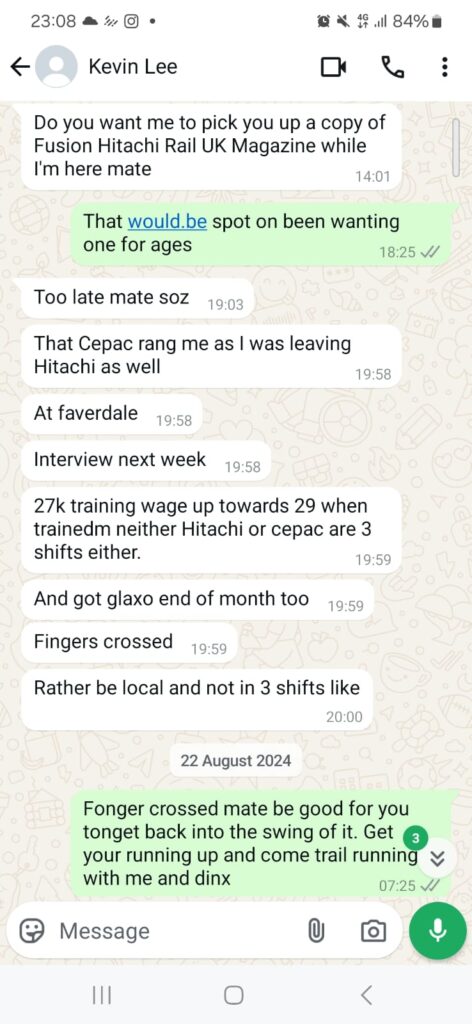
Afterwards, I messaged a friend: “Interview next week” and “27k training wage up towards 29”. At that point, I was thinking about returning to work. There was no complaint, no tribunal claim and no grand publishing enterprise waiting to spring out of the fucking phone. I had received an interview offer and told somebody about it, as people tend to do when something might improve their circumstances.
The recipient retained the exchange and later provided a supporting witness statement dated 20 February 2025. Meanwhile, the promised confirmation call never arrived. The WhatsApp records what I understood immediately after the conversation, including the timing and salary. Put it beside Page’s call notes, any retained recording and the candidate-status history. That is where an investigation starts: with the conversation and what happened next.
Maria Walker Rewrites The Programme
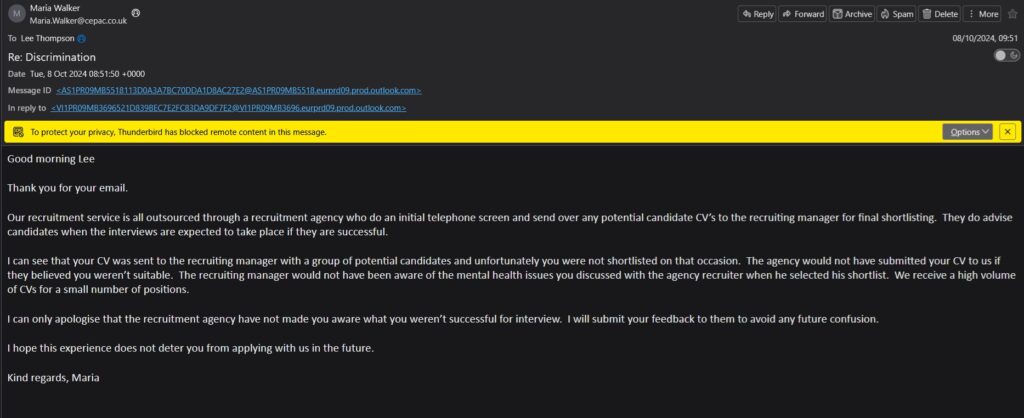
At 04:35 on 8 October 2024, I complained directly to Cepac. My email described the offered interview, the missing confirmation and the mental-health disclosure. Maria Walker, Cepac’s HR Business Partner, replied at 09:51. She explained that Page screened candidates before sending CVs to the recruiting manager for final shortlisting.
According to Walker, my CV reached the manager, but I was “not shortlisted on that occasion”. She maintained that the manager would not have known about the mental-health discussion. Her apology concerned Page’s failure to explain that I had not secured an interview. Therefore, an account of an offered interview became an unsuccessful application with some communication confusion attached.
Walker had not seen the WhatsApp when she gave that answer. However, the exchange already preserved the interview and wage discussion from weeks earlier. What did she examine before settling on her explanation? A premature agency offer, an administrative mistake and a changed selection decision would require different accounts. Calling the result confusion leaves that distinction conveniently unmade. It is a piss-poor explanation for somebody asking what happened after disclosing a health condition. Kinnerton should want the records behind it.
The ET3 Opens The Other Compartment
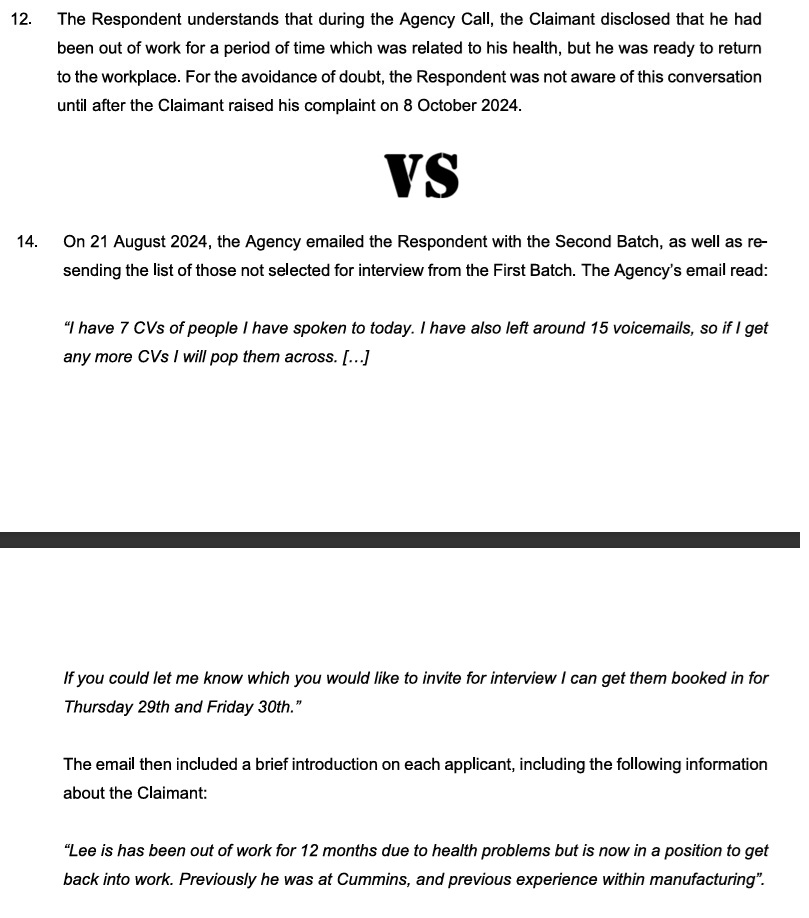
Cepac’s ET3, its formal response to the claim, adds an important dated communication. Paragraph 12 places awareness of the detailed agency conversation about my health-related employment gap after the October complaint. Paragraph 14, however, describes an email Page sent Cepac on 21 August. It contained information that I had spent around twelve months out of work because of health problems and was ready to return.
Consequently, the company’s own defence places health information inside Cepac during recruitment. Follow that August email. Identify who received it, where it went and when the shortlist decision happened. Then compare those records with Walker’s account of what the recruiting manager would have known. Company receipt and a particular manager’s knowledge are questions the communication trail can resolve.
This is where the elegant little box starts catching on its own folds. The October explanation offers reassurance; the defence identifies an earlier document requiring examination. Somebody needs to open the actual email rather than pat the packaging and announce that everything feels sturdy. Kinnerton has no need to invent an investigation. Cepac’s pleaded account has already supplied a date, a sender and the information to trace. The bloody instruction sheet is inside the box.
Michael Page Brings The Black Marker
Page’s response to my data-access request supplied another problem. Names and passages appeared beneath redactions, with third-party information cited as the reason. The Page Partners investigation examines that disclosure in detail. Here, the difficulty is practical: I asked for the records of my application, yet parts of the route through the business remained difficult to follow. Black rectangles offer remarkably little help with who knew what.
Nevertheless, the redactions on my copy do not erase the underlying records from Page’s systems. An investigation can establish who handled the application and what decisions they made while treating other people’s information appropriately. Kinnerton should expect an intelligible account if it examines the complaint. A marker pen cannot become a substitute witness simply because everybody finds its answers pleasantly short.
The same disclosed material also showed Page searching for my previous tribunal history after the complaint. That change of focus deserves examination alongside the recruitment records. Understanding the applicant’s reputation is a different exercise from explaining the applicant’s treatment. The agency had enough curiosity to investigate the person asking the question. It can bloody well apply some of that energy to answering it.
The Appointment Book Joins The Case
Later, Horsfield Menzies contacted my medical centre about appointment availability and used the resulting information to oppose a postponement. This was the solicitor acting for Cepac examining my access to an appointment during litigation. Meanwhile, my original complaint still concerned the recruitment call and the missing interview confirmation. The dispute had acquired a deeply unpleasant interest in the complainant’s medical arrangements.
Stress affects my emotional regulation. Yet correspondence, complaints and publications became material for the case about my conduct while I challenged the pressure surrounding my responses. That is why my criticism of bullying needs the full sequence. Examine what prompted the reactions, what the medical evidence said and how the respondents presented the resulting communications. Otherwise, the account arrives with its cause removed and its consequences carefully highlighted.
Kinnerton should read that correspondence alongside the documents from recruitment. Its chosen code addresses intimidation as well as hiring. A serious assessment therefore has reason to consider how a complaint developed, including the treatment of the person pursuing it. A solicitor’s letterhead adds neither tenderness nor nutritional value. Sometimes it is simply a very expensive wrapper around a thoroughly shitty experience.
The Tribunal Outcome Belongs In The Record
Following the hearing on 24 April 2026, which proceeded in my absence, Employment Judge James struck out my claims and ordered me to pay Cepac £20,000. The judgment records combined costs schedules exceeding £50,000 in Cepac’s application. Those are different figures: the scheduled claim and the award. Neither should vanish from the account because it makes uncomfortable reading.
The Tribunal found my conduct of the proceedings unreasonable, scandalous and vexatious. It also said my comments about the respondents’ solicitors lacked a reasonable foundation. However, it did not determine the recruitment discrimination allegations on their merits. The interview conversation, missing confirmation and route taken by the health information therefore remained without that examination.
I dispute the one-sided treatment of conduct when I had raised allegations about both sides. TCAP’s Newcastle Employment Tribunal investigation sets out the administrative failures, participation difficulties and medical context behind that criticism. Kinnerton can read it alongside the judgment and the underlying correspondence. A supplier review should examine the whole sequence, including the findings against me.
The practical distinction remains straightforward. A ruling about my conduct does not explain what happened during recruitment. If a purchasing department treats it as that explanation, it has changed the question halfway through the assessment. That is a neat little conjuring trick. Unfortunately, the WhatsApp, Walker email and August communication still require answers when the curtain comes down.
What Would An Ethical Assessment Actually Examine?
Kinnerton’s group statement identifies reported concerns and their outcomes, ethical audits of high-risk suppliers, temporary-worker interviews and labour-provider audits among its measures of effectiveness. Those measures make the agency handover an obvious place to look. A recruitment arrangement involves people, records and decisions. Counting an audit tells us an exercise happened; explaining a disputed decision tells us what it achieved.
Start with the purchase records establishing Kinnerton’s Cepac relationship and the standards that applied. Next, obtain Page’s account of the 21 August call, its candidate history and the email Cepac identifies in paragraph 14. Establish what reached the recruiting manager before selection. Walker’s explanation then needs the records she relied on, followed by a comparison with the WhatsApp and supporting witness statement.
The later disclosure, medical-centre contact and litigation correspondence complete the picture of how the complaint developed. They should reach whoever assesses the matter alongside the judgment, rather than through a reassuring summary supplied by one side. Give me an opportunity to answer any new account. Otherwise, the investigation risks becoming a suggestion box with the supplier holding the only key. That would be an impressively circular piece of corporate wank.
Genuine Standards Or Progressive Presentation?
So, Kinnerton and Zertus, what happens next? Will you establish the commercial position, examine the recruitment trail and explain whether the conduct meets your published expectations? Who will assess the material, and how will you hear from the person who raised it? If your enquiries identify a failure, what correction or remedy will follow? Those questions concern the policy you chose to publish.
A substantive response should identify the records examined, explain the differences between the accounts and state the resulting action. Commercial confidentiality need not swallow every meaningful answer. You can describe an investigation and its conclusions without publishing a purchase ledger. Equally, if Cepac no longer supplies your business, the end date and relevant history would settle that part of the enquiry.
TCAP will publish a substantive response and correct anything the evidence requires. The invitation is open because the point of presenting documents is to obtain an answer capable of standing beside them. Another general assurance about taking matters seriously would merely add more decorative paper to an already overwrapped box.
The distinction between a genuine policy and progressive presentation becomes visible in what the company does with inconvenient information. Here it is: the message, the email, the defence and the subsequent record. Kinnerton already knows how to sell a magical disappearance. Now explain whether its supplier standards can make the facts reappear. Otherwise, that handsome ethical wrapper contains fuck all.
Lee Thompson – Founder, The Cummins Accountability Project
Sources
- Cepac: Our Awards
- Kinnerton: Social Compliance
- Zertus UK & Ireland: Group Modern Slavery Statement, 26 May 2026
- Ethical Trading Initiative: ETI Base Code
- TCAP: Thirty Trophies, Twelve Pernod Ricard Boxes And Harry Potter’s Missing Fucking Award
- TCAP: KFC II, Maria Walker And The Interview Receipt
- TCAP: Page Partners, Redactions, Panic Calls And The Disabled Candidate They Googled
- TCAP: Newcastle Employment Tribunal, Deliberate Maladministration
- Employment Tribunal: Thompson v Cepac Limited And Page Outsourcing UK Limited