
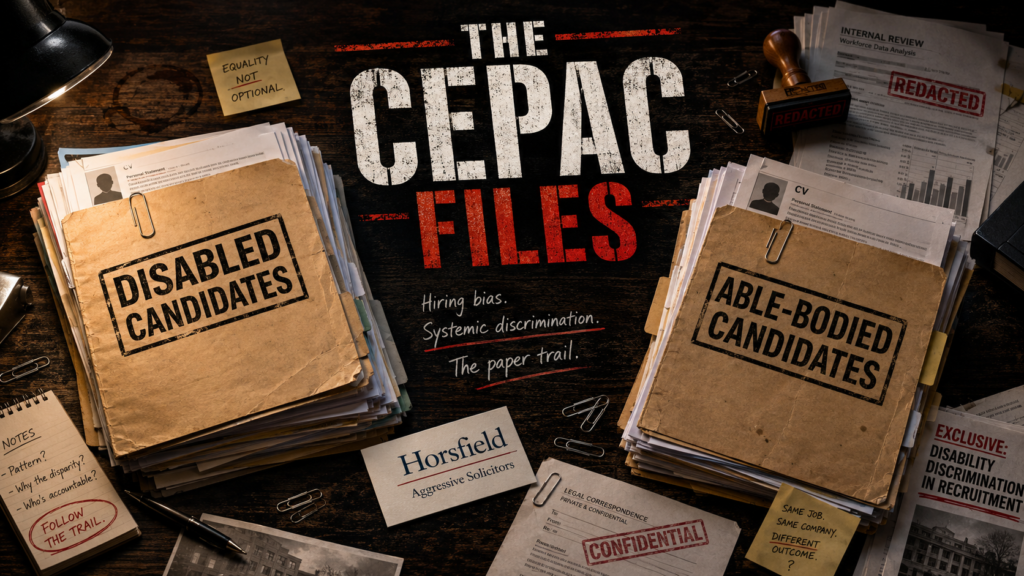
Cepac names Natural Trainer packaging in its own awards announcement. Behind the pet-food brand sits Affinity Petcare, with a business-partner code and a promise to handle ethical concerns. Here are the WhatsApp, Maria Walker’s reply, Cepac’s ET3 and the subsequent litigation record. The question is whether Affinity’s principles can produce an answer when the paperwork becomes less cuddly than the advertising.
Highly Commended Cardboard, Unanswered Questions
A dog can learn to bring you a slipper. A corporation can produce nineteen pages about ethical business and still require someone to explain what the bloody paperwork is for. Affinity Petcare has supplied the pages. Cepac has supplied the commercial connection. Between them sits a recruitment complaint with enough dated material to make a supplier assessment considerably more interesting than another reassuring questionnaire.
On 7 July 2025, Cepac announced its results from the FIA UK awards held the previous month. Among the entries was Natural Trainer – Straccetti packaging, which received Highly Commended recognition. Cepac names the work itself. Meanwhile, Affinity includes Natural Trainer’s activities in its own sustainability reporting. The route into this article comes from the companies’ publications.
The Natural Trainer Cepac connection therefore has a dated receipt. Affinity can establish who commissioned that work, which business supplied it and whether orders continued. It can also identify the standards governing that relationship. Those details belong in the answer, rather than disappearing beneath a general assurance that everyone involved takes everything terribly seriously.
TCAP previously mentioned the packaging in its awards investigation. This time, the judging concerns something beyond print quality. A well-produced box deserves its commendation. It cannot answer a recruitment complaint on its manufacturer’s behalf, however enthusiastically somebody strokes the finish.
The Rulebook Already Contains The Difficult Words
Affinity’s sustainability pitch connects animal welfare with the people and communities supporting its business. Natural Trainer’s Cani Eroi programme appears within that account, including work involving assisted therapy and education. Care, in this presentation, reaches beyond the feeding bowl. That is a substantial public promise, and it gives the company a useful standard against which to examine less photogenic circumstances.
Its Business Partners Code applies across suppliers and subcontractors, with compliance described as contractual. The employment provisions expressly cover hiring and prohibit discriminatory decisions based on disability and “medical evidence”. Psychological abuse, harassment and intimidation also fall within its prohibitions. These are operational expectations addressed to business partners, rather than an employee poster somebody accidentally left on the website.
Consequently, the test is concrete. Can Affinity examine a disputed recruitment decision involving disclosed health information? Will its assessment follow the complaint through the agency, employer and subsequent correspondence? A policy earns its keep when somebody uses it on awkward material. Otherwise, it becomes the corporate equivalent of an obedience certificate awarded to a dog that has just eaten the examiner’s trousers.
There is no need to invent a new mission statement. Put the existing commitments beside the documents below and explain the result. If that proves commercially uncomfortable, the discomfort is precisely where the ethics start doing some fucking work.
Before The Lawyers, I Told A Friend
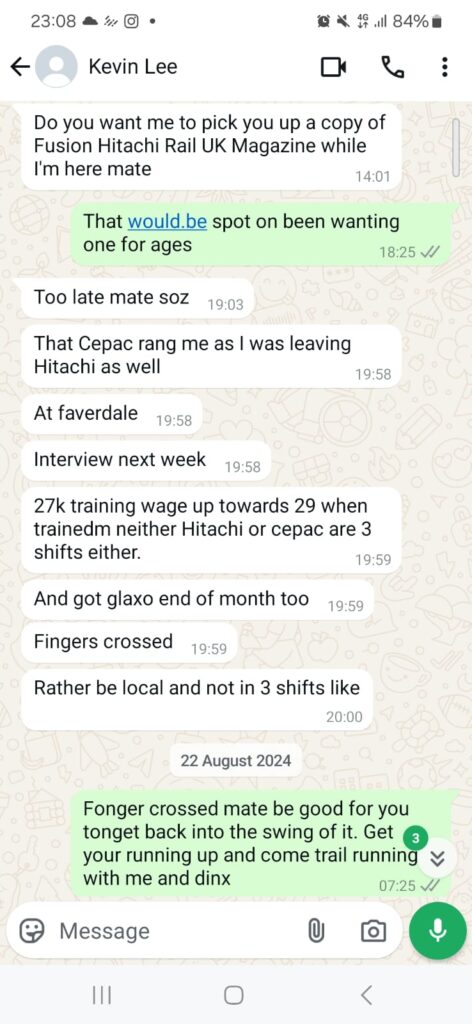
On 21 August 2024, Page Outsourcing called me about a production role at Cepac. During that conversation, the recruiter offered an interview for the week after the bank holiday. We discussed a £27,000 training wage rising towards £29,000. I also explained that my employment gap involved my mental health. Page would pass my details on, then call again to agree an exact interview time.
Afterwards, I sent a friend two WhatsApp lines: “Interview next week” and “27k training wage up towards 29”. This was an ordinary message about a possible return to work. Nobody needed a litigation strategy because there was no litigation. I had something hopeful to tell somebody, so I told them. Even that modest ambition eventually acquired a solicitor and a fucking invoice.
The friend retained the exchange and later supplied a supporting witness statement dated 20 February 2025. However, the promised confirmation call never arrived. The message preserves my account immediately after the recruitment conversation, including the timing and pay. It gives an investigator a contemporary record to compare with Page’s notes, any retained recording and the application history.
That comparison matters because the later explanation described a different position. Start with the call, establish what the recruiter offered and follow the decisions afterwards. The evidence has a date. It does not need a better personality before somebody reads it.
Maria Walker Offers Confusion As A Complete Meal
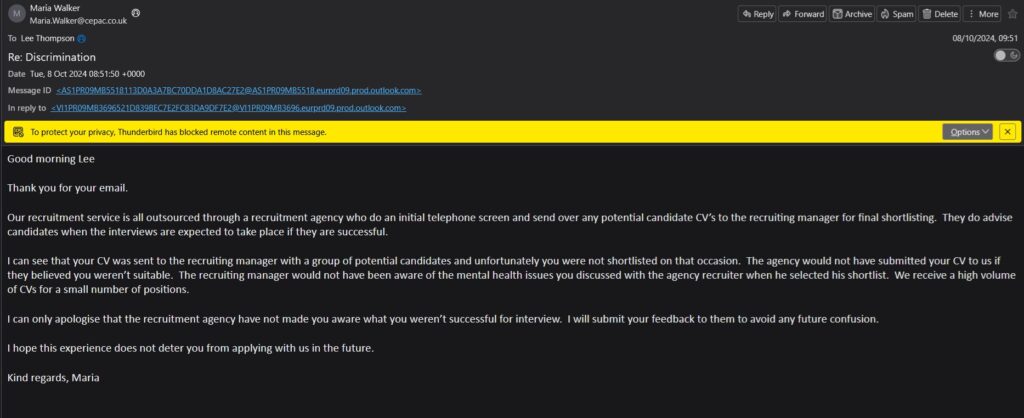
At 04:35 on 8 October 2024, I complained directly to Cepac. My email described the interview offer, the missing confirmation and the mental-health disclosure. Maria Walker, Cepac’s HR Business Partner, replied at 09:51. Her explanation set out an agency screening process followed by Cepac’s final shortlisting decision.
According to Walker, my CV reached the recruiting manager, but I was “not shortlisted on that occasion”. She maintained that the manager would not have known about the mental-health discussion. The apology concerned Page failing to explain that I had not secured an interview. Therefore, my complaint about an offered interview became a communication problem attached to an unsuccessful application.
Walker had not seen the WhatsApp when she answered. Meanwhile, the exchange had already preserved the interview and salary discussion from weeks earlier. That leaves an obvious enquiry: what records supported her account? An agency offering an interview prematurely, a later change of decision and an administrative failure would each require a different explanation. Confusion cannot identify which happened merely by sitting at the end of an HR email looking well groomed.
The response is piss-poor because it supplies a conclusion without resolving the account it answers. Affinity should ask for the records Walker examined and the checks behind her assurance about the manager. Fetch those first. Corporate reassurance can wait outside with the other things that have not learned to substantiate themselves.
Paragraph Fourteen Knows Where To Look
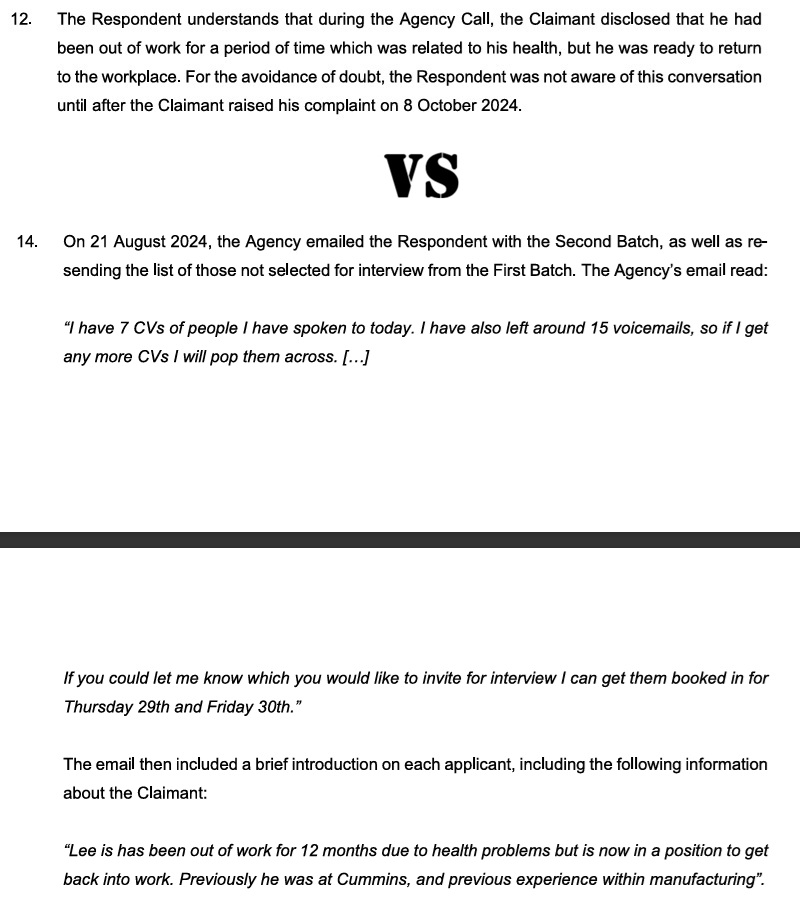
Cepac’s ET3, its formal response to the claim, supplies another dated record. Paragraph 12 places awareness of the detailed agency conversation about my health-related employment gap after the October complaint. Paragraph 14, however, describes an email Page sent Cepac on 21 August. That email contained information that I had spent around twelve months out of work because of health problems and was ready to return.
The defence therefore places health information inside Cepac during recruitment. Follow the August email and establish who received it. Next, examine where it went, when the shortlist decision happened and what reached the recruiting manager. The difference between company receipt and a particular manager’s knowledge is something the records can settle. Hand-waving cannot do the same job, even in an expensive suit.
Together, the documents create a precise line of enquiry. The WhatsApp records what I understood from the call. Walker explains the outcome in October. Cepac’s pleading identifies an August communication that an investigator can trace. Each has a different role, and their relationship needs examination rather than another helping of the same warm HR slurry.
Affinity now has a date, a sender and an identified communication to ask about. A supplier assessment could begin there tomorrow. The instruction is hardly beyond a business capable of tracing ingredients through a production chain: find the email, follow its recipients and explain the decision.
Michael Page Adds A Blackout Curtain
Page’s response to my data subject access request made parts of that route harder to follow. Names and passages appeared beneath redactions, with third-party information cited as the reason. The Page Partners investigation examines the disclosure. For this enquiry, the practical problem is straightforward: I asked for my recruitment data and received material that concealed parts of who handled it.
Nevertheless, a redacted copy does not erase the underlying records. Page can explain the application history while handling other people’s information appropriately. An investigator needs that account, including the decisions and communications behind it. Black rectangles are wonderfully economical witnesses, but their evidence consists entirely of shutting the fuck up.
The disclosed material also showed Page searching for my previous tribunal history after the complaint. Apparently, curiosity about the complainant survived the recruitment process rather better than the promised callback. Affinity should want the original question answered before anyone serves the applicant’s biography as a substitute. What happened to the interview, and who decided it?
Then The Solicitors Checked The Appointment Book
As the dispute developed, Horsfield Menzies contacted my medical centre about appointment availability and used the resulting information to oppose a postponement. Cepac’s solicitors were examining my access to an appointment while the recruitment complaint still awaited determination. That is the contact at issue, and the correspondence belongs beside the medical evidence and postponement request.
Stress affects my emotional regulation. Yet the case against my conduct gathered correspondence, complaints and publications while I challenged the pressure surrounding those responses. My criticism of bullying concerns that whole sequence: the treatment, the medical context, the reactions and their later presentation. Remove the circumstances and you produce a remarkably convenient specimen of an unreasonable man, neatly labelled for the bundle.
This is where the dispute became such a miserable bastard of an experience. I wanted an answer about a job interview. Instead, I had to contest how my healthcare arrangements and responses to pressure featured in a battle over whether the claim should continue. The original employment question remained underneath an increasingly expensive argument about the person asking it.
Any supplier assessment should read both sides’ correspondence and allow a response to competing accounts. Otherwise, the solicitors’ summary becomes the whole menu, with everything awkward quietly scraped into the kitchen bin. Affinity can examine the actual material and reach its own view.
The Court Result Goes In The File Too
The hearing on 24 April 2026 proceeded in my absence. Employment Judge James struck out my claims and ordered me to pay Cepac £20,000. Paragraph 116 of the judgment records combined costs schedules exceeding £50,000 in Cepac’s application, which its representative limited to £20,000 to avoid detailed assessment. The schedules and the award are different amounts, and both belong in this account.
The Tribunal found my conduct of the proceedings unreasonable, scandalous and vexatious. It also said my comments about the respondents’ solicitors lacked a reasonable foundation. However, it did not determine the recruitment discrimination allegations on their merits. The decision ended the claims without deciding the contested recruitment events at their centre.
I dispute the one-sided treatment of conduct when I had raised allegations about both parties. TCAP’s Newcastle Employment Tribunal investigation sets out the administrative failures, participation difficulties and medical context behind that criticism. Read it with the judgment and the underlying correspondence. Nobody assessing the supplier should receive an edited version that hides the findings against me.
Nevertheless, a finding about my litigation conduct cannot identify who read an August recruitment email. Nor can it explain the missing callback. Those questions survive because they concern different events. The cost of ending a case is not a receipt for answering it, however triumphantly someone waves the fucking total.
Do The Right Thing Has An Actual Procedure
Affinity calls its reporting channel “Do The Right Thing” and assigns oversight to its Ethics & Compliance Committee. Its published whistleblowing policy describes admission decisions, investigations and reasons for rejecting reports. It also promises independent handling and protection against retaliation for good-faith complaints. There is a process behind the slogan, which gives the company something more useful to demonstrate than another declaration of concern.
Separately, the partner code reserves rights to obtain information and inspect supplier records. It requires partners to provide confidential reporting routes, investigate reports and address breaches. Affinity can require corrective measures and suspend or end relationships where necessary steps towards compliance do not follow. The policy has consequences available; someone needs to decide whether the evidence warrants using them.
Here is the practical invitation. Tell me which team should receive the recruitment records, how it will assess the commercial connection and whether this concern falls within its remit. If another process applies, identify it. I can provide the supporting material and answer questions in writing. An actual route to examination would be welcome after so much procedural arse-about-face.
A reporting system should do more than ferry a complaint back to the subject and return with a reassuring pat on the head. Ask for a response, certainly. Then compare it with the documents and let the complainant address anything new. Otherwise, the supposedly independent assessment becomes a game of fetch in which the supplier keeps bringing back its own character reference.
Follow The Application Through The Business
For the Natural Trainer Cepac enquiry, begin with the purchasing history and the relevant contracts. Establish the commissioning route, the period of supply and the standards applicable then and now. Where the relationship has ended, provide the end date. That puts the commercial facts in order before anybody argues about responsibility.
Next, ask Page for its account of the August call, the candidate-status history and the email Cepac identifies. Trace the information through the employer and establish the timing of the selection decision. Walker’s October reply then needs its supporting records. Compare all of that with the WhatsApp and the recipient’s witness statement, rather than choosing whichever account arrives in the most respectable font.
Afterwards, examine how the complaint developed: the disclosure, the medical-centre contact, the correspondence and the judgment. Distinguish the findings the Tribunal made from the recruitment questions it did not decide. Invite my response before reaching conclusions about disputed events. These are manageable enquiries with identifiable documents, not an expedition requiring sherpas and a fucking helicopter.
The useful answer would explain what Affinity examined, what it concluded and what follows. Commercial confidentiality can protect purchasing detail without swallowing every meaningful finding. A company can give an intelligible account of its assessment while keeping its prices private. Nobody has asked it to staple the procurement ledger to a bag of dog biscuits.
Care Needs To Survive An Awkward Complaint
Affinity’s business depends on people trusting the care promised around its products. That makes the treatment of an inconvenient complaint a revealing test. Warmth is easy when the audience wants a feeding recommendation. The harder task arrives when somebody brings documents, dislikes the answers and refuses to perform gratitude for another brush-off.
A genuine assessment can disagree with me. It can identify a missing fact, explain a decision or produce records that alter the picture. TCAP will publish a substantive response and correct anything the evidence requires. That invitation matters because the point is an answer capable of surviving comparison with the material already available.
What will not do is a general statement about values with every practical question left untouched. That would turn the policy into a squeaky toy for the communications department: press the right spot, produce a reassuring noise, repeat until the audience gets bored. Meanwhile, the recruitment decision would remain unexplained and the applicant would still have no answer.
So, Affinity, put the concern through the process you publish and show what comes out. The message has a date, the HR response has an author and the defence identifies an email. There is plenty to investigate. You have built a business around care; now show whether that care can tolerate evidence with rough edges. Do the right thing. Open the bloody file, and give us something with more substance than premium bullshit in a resealable pouch.
Lee Thompson – Founder, The Cummins Accountability Project
Sources
- Cepac: Best In Show At The FIA UK 2025 Awards
- Affinity Petcare: Sustainability
- Affinity Petcare: Ethical Commitment
- Affinity Petcare: Business Partners Code Of Conduct
- Affinity Petcare: Whistleblowing Channel Policy
- TCAP : Thirty Trophies, Twelve Pernod Ricard Boxes And Harry Potter’s Missing Fucking Award
- TCAP : KFC II, Maria Walker And The Interview Receipt
- TCAP : Page Partners, Redactions, Panic Calls And The Disabled Candidate They Googled
- TCAP : Newcastle Employment Tribunal, Deliberate Maladministration
- Employment Tribunal: Thompson v Cepac Limited And Page Outsourcing UK Limited