
Two public display projects connect Walker’s Shortbread to Cepac. Meanwhile, the biscuit maker puts suppliers inside its ethical-trade promise and calls itself Disability Confident. So where does a disabled applicant at its packaging supplier take a vanished interview, a same-day WhatsApp record and an HR explanation that fails to settle the contradiction? Somewhere beyond an employee handbook he cannot use would be a start.
Two Displays And An Unexpected Ingredient
Walker’s Shortbread knows how to package reassurance. Tartan, butter, family history and a tin that will eventually hold somebody’s sewing kit. Everything has its place. Unfortunately, the Walker’s Shortbread Cepac connection comes with an extra ingredient: a recruitment dispute that refuses to fold neatly underneath the biscuits.
The commercial evidence is specific. POPAI’s 2024 gallery lists a Walker’s trade-show point-of-sale project under Cepac Display, with Walkers Shortbread Ltd named as the client. A second entry identifies the same pairing for a pop-up freestanding display unit. These are two named projects in an industry record, rather than a speculative leap from a red box glimpsed behind a forklift.
Those entries establish work recorded in 2024. They do not establish a continuing contract in October 2026. Walker’s can clarify the present relationship, the contracting company and, if relevant, when the work ended. That is a straightforward purchasing-record question, with considerably less mystery than the average biscuit assortment.
However, the ethical question reaches further. Walker’s publishes standards about suppliers and fair treatment. Cepac’s record includes a promised interview, health information moving through recruitment, an HR denial and litigation that ended without deciding the discrimination claim. Those facts deserve a named person, an examination and an answer. They should not spend eternity wedged between procurement and a decorative fucking mission statement.
The Values Travel Further Than The Handbook
Walker’s Ethical Trade Policy, approved on 21 March 2025, expressly includes the suppliers it uses. Its definition concerns confidence that production does not come at employees’ expense. The directors hold overall responsibility, while HR supports procedures and implementation. Thus, the supplier belongs inside the ethical picture Walker’s has chosen to publish.
Elsewhere, the policy rejects discrimination, including disability discrimination, throughout employment. It also rejects abuse, harassment and intimidation towards its employees. Those passages describe Walker’s own employment commitments. Consequently, the question is what equivalent expectations Walker’s places on suppliers, and how it applies them when someone supplies evidence of a recruitment problem.
Its careers site makes the public promise even clearer. Walker’s presents itself as a Disability Confident employer and advertises equal opportunities. Integrity and responsibility sit among its stated values. A brand that understands why those principles matter at its own front door should be able to explain their relevance at the door of a company it buys from.
Nobody needs another embossed declaration about how terribly important people are. The stationery cupboard can barely close already. Instead, Walker’s needs to say whether disability equality influences supplier selection, review and complaints handling. Otherwise, the values risk becoming a tartan tablecloth: attractive from a distance, useful mainly for concealing whatever bastard mess sits underneath.
A Door Marked Employees Only
The published Whistleblowing Policy creates the practical question. Its reporting instructions address employees who witness wrongdoing relating to Walker’s. Meanwhile, it directs personal grievances about bullying, harassment or discrimination towards the Walker’s Handbook. That makes sense as an internal arrangement. It does not explain where a rejected applicant at a supplier should take his documents.
I never worked for Walker’s. My complaint concerns recruitment through Page Outsourcing for Cepac. Therefore, a route into Walker’s employee procedures would leave me standing outside the wrong building, clutching evidence while somebody helpfully explains where staff keep their coats. The policy’s broad concern with wrongdoing still needs a usable entrance for this situation.
This article asks Walker’s to identify that entrance. It does not record an earlier refusal by Walker’s, nor establish that the company has no other reporting channel. The gap is in the published explanation. If a written route exists for supplier applicants, Walker’s can identify it, name the responsible team and explain what happens after the evidence arrives.
That answer matters because ethical sourcing needs information from people who never make it onto a supplier’s payroll. A recruitment complaint can concern the very process that kept somebody outside. Excluding those people from practical scrutiny would give the gatekeeper a wonderfully convenient power: reject the applicant, then declare that the complaints system only recognises employees. Some ingenious little shit could call that efficiency.
Before The Lawyers, There Was A WhatsApp
On 21 August 2024, Page Outsourcing called me about a production role at Cepac. We discussed an interview for the week after the bank holiday and a training wage of £27,000, rising towards £29,000. During that conversation, I explained the mental-health circumstances behind my employment gap. Page said a further call would settle a suitable interview time. It never came.
However, I had already told a friend what happened. My same-day WhatsApp message recorded “Interview next week” and “27k training wage up towards 29”. This is my contemporaneous account to another person, not an offer written by the recruiter. Its importance lies in its timing and specificity. The interview and salary appear together before a complaint, tribunal pleading or legal argument existed.
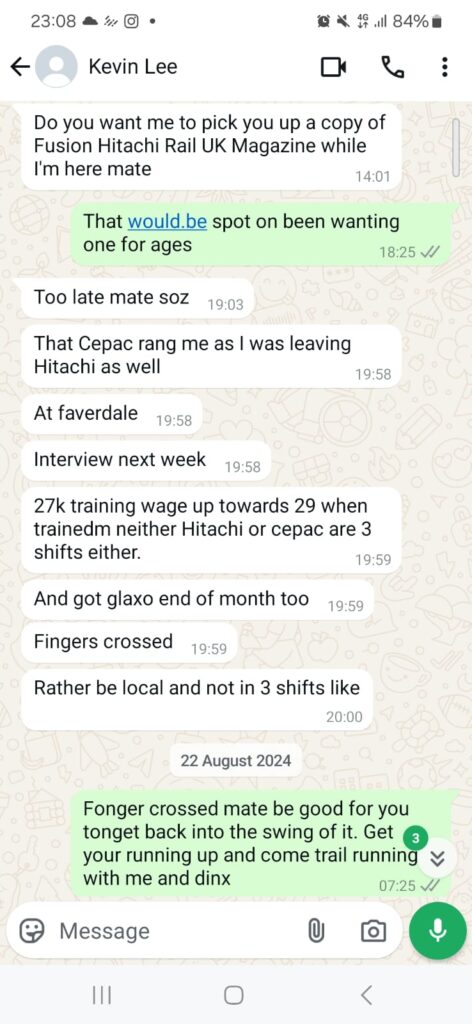
The friend’s statement, dated 20 February 2025, supports the message’s origin and context. Together, they give an investigator something concrete to compare with Page’s records. Ask what the caller offered, what the system recorded and why no confirmation followed. Those are ordinary questions, although they apparently require more excavation than a fucking Roman villa.
For Walker’s, the relevance is simple. A supplier complaint arrives with a dated account that predates the dispute. Any serious review should examine that record alongside the recruiter’s explanation. The complainant’s later tone cannot travel backwards and rewrite his WhatsApp.
Maria Walker’s Reply Changes The Story
At 04:35 on 8 October 2024, I complained to Cepac. The email described the interview offer, the expected timing, the promised follow-up and my mental-health disclosure. Maria Walker, Cepac’s HR Business Partner, replied at 09:51. She said my CV had reached the recruiting manager but that I was “not shortlisted on that occasion”.
Her explanation placed the failure with Page’s communication. According to the reply, the manager would not have known about my mental-health discussion with the agency. Page should have explained that I had not secured an interview. Thus, the offered interview in my account became a failed shortlisting exercise in hers, with confusion doing the heavy lifting between them.
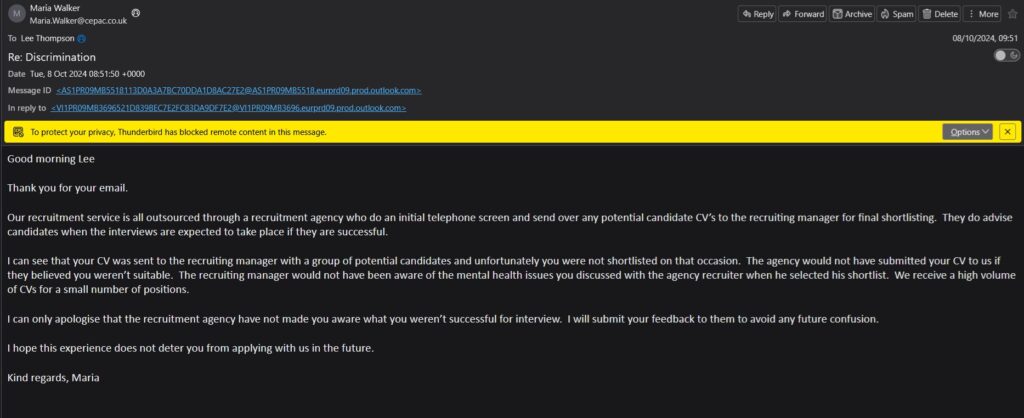
Walker had not seen the WhatsApp when she answered. That sequence matters, because her account now has to sit beside a record she did not address. Neither a corporate job title nor a courteous sign-off resolves the disagreement. Somebody needs to identify what she checked, who supplied the shortlisting explanation and whether Page’s contemporaneous records support it.
The KFC II article brought this evidence together. Here, it lands beside another customer’s ethical promise. Walker’s Shortbread need not adjudicate the whole dispute to recognise an unresolved recruitment question. It can ask for the records. Even a biscuit company should know the difference between an explanation and a lid.
Paragraph Fourteen Leaves Crumbs
Cepac’s ET3 adds a further problem. Paragraph 12 places its awareness of the detailed recruitment conversation after my October complaint. Yet paragraph 14 identifies an email from Page to Cepac on 21 August. That email conveyed that I had spent around twelve months out of work because of health problems and was ready to return.
The distinction needs care. Receipt by Cepac does not automatically prove that a particular manager knew a diagnosis or read a particular message. Nevertheless, health-related information reached the company during recruitment. Therefore, the useful inquiry concerns its route: recipients, access, timing, onward communication and the decision that followed.
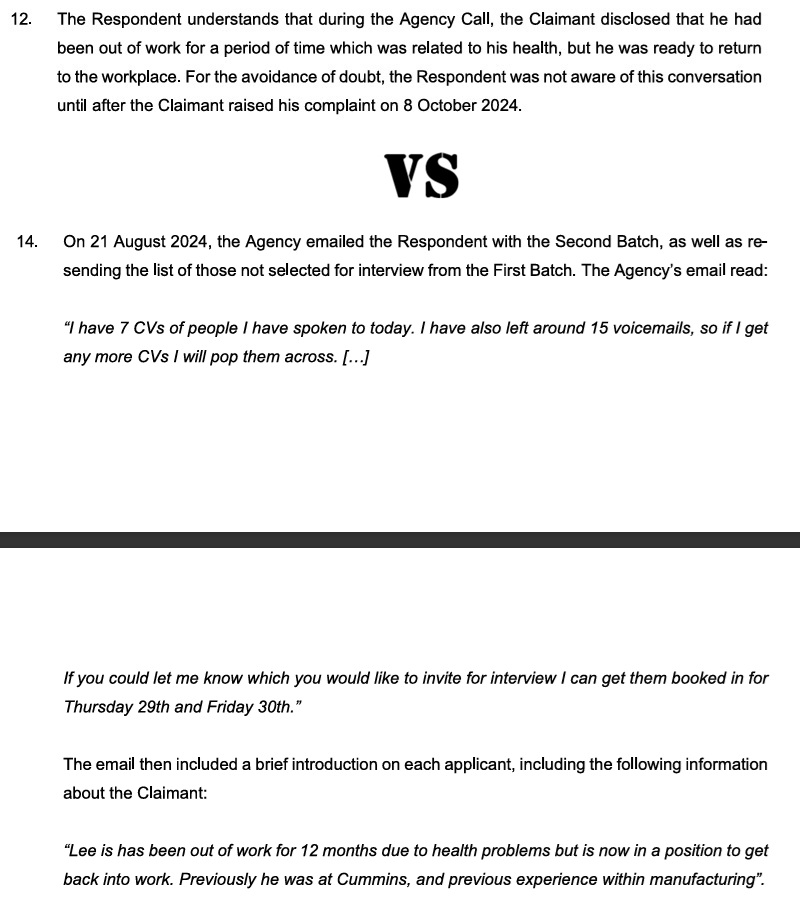
Set that beside Walker’s response and the WhatsApp. An interview appears in my same-day message. Cepac later says I never reached the shortlist. Its defence nevertheless identifies health information arriving from Page on the day of the call. These are records with dates, people and a sequence. They demand comparison, however inconvenient the resulting paperwork might become.
A supplier review should follow that trail before accepting a reassuring summary. Otherwise, the exercise resembles checking a biscuit tin for damage by asking the lid whether everything underneath is splendid. Of course the lid says yes. The bloody thing has one job.
Page’s Blackout Does Not Supply An Answer
Michael Page belongs in this file because its outsourcing operation handled the recruitment. My account of the subject access disclosure describes redacted names and passages, with third-party information cited as the reason. The material also records later attention to my previous tribunal history after I complained. Redaction can have a legitimate basis; nevertheless, black bars do not answer who knew what during recruitment.
Therefore, Walker’s should ask what underlying records can resolve the chronology: the call record or recording if one exists, candidate-status changes, the 21 August email and the basis for the explanation given to Maria Walker. It should also ask which records each company holds and what it can disclose to support a review. An incomplete window into a system should prompt questions about the missing view.
The contrast remains ugly. The original issue concerned what happened when I applied for work. Subsequently, my history became an object of investigation. That shift deserves scrutiny because researching the person who complains can create a vast diversion around a very small unresolved question. What happened to the interview?
A human-resources operation ought to manage that question without turning the applicant into an archaeological dig. Yet every extra shovel through my past leaves the original recruitment decision unexplained. The awkward question remains, regardless of how neatly the biscuit display folds flat for transport.
Horsfield Menzies And The Conduct Factory
Then came the legal machinery. Horsfield Menzies, acting for Cepac, contacted my medical centre about appointment availability and used the information to oppose a postponement. That was a query about availability, not access to my full medical records. Even so, I regard an opponent probing my healthcare arrangements to resist an adjustment as an intrusion that demands explanation.
Meanwhile, the litigation increasingly centred on my correspondence, complaints and publishing. I maintain that Cepac’s approach applied pressure, harvested disability-related distress and presented the resulting language as a separate conduct problem. Once that conversion takes hold, the recruitment documents compete for attention with a dossier about the person asking to have them examined.
My account of Newcastle Employment Tribunal’s handling sets out the administrative failures, medical context and decisions I challenge. Those issues form part of my criticism of how this case ended. They explain why I reject the neat story in which an unreasonable claimant simply ruined an otherwise immaculate process.
The mechanism deserves scrutiny in its own right. A supplier can produce an enormous file about an applicant’s reactions while leaving the recruitment sequence unresolved. Procurement then receives a polished summary: difficult individual, litigation concluded, nothing further required. What a convenient little shit-laundering service that would be. Walker’s should ask for the underlying record before accepting the packaging.
What The Carefully Curated Judgment Decided
The adverse judgment belongs in this account. Following the hearing on 24 April 2026, which proceeded without me, the Tribunal struck out my claims and ordered £20,000 in costs to Cepac. It found my conduct unreasonable, scandalous and vexatious. It also said my comments about the respondent’s solicitors lacked a reasonable foundation. Those findings are serious, and a supplier reviewer should read them.
However, the decision did not determine whether disability discrimination occurred in recruitment. It did not resolve the interview discrepancy or trace the health information through the decision-making process. I challenge its treatment of my conduct and the circumstances surrounding it. The judgment’s existence does not turn those unanswered questions into findings in Cepac’s favour.
Paragraph 116 also records that Cepac’s combined costs schedules exceeded £50,000. Its representative limited the application to £20,000 to avoid detailed assessment. That figure concerns Cepac’s schedules, rather than a combined bill for both respondents. The scale of the litigation therefore has a documentary anchor, however comforting a shorter corporate summary might sound.
For Walker’s, reading the outcome properly means keeping its scope intact. The Tribunal made findings about conduct and costs. The recruitment merits remained undecided. A customer that treats the first as an answer to the second would be making its own analytical mistake. There is already enough bullshit in this file without procurement contributing a fresh layer.
The Supplier Machinery Already Exists
Walker’s modern-slavery statement describes supplier checks, reviews and monitoring. It requests supplier participation in Sedex and access to ethical self-assessment information. It also describes sanctions, including termination, for failed action plans or serious violations of relevant policies. Thus, Walker’s already presents itself as capable of questioning suppliers and acting on findings.
That statement addresses modern slavery; a discrimination complaint is not automatically a slavery allegation. Its relevance here is the existence of an oversight process. Walker’s can explain whether that process, another policy or a separate review covers recruitment discrimination. It can also identify who decides when a complaint requires closer examination.
The practical test is whether the organisation can receive inconvenient information from outside its approved forms. A questionnaire records what someone says about their systems. A dated email may show what happened inside them. Consequently, a credible review needs room for both, including evidence that arrives from a person the supplier would rather stop hearing from.
For this Walker’s Shortbread Cepac case, the documents are specific enough to support focused questions. The task does not require Walker’s to absorb every argument in the litigation or endorse every word I have written. It requires someone to examine the recruitment evidence and explain the applicable standard. If ethical trade cannot accommodate that much discomfort, the tin has more substance than the promise inside it.
Take The Lid Off
Walker’s should begin with its own records and confirm the commercial relationship. Then it should identify the standards it expects of that supplier, including any requirements concerning disability, recruitment and treatment of complainants. A director responsible for ethical trade should be able to assign those questions without convening a séance around the purchase ledger.
Next, provide a written route for the evidence and name the team that will assess it. Compare the WhatsApp, Walker email and ET3 with the underlying recruitment records. Ask Cepac and Page to explain the differences. Finally, state what findings emerge, what further information remains necessary and what action follows under the applicable policy. That is a review with an outcome, rather than a complaint passed around until everybody develops selective amnesia.
The evidence does not disappear because it arrives with anger attached. Nor does a warm careers page answer a question about a supplier’s conduct. Walker’s has the opportunity to show that its public commitments survive contact with an awkward person and an inconvenient file. The standard should be clear enough to apply when the paperwork spoils the mood.
The biscuits can stay neatly arranged. This complaint cannot. It contains an interview that never happened, two accounts that require reconciliation and health information with a route still worth tracing. Walker’s put suppliers inside its ethical promise. Now it can show where the evidence goes when somebody takes that promise seriously. Open the tin. Read the fucking documents.
Lee Thompson – Founder, The Cummins Accountability Project
Sources
- POPAI Awards Gallery 2024: Short Run – Temporary Display
- POPAI Awards Gallery 2024: Grocery & General Merchandise – Temporary Display
- Walker’s Shortbread: Ethical Trade Policy
- Walker’s Shortbread: Whistleblowing Policy
- Walker’s Shortbread: Modern Slavery And Human Trafficking Statement
- Walker’s Shortbread: Careers
- TCAP – The Cepac Files : KFC II : Maria Walker And The Interview Receipt
- TCAP – Page Partners Cepac Limited : Redactions, Panic Calls And The Disabled Candidate They Googled
- TCAP – Newcastle Employment Tribunal : Deep Dive – Deliberate Maladministration
- Employment Tribunal: Thompson v Cepac Limited And Page Outsourcing UK Limited