
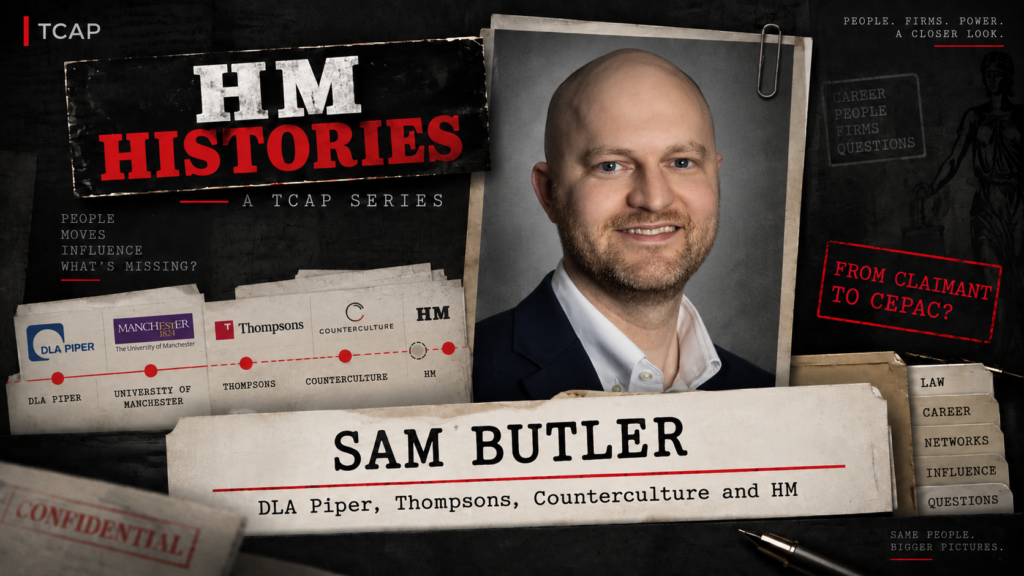
Sam Butler at Thompsons takes HM Histories to a firm built around defending workers. We have followed him through DLA Piper and the University of Manchester. Now comes the employee-and-trade-union chapter of the CV: reassuring territory, apparently, until you open a disciplinary judgment and find redundant workers receiving updates about proceedings that no longer existed.
Years before Butler joined, a senior employment lawyer at Thompsons let claims be struck out and then concealed what had happened. On 8 November 2012, Jean Etienne Attala supplied this splendid little reassurance: “I’ve been promised a notice of hearing in the post today or tomorrow”. The proceedings had already been struck out in November 2011. Somewhere between professional confidence and the outgoing mail, litigation had become a fucking séance.
Butler’s career supplies our route into this history. Attala’s conduct belongs to Attala. The institution connecting them sells expertise in protecting working people. Sam’s career brochure will therefore be getting considerably less reverence than its authors might prefer. A familiar name on a CV is an invitation to open the cupboard, and TCAP has never been particularly good at standing outside politely.
Sam Butler At Thompsons: The Workers’ Side Of The CV
In his Horsfield Menzies joining interview, Butler explained that he moved to Thompsons “to develop my employee and trade union representation”. Tribunal work formed the focus. The University of Law independently places him there in July 2021, introducing him as an employment solicitor during a social-mobility event.
That is a useful piece of his professional history. Sam has worked with people trying to enforce employment rights. His experience extends beyond explaining to management how to navigate an awkward claim. Consequently, when his current profile advertises collective redundancy and tribunal litigation, readers can reasonably expect some understanding of what the process feels like from the claimant’s chair.
The biography packages this beautifully. Each employer becomes another polished credential, each move another opportunity to develop. What a lovely little procession of professional self-improvement; apparently every stop on the bastard railway deserves flowers. Meanwhile, the people who needed those institutions receive considerably less space. A career paragraph can accommodate global deals, expertise and personal growth without disturbing itself over the poor sod waiting for somebody to answer the phone.
HM Histories makes room for that person. Sam’s professional development can survive sharing a page with the history of the firms that supplied it. If the resulting portrait looks less like a recruitment brochure, that is a problem for the brochure.
Sunderland: The People Behind The File
The Attala proceedings followed a site closure in Sunderland. The disciplinary judgment records 106 claimants seeking unpaid redundancy pay and 754 seeking notice pay.
For a worker leaving a closed workplace, such money can be painfully practical. It may cover rent, food or the interval before another wage arrives. Legal correspondence turns that insecurity into manageable headings. A solicitor has a file reference; the person behind it still has a life to keep running.
In September 2011, the employment tribunal warned that the proceedings risked strike-out because nobody was actively pursuing them. Attala said he was seeking instructions, but failed to provide the substantive response required. The claims were struck out, and a review in March 2012 upheld that outcome.
There is a particular cruelty in needing expert help and having no easy way to check whether the expertise is doing anything. Clients cannot reasonably be expected to run a parallel legal practice from the kitchen table. They instruct a professional because the machinery is unfamiliar. Trust is part of what they are buying, even when their union arranges the representation.
The Hearing That Never Happened
Afterwards, Attala kept telling clients and the GMB that matters were progressing. His updates advanced through the familiar stages of litigation: a hearing expected, a hearing supposedly arranged, a legal issue awaiting determination. The Bar Standards Board’s later findings expressly record these false accounts.
Consider the practical effect of that fiction. A client who believes a decision is imminent has a reason to wait. Another reassuring message can postpone another awkward question. Professional language makes the delay sound purposeful, while the person receiving it has fewer reasons to seek a second opinion.
The absurdity is almost comic until you remember who was waiting. This was legal theatre with an audience who had come for their wages. The scenery looked convincing because the correspondence borrowed the ordinary furniture of a real case. Behind it, there was fuck all happening to justify the story.
A useful update should allow a client to understand their position and make decisions. A fabricated one does the opposite. It spends somebody else’s time to protect the person writing it. That is why the offence goes beyond an embarrassing administrative cock-up. The lie interferes with the client’s ability to respond to the original failure.
Teaching Rights While The File Went Wrong
An additional piece of the contemporary record deserves daylight. The September 2011 edition of RMT News carried an article by Etienne Attala of Thompsons about the new Agency Workers Regulations. On page 17, he explained the protections and the possibility of seeking redress through an employment tribunal.
That was the same month in which the tribunal warned that the Sunderland proceedings could be struck out. The magazine article and the threatened claims concerned different matters, but the juxtaposition is extraordinary: public instruction about enforcing rights, alongside private casework already attracting a warning about inactivity.
The lesson for readers reaches beyond one lawyer. Fluency is persuasive. A confident explanation of legal rights can make its author appear dependable before anyone has inspected the actual work. The profession benefits enormously from that assumption. Published expertise deserves verification as well as respect. Being able to explain how a bridge works does not establish that you have checked the bastard bolts.
For Sam Butler’s career history, that distinction matters. The employers, titles and public-facing expertise establish experience. Assessing how professional power serves the person relying on it requires a closer look.
What Thompsons Did Next
Clients’ enquiries through the GMB prompted an internal file review in 2013. Attala initially resisted producing the file and supplied further false explanations. He eventually admitted the deception. Thompsons investigated and dismissed him.
The firm also gave a substantive public response. It said it had acted immediately on discovering the problem to ensure that affected members did not lose out, and that the incident informed its continuing review of supervision. That response is part of the history, including the remedial action the firm said it took.
Nevertheless, eventual repair and earlier detection answer different questions. A cheque may address a financial loss. It cannot return the months during which somebody trusted an invented account of their case. Nor does dismissing the individual, necessary as that may be, tell the client which control will catch the next failure sooner.
Thompsons’ statement therefore provides the starting point for scrutiny. Which checks compare a lawyer’s updates with the tribunal’s actual orders? How does a warning about inactive proceedings reach somebody beyond the person handling them? What changed after this episode? Those are questions about the service people rely upon, and they deserve answers with more substance than the usual lessons-learned horseshit.
Attala raised depression in mitigation, explaining that it affected his decision-making. The disciplinary tribunal considered his medical evidence and admissions, found dishonesty and struck him off in September 2015. The Bar disciplinary process subsequently resulted in disbarment.
From Union Representation To Cepac
Butler’s later work brings this history back to TCAP’s own doorstep. Having developed employee and trade-union representation at Thompsons, he went on to act for Cepac in my disability-discrimination proceedings. His current firm explicitly markets its services to employers and senior executives. The direction of the professional journey is clear enough.
I have already documented his March 2025 correspondence in The Cepac Files: the estimated £25,000–£30,000 in costs, the invitation to withdraw and his description of my conduct as “quite frankly bizarre and utterly vexatious”. That is the Butler whose reassuring career narrative I am examining. The former employee representative knew something about the territory on both sides of the table.
My claim ultimately ended in strike-out and a £20,000 costs order. The tribunal accepted the respondents’ conduct arguments and found that a fair trial was no longer possible. I dispute its reasoning. The underlying recruitment-discrimination allegations did not receive a merits determination.
For me, Butler’s worker-representation background makes the costs pressure especially contemptible. A lawyer with that experience should understand what a five-figure warning means to somebody trying to enforce employment rights without an employer’s resources. My objection concerns the use of that expertise and its human consequences. Reading the worker-representation paragraph beside that correspondence, I find the reassuring professional packaging a monumental piss-take. I have no intention of supplying the deferential smile.
Sam can advertise the breadth of his experience. I can examine where that experience came from and what I think of the way he deployed it. Professional self-promotion does not come with a contractual entitlement to applause, however fucking accustomed the profession becomes to hearing it.
The Whole History Comes With The Name
Thompsons presents itself as a firm committed exclusively to injured and mistreated claimants. Its public history includes substantial work advancing workers’ rights. Those achievements make the responsibility attached to its name greater: people arrive expecting protection, competence and a truthful account of what is happening.
The Attala episode belongs in that history alongside the victories and the firm’s response. It exposes how much clients can depend on a narrative they cannot readily verify. A claim exists in the tribunal’s records, but to the person waiting at home it also exists through letters, calls and promises. That second version can acquire a terrifying life of its own.
This is why HM Histories follows the names in Butler’s biography. Institutions supply reputations as well as employment. Once those reputations become part of a lawyer’s sales pitch, their less flattering records remain fair subjects for examination.
Sam Butler at Thompsons is a line about professional development. Read more widely, it becomes an invitation to consider the workers for whom legal competence was supposed to deliver something tangible. They deserved accurate information, effective representation and the chance to make informed choices about their own claims.
A hearing notice promised tomorrow is reassuring only while somebody is telling the truth. Otherwise, it is a dead case in a clean shirt, and the poor bastard waiting for it has been asked to mistake the costume for a pulse.
Lee Thompson – Founder, The Cummins Accountability Project
Sources
- Horsfield Menzies – Welcome Sam Butler: his career route and employee-and-trade-union work at Thompsons
- Horsfield Menzies – Sam Butler: current profile and employment-law expertise
- University of Law – Diversity Matters: July 2021 event identifying Butler as a Thompsons employment solicitor
- Solicitors Disciplinary Tribunal – SRA v Jean Etienne Attala, case 11360-2015: agreed facts, correspondence, mitigation and findings
- Legal Futures – Solicitor expelled from profession for lying about progress of struck-out cases, 14 October 2015: chronology and Thompsons’ response
- Bar Standards Board – Jean Etienne Attala: disciplinary findings and disbarment
- Legal Futures – Dual-qualified lawyer disbarred for persistent dishonesty, 25 January 2016
- RMT News – September 2011, page 17: Etienne Attala on agency workers’ rights
- Thompsons – About the firm: history and commitment to claimant representation
- Horsfield Menzies – About the firm: services for employers and senior executives
- Employment Tribunal – Thompson v Cepac Limited and Page Outsourcing UK Limited: April 2026 strike-out and costs judgment
- TCAP – The Cepac Files: Horsfield Menzies – Executing Their Advertised Tactics
- TCAP – Sam Butler At DLA Piper: Churn That Bill, Baby
- TCAP – Sam Butler At Manchester: Fences Up, Wages Down