

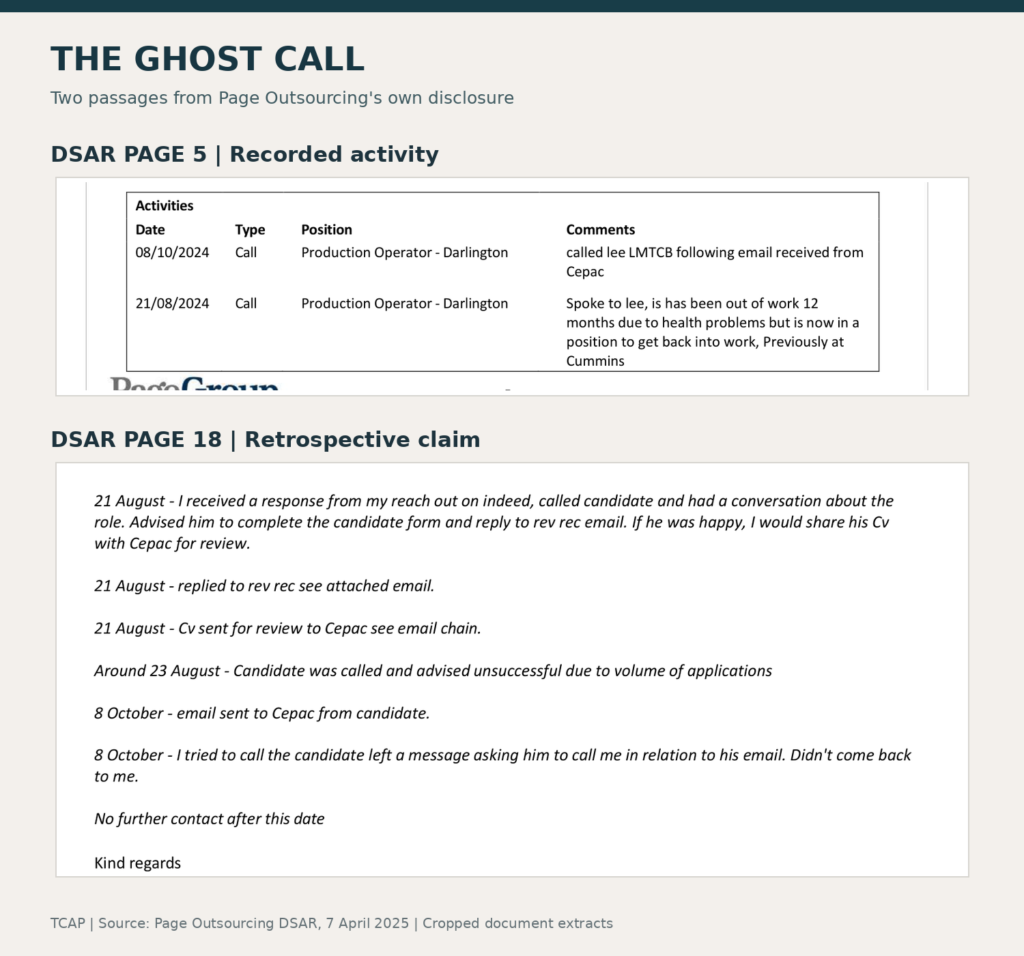
Page Outsourcing UK Limited says it rejected a disabled candidate by telephone. Its disclosed activity history records the first call and the later complaint-stage call – but not the supposed rejection. That is merely what survives in the redacted version. For a business selling recruitment integrity, the implications are fucking spectacular.
The documents concern Page Outsourcing UK Limited, the second respondent in my Employment Tribunal claim and a company within the Michael Page group.
There is a telephone call wandering around Michael Page’s recruitment records like a ghost that has discovered the benefits of corporate employment. Nobody has produced its voice, its duration, its telephone-system record or a dated activity entry showing that it reached me. Nevertheless, it has enjoyed a magnificent career. It has explained away an interview that never materialised, supplied a convenient answer to a discrimination complaint and appeared in a retrospective account assembled when litigation was approaching.
Its alleged appointment date? “Around 23 August” 2024. Apparently, even the ghost doesn’t know exactly when it clocked in.
Page Outsourcing says the call happened. I say it did not. More importantly, Page’s own 100-page subject access disclosure provides a dated activity history recording a recruitment conversation on 21 August and an attempted follow-up on 8 October, but no rejection call in between. The person supposedly contacted has denied receiving it throughout. Two years later, the only contemporary August rejection-call record I have been shown remains conspicuous by its absence.
The Missing August Call
This is the heart of my allegation. I suspect Page Outsourcing’s account of a completed rejection call was invented or retrospectively adopted to protect its client, Cepac, from having to explain what happened after I disclosed health problems. That is my allegation and inference, not an adjudicated finding. The documents establish a serious discrepancy, not conclusive proof of fabrication. A real call might have been logged somewhere else, or an existing candidate-status note might have been mistaken for evidence of a conversation. Both possibilities are testable.
Yet the explanation has survived remarkably well without the one thing that could settle it: the original, auditable record. Convenient little bastard, isn’t it? And this is only the paperwork Page chose to show me after removing material from the disclosure. The visible record already fights with the later explanation. Imagine asking customers to entrust their recruitment reputations to that standard of housekeeping.
Start With The Job, Not The Lawyers
On 13 August 2024, I expressed interest in a production-operator vacancy at Cepac’s Darlington operation. The position was not an imaginary opportunity dreamed up to create an employment claim. Page’s own recruitment material advertised a starting salary of £27,607, rising to £28,984 after probation, with rotating day shifts and a potentially substantial production bonus.
On 21 August, Page telephoned me. I maintain that the conversation included an interview for the following week, with a further call promised to confirm a suitable time. I was asked about my extended absence from work and explained that it related to treatment for a mental-health condition. After that conversation, no interview confirmation arrived.
Page’s own dated activity entry confirms that the conversation happened on 21 August. The dispute is about what was said. That evening I told a friend on WhatsApp that I had an interview the following week and discussed a training wage rising towards £29,000. That exchange was made before any complaint, legal proceeding or corporate explanation existed. It records my immediate understanding of the call, not a written invitation from Page. The recipient subsequently supplied a signed witness statement, dated 20 February 2025, corroborating the origin and timing of those messages.
The promised follow-up did not arrive. That is why the actual conversation, the candidate-status audit and the alleged later rejection call deserve examination. A company can argue that its recruiter discussed an opportunity rather than making a firm appointment. It cannot resolve what was said merely by pointing to a later summary written after a complaint.
The Health Disclosure Arrived At Cepac In August
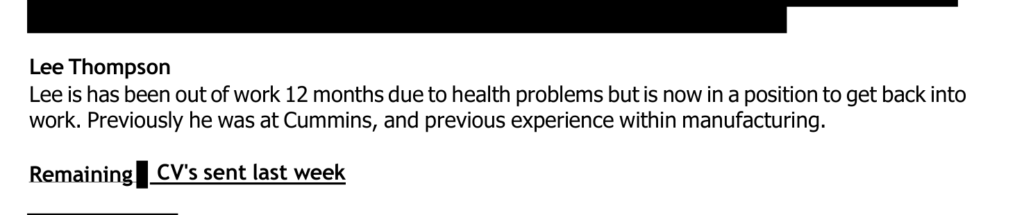
Here is a fact that does not require much interpretation. In its 21 August candidate-introduction email, Page included me among the people being put forward and told Cepac that I had been out of work for twelve months because of health problems but was now ready to return. The note also described my earlier Cummins employment and manufacturing experience.
That was the communication, in writing, at the recruitment stage. Health-related information travelled from the agency to the employer. It did not first materialise in October when I complained.
This point needs to be kept exact. “Health problems” did not tell Cepac the diagnosis I had discussed with the recruiter; nor does the existence of an email establish which recruiting manager read the introduction or what influenced the shortlist decision. Company receipt, individual knowledge and discriminatory motive are three different evidential questions. But an employer cannot sensibly explain the August communication away by pretending the company received no health-related information until the complaint arrived.
Cepac’s eventual ET3 makes the same chronology unusually awkward. Paragraph 12 puts awareness of the fuller health-related recruitment conversation after my October complaint, while paragraph 14 refers to Page’s August introduction containing the health-related work-gap information. It is an issue of scope and knowledge that demands reconciliation, not a magic admission that a discrimination claim has been proved.
The CV Became Three Different People
Before anyone asks me to accept Page’s word about an August telephone call that is missing from its disclosed activity history, perhaps the recruitment experts could explain what the fuck they did to my CV. The comparison isn’t between my memory and theirs. It is between my original CV, Page’s reformatted candidate CV and Page’s own stored candidate profile – all reproduced inside the same 100-page disclosure.
My original CV gives my Cummins employment as February 2018 to December 2019, followed by March 2020 to February 2023. It separately labels February 2023 onwards as a sabbatical, describing time spent on personal well-being, family responsibilities and self-directed learning. Red Architectural Ltd appears as a site-labouring job from June to December 2005. Those are not particularly difficult entries to copy. One would hope a recruitment agency had encountered a calendar before.
But turn to page 4 of Page’s disclosure. Its structured employment history records Cummins only from 1 February 2018 to 31 December 2019. The entire March 2020–February 2023 stint is absent from that entry. Then the database performs a splendid feat of corporate resurrection: it lists Red Architectural Ltd from 1 February 2023 to “present”, under a description lifted from the sabbatical. It has apparently turned an old employer from 2005 into a present-day employer and converted time out of work into a job. Page took the very absence I discussed because of my health and, in one version of the record, dressed it up as employment.
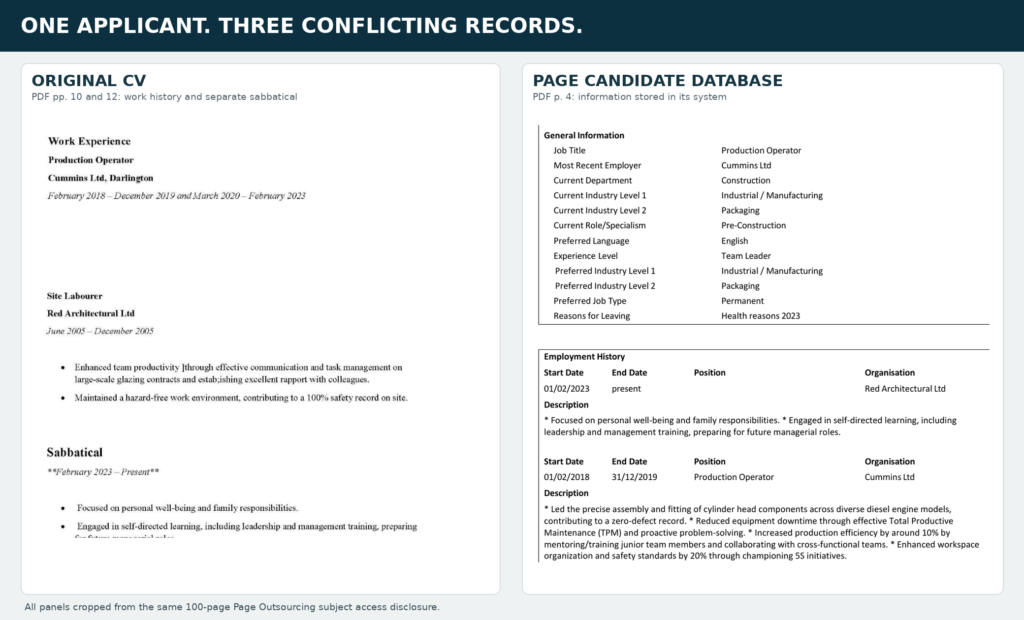
The general-information fields are hardly reassuring. Page’s record classifies my current department as “Construction” and current specialism as “Pre-Construction”, although my application concerned production work and my CV describes extensive manufacturing experience. These appear to be inaccurate classifications, although the disclosure does not establish how the fields were generated or whether Cepac saw them.
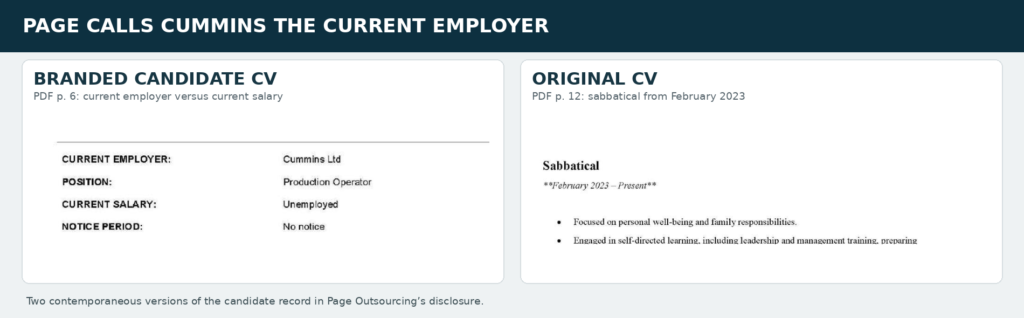
Now inspect page 6, Page Outsourcing’s own branded Candidate CV. It declares “CURRENT EMPLOYER: Cummins Ltd” while listing “CURRENT SALARY: Unemployed”. Apparently I was simultaneously working for Cummins, taking a sabbatical and employed by a glazing firm I had last worked for nearly twenty years earlier. At least Page’s reformatted career-history section preserves both periods at Cummins – which makes the missing period in its own database even more bloody inexplicable. The information was there to get right. Page simply didn’t keep its versions consistent.
Page Could Not Count The Months, Either
Then comes the little numerical vanishing act. My original CV records the sabbatical starting in February 2023. When Page introduced me to Cepac on 21 August 2024, that represented approximately 18 months out of employment. Its candidate introduction said 12 months. Six months of my life apparently disappeared somewhere between the documents Page possessed and the words it sent to the hiring company. This was not an irrelevant figure: Page chose to communicate my health-related absence to Cepac, and got the duration wrong.
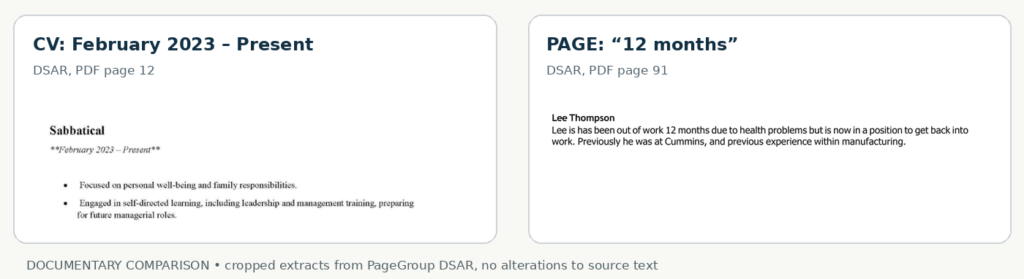
What explains that reduction? Careless transcription? A recruiter rounding the number down without bothering to check? Or was somebody deliberately softening the apparent extent of a health-related employment gap because disability-related questions might be uncomfortable for a client? I cannot establish motive from the discrepancy alone, but the question is fair. A shorter absence can make a candidate’s history look less significant, and Page’s own record gives us no explanation for choosing twelve months over the dates in my CV.
There is an important legal distinction. The Equality Act 2010 looks at the substantial, long-term effects of an impairment, not at how many months a person happens to have been unemployed. Its long-term test includes effects lasting or likely to last at least twelve months. So the six-month reduction is not proof of an attempt to escape the statutory definition of disability. It is evidence of an inaccurate health-related account; whether anyone intended to minimise its significance remains a question, not an established answer.
But what a fucking advertisement for recruitment diligence. Page’s system misassigned an old employer, lost a substantial period of manufacturing experience, invented the appearance of current employment during a sabbatical, assigned odd role classifications and understated the break that it told Cepac arose from health problems. Its own branded CV and its own profile don’t even agree with each other.
And now the same organisation expects its uncorroborated account of a later telephone rejection to be accepted on trust. The claim isn’t that a bad CV entry automatically proves a fake call. It’s that a recruiter displaying this level of documentary unreliability has earned no presumption that its unsupported recollection is accurate. If its systems can misplace years of employment, the original call and candidate-status audit are the very least it should be able to produce before anyone treats the disputed rejection as settled history.
This is the material Page actually disclosed. If the fucking visible record is this inconsistent, what would the complete underlying audit show?
One Witness, Two Versions And A Recruitment Agency That Cannot Copy A CV
Let’s consider the credibility contest here, because it is fucking extraordinary. Page now insists that no interview was offered. I say otherwise. During a later telephone conversation with Page, a representative was adamant that the offer had never been made. Fine. But a categorical denial isn’t evidence simply because it comes from somebody with a recruitment company’s name in their email signature.
On one side, there’s me. Page’s own record establishes that it called on 21 August 2024. That day, I messaged a friend about an interview the following week and the wage we had discussed. The WhatsApp exchange existed before I complained to Cepac, before anyone instructed solicitors and before the dispute acquired its expanding population of corporate explanations. It was not reconstructed in December when a defence was required. It was written when I thought I had a fucking interview.
And I didn’t merely produce a screenshot and ask the world to take my word for it. On 20 February 2025, the person who received those messages supplied an electronically signed witness statement to the Employment Tribunal. The statement confirms that the screenshot came from the recipient’s own phone, that the messages were sent on 21 August and that a reply followed the next day. It also explains why my name appeared differently in the saved contact entry. The original statement is preserved; the public extract below deliberately withholds the witness’s name and address.
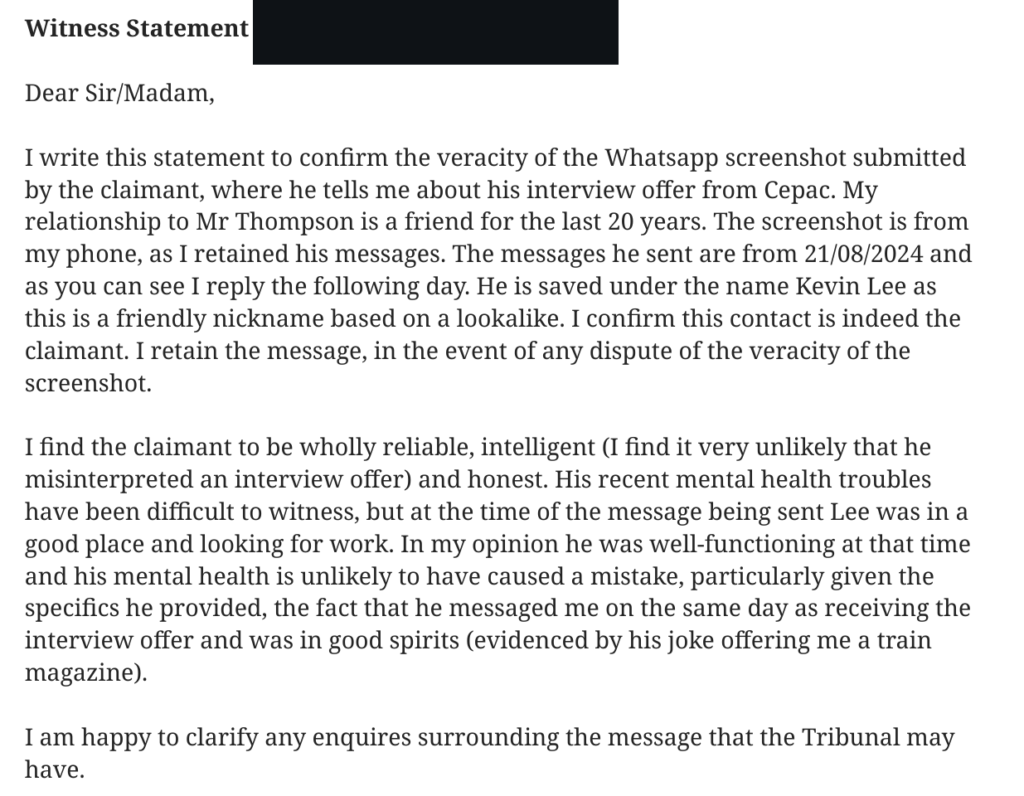
The witness describes me as “wholly reliable” and “honest”, and considers it “very unlikely” that I misunderstood an interview offer. That is a longstanding friend’s opinion, not a judicial finding or a recording of what the recruiter said. The witness did not hear the original telephone call. What the statement independently corroborates is the provenance and timing of my contemporaneous account. Those distinctions are important, precisely because evidence should not need exaggerating to be fucking persuasive.
Now look at the other side. Page’s structured profile omits nearly three years of Cummins employment, turns a sabbatical into apparent employment at a firm I last worked for in 2005, and classifies my manufacturing career under construction-related labels. Its branded CV identifies Cummins as my current employer while simultaneously describing me as unemployed. Its introduction to Cepac reduces approximately eighteen months away from work to twelve. The company entrusted to represent a candidate accurately couldn’t even get the candidate right.
And this is the organisation whose account of two further disputed events – that it never offered the interview, and that it subsequently telephoned me to reject me – we’re apparently supposed to accept on trust. One of those claims collides with a same-day message backed by its recipient. The other still lacks a matching entry in the dated activity history Page actually disclosed.
Why the fuck should a contemporaneous account supported by a witness be discarded in favour of a recruitment agency whose own paperwork cannot agree with itself? If Page wants its denial preferred, let it produce the underlying call notes, candidate-status audit and communications that demonstrate exactly what was said and done. That’s how a professional recruitment business establishes credibility. Not with a fucking assertion and a shrug.
Michael Page sells employers expertise in assessing people and handling recruitment information. Perhaps it should demonstrate some competence in assessing its own paperwork first.
The Apology Arrived Before The Investigation
At 04:35 on 8 October 2024, I emailed Cepac. The complaint described the interview offer as I understood it, the missing confirmation and my mental-health disclosure. It asked the company to explain what had happened.
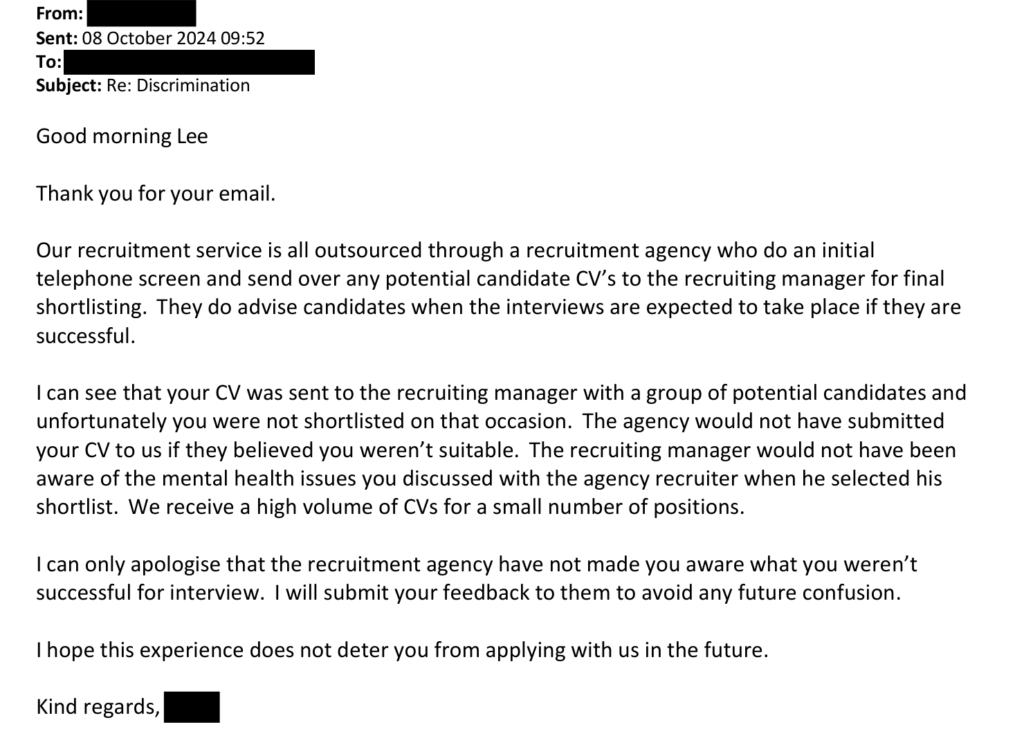
At 09:52, Cepac HR representative Maria Walker replied. She said my CV had been sent to the manager, that I had not been shortlisted and that the manager would not have known about my mental-health discussion with Page. She also apologised because the agency had failed to tell me I was unsuccessful for an interview.
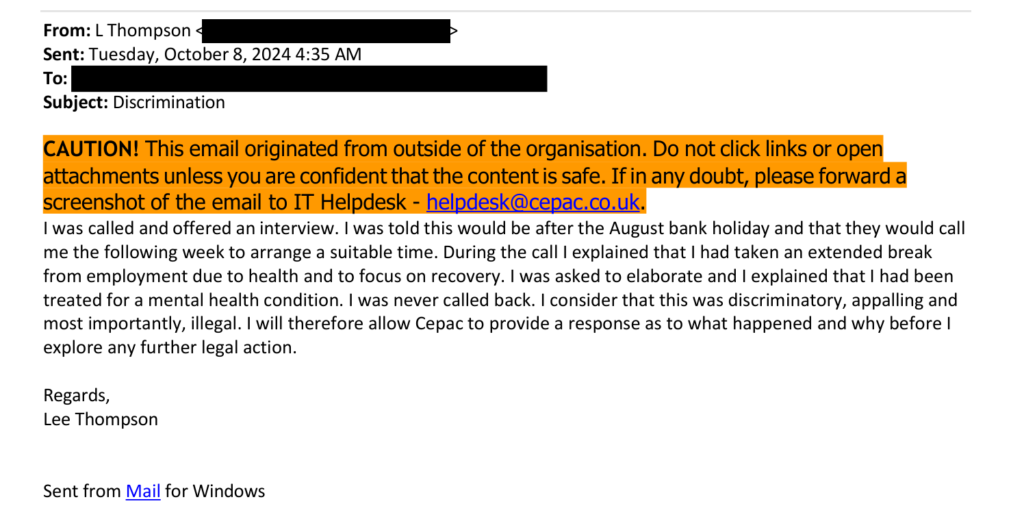
That apology is a remarkable part of the sequence. The email arrived before Cepac forwarded the complaint to Page at 12:48. Walker had supplied an account of the agency’s communication failure before Page had responded to that forwarded complaint.
That does not prove she invented anything. She may have been relying on prior information about the shortlist. But on the face of the disclosed chain, her reply was not the outcome of a completed post-complaint inquiry with the recruiter. If she had already verified the alleged rejection call, what did she check, with whom and when? Her explanation and her apology deserve the same scrutiny as the agency’s later answer.
In a dispute about disability discrimination, this is an interesting fucking workflow. The applicant asks what happened. The employer says the agency failed to tell him. Then the agency says it actually did tell him. Everybody has an explanation. Nobody has yet produced the decisive August call entry.
Then Page Remembered The Call
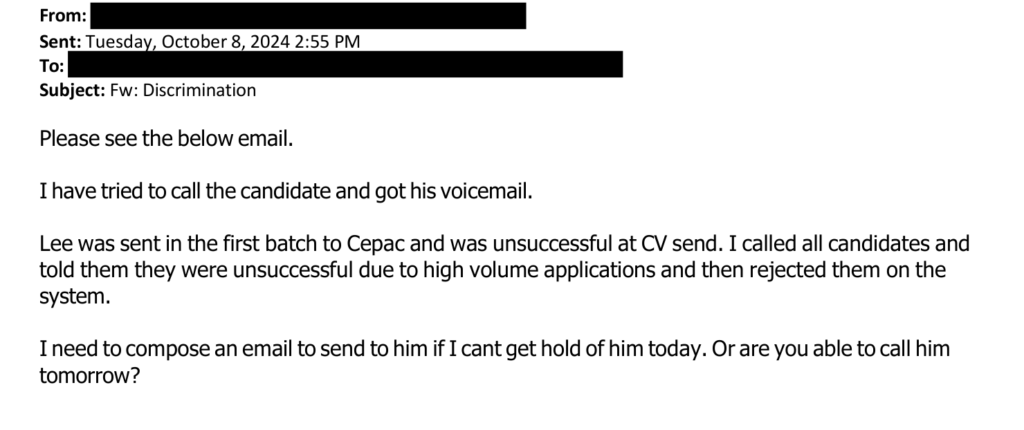
At 14:55 on 8 October, after the complaint had reached Page, an internal email asserted that I had been unsuccessful at the CV-submission stage. Its author said all unsuccessful candidates had been telephoned and rejected on the system. A later message that evening referred to further attempts to call or text me about the complaint.
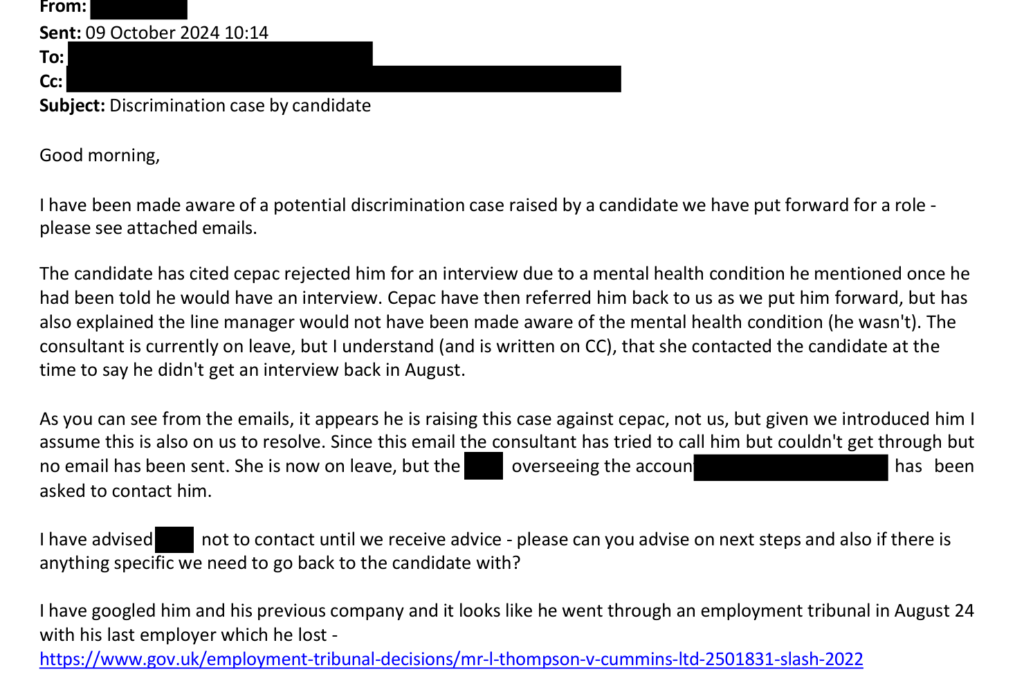
The following morning, another internal Page email said the consultant had called me in August and that this was written on “CC”. Its writer also repeated the assurance that the Cepac manager had not known of the mental-health condition.
There it is: the supposedly solid original record, now described from inside the organisation. Written on CC, apparently. Excellent. Then show the entry.
He Wasn’t
There is a marvellous little parenthesis in that same internal message: “(he wasn’t)”. Page did not merely report that Cepac believed its line manager had not been told about my mental-health condition. The writer supplied the assurance as an apparently settled fact. Two small words, doing the work of an entire investigation.
Except Page’s 21 August candidate introduction sent to Cepac put this information immediately beneath my name: I had been out of work for twelve months “due to health problems” and was ready to return. Not buried inside Page’s private notes. Sent to the business handling the decision, alongside my experience at Cummins.
The distinction is important. “Health problems” does not identify a mental-health diagnosis, and sending information to Cepac does not by itself establish that a particular manager read it. What it establishes beyond dispute is that the company had been furnished with health-related information during recruitment. So what check supported Page’s categorical “he wasn’t”? Who was asked? What did that person actually receive or see? What was the basis for treating the manager’s state of knowledge as settled?
An organisation entrusted with sensitive candidate information should have an answer grounded in the underlying communication and decision trail. A parenthesis is not a fucking audit.
The disclosed papers independently demonstrate that a CC/Salesforce-based system existed: a 21 August notification records the submission of my digital candidate-registration form. Elsewhere in the chain, Page employees refer to my CC record and the status of my application. The problem is not that there was no recruitment system. The problem is what the actual system shows about the alleged telephone call.
An unsuccessful status and a successful phone call are not interchangeable facts. Someone can select “rejected” on a screen without speaking to a candidate. An employee can recall having telephoned a group of applicants without having contacted every individual. A later note can repeat an earlier assertion without proving that it was true. That is why the native entry, creation timestamp, status-change history and telephone metadata matter.
Page may have a perfectly good explanation. A rejected-candidate note could sit in a different CC record category from the disclosed activities table. A call could have been made but not logged. There may be an audit record or telephone-system evidence not included in an Article 15 disclosure. None of that has been demonstrated by the supplied pages. What Page disclosed records a complaint-stage call it says I did not answer, but not the earlier rejection call it says I did.
That asymmetry is the issue. It is not a courtroom finding. It is an evidential question with the dimensions of a bloody billboard.
December Gave The Ghost An Approximate Birthday
By 20 December 2024, legal proceedings were looming and Page personnel were gathering material for their legal team. The emails describe urgent requests for information, contact with Cepac’s solicitors and a need to explain what the agency had done.
A retrospective chronology included this entry: “Around 23 August – Candidate was called and advised unsuccessful due to volume of applications”.
Around. No dated call-record timestamp followed. Neither a dialled number nor a duration appeared. An original telephone-system export was absent too. What remained was a summary prepared months later.
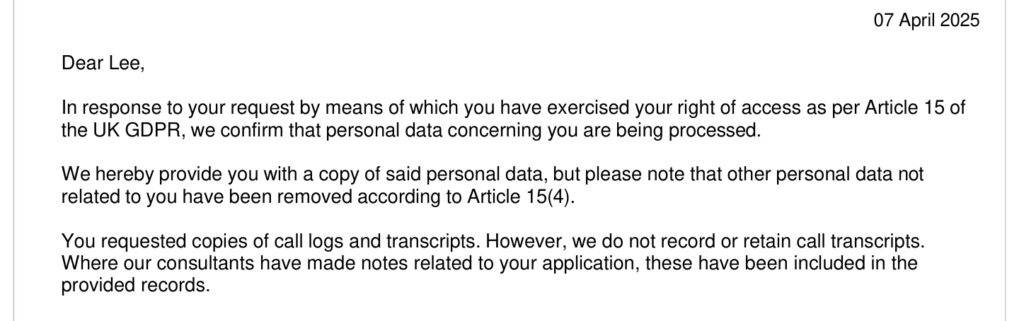
The distinction becomes sharper when the chronology is placed beside Page’s April 2025 disclosure letter. Page told me that it did not record or retain call transcripts, but that notes made by consultants relating to my application had been included. The Activities table then showed two contacts: the original 21 August call and the 8 October attempted call following my complaint. No equivalent activity entry appears for a rejection call around 23 August.
The invitation to Page is straightforward. If the supposed August rejection was entered on CC, identify precisely what was recorded, its creation and modification dates, and whether it evidences a conversation rather than simply an application outcome. Any surviving telephone metadata should then verify the call. Should the CC entry prove to be merely a status note, stop treating it as a record of an actual conversation.
Until that happens, my suspicion remains: the asserted telephone call looks less like a documented event than an explanation built to make a client’s discrimination complaint disappear. I allege a possible invented rejection account serving Cepac’s interests. I do not pretend the disclosed gap alone proves who invented it, when or why. The allegation is serious enough to require the source material, not another polished paragraph from someone who has read the last polished paragraph.
The Applicant Got Researched. The Call Did Not Get Produced
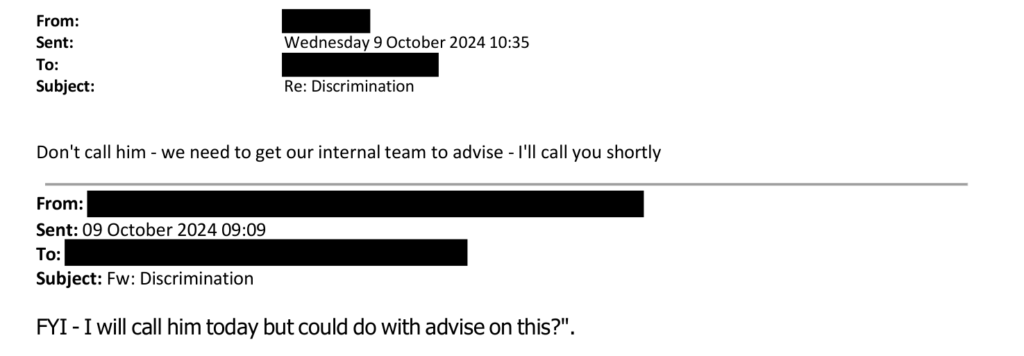
The correspondence becomes more revealing after 8 October. Internal Page staff sought advice on the complaint and discussed whether to contact me. On 9 October, an instruction said not to telephone until the internal team had advised. Seeking advice in the face of a discrimination complaint is not misconduct. It is often sensible.
Another message, however, records that someone Googled me and found my previous Employment Tribunal proceedings against Cummins. A separate internal observation speculated about whether I was the kind of candidate who did this regularly. That is what the documents say; it does not establish an unlawful decision or a shared corporate conspiracy.
But the contrast is hard to miss. By that stage, Page had time to investigate the complainant’s litigation history, discuss risk and seek internal guidance. The original August rejection-call evidence remained unproduced in the file later given to the complainant. I understand why a defendant investigates a claim. I also understand why I am entitled to ask why the chronology of the recruitment itself has not been pinned down with comparable zeal.
This is where the usual corporate language starts to sound like a customer-service script read over the sound of a shredder. Investigate the claimant. Study the blog. Revisit the previous lawsuit. Just don’t look too closely at the fucking phone log.
The Black Ink And The Wrong Applicant
Page’s 100-page disclosure contains extensively redacted recruitment correspondence. Protecting other candidates’ personal information can be legitimate; the Information Commissioner’s Office makes clear that access rights must be balanced against the rights of other people. I am not claiming every black bar is unlawful or necessarily conceals anything improper.
The practical limitation remains: I cannot reconstruct the complete decision trail from the edited documents I was given. Meanwhile, the same disclosure includes many pages of recruiting alerts concerning another person sharing my name, a management-accounting candidate associated with Nottinghamshire rather than the production role in County Durham.
I am not publishing that other individual’s personal details. Their presence in a disclosure supposedly assembled about my data is sufficient to raise a data-quality question. How was the material identified and reviewed? Why did unrelated recruitment alerts pass through while material bearing on my own recruitment decision remains difficult to test? Can the agency explain the searches, redactions and exclusions that produced this rather extraordinary document?
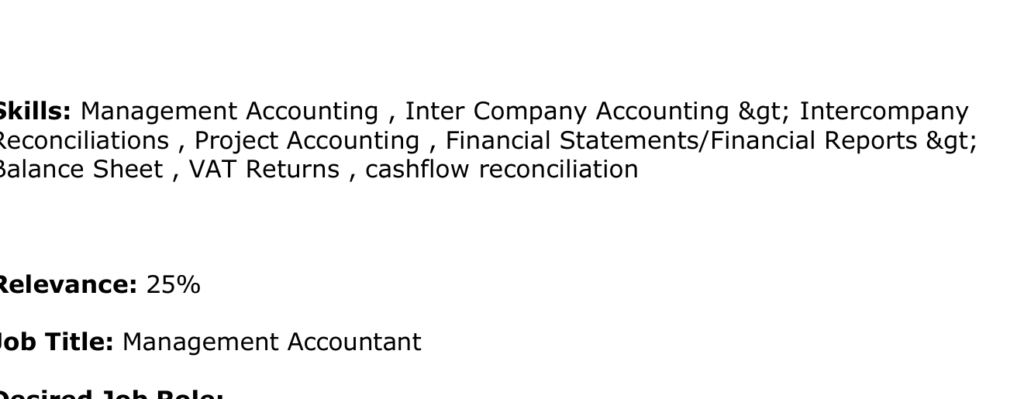
Perhaps the best joke is also the ugliest. A recruitment agency that apparently failed to distinguish two people with the same name in a data-access production is asking clients to trust it to distinguish the right candidates, the wrong candidates and the people who have actually been called. That is not proof of widespread failure. It is a rather spectacular question about care with records in this particular case.
And That’s Only The Shit We Can Fucking See
It is worth remembering what this document actually is. Not the whole Page recruitment system. Not an unredacted litigation disclosure. A 100-page response to my subject access request, assembled by Page, with passages and names withheld. It arrived accompanied by a letter saying consultant notes about my application had been included. We can scrutinise what it contains; we cannot honestly pretend to know everything withheld.
Even through that restricted window, look at the bloody view. The August email put health-related information in Cepac’s hands. A dated activity table remembers my first conversation and the attempt after I complained, but not the rejection call Page later insisted had occurred. October brings an assertion that the call was recorded in CC. December contributes its charmingly approximate ‘around 23 August’. Meanwhile, internal discussions examine my previous litigation, and pages of recruitment material apparently belong to an entirely different person.
That is the redacted version. The edited, restricted, black-marker version. That is all the shit we can fucking see.
So the question is unavoidable: if this much is visible in the supposedly controlled disclosure, what the fuck is behind the black bars – and what would the complete audit trail show?
There is an entirely lawful reason to conceal other applicants’ names. I am not claiming every redaction masks wrongdoing, or that the unseen parts must contain a smoking gun. Some might be mundane third-party identifiers. Others could clarify Page’s account. Equally, the missing passages might make things worse. The point is that the people affected by the dispute cannot reconstruct the decision and contact history from this redacted copy, while the business holding the underlying records has relied on an account that the visible activity table does not substantiate.
Page is not being asked to hand me strangers’ medical histories or spray their names across TCAP. It is being asked to explain my application: when and by whom my application was rejected, the date and author of any rejection entry, what CC showed before the complaint, and whether any telephone-system record proves the alleged conversation. An independent or appropriately confidential inspection could test that without sacrificing anybody else’s privacy.
In other words, the black ink does not prove a cover-up. But it does not provide Page with an exemption from answering the fucking question either. And when an agency’s own filtered paperwork already looks like a disciplinary hearing for its filing cabinet, confidence in the unseen paperwork has to be earned, not assumed.
Who The Fuck Would Hire Them On This Evidence?
A recruitment agency has a fairly simple bargain with the world. Employers hand over money and a degree of control. Candidates hand over their employment histories, their expectations and sometimes deeply personal information. The agency is supposed to repay both with competence, integrity and records that mean something when the relationship goes wrong. Page Outsourcing sells trust as a service. In this file, trust appears to have been put through the office shredder and returned in a stapled envelope.
This is the commercial trap that makes the Cepac affair more than an argument between a disappointed applicant and a former prospective employer. It creates a question for every business considering whether to put its recruitment function in Page’s hands: what, precisely, would I be buying?
The Ethical Client Has A Problem
Imagine the responsible employer. It has an equality policy that means something, managers who don’t want to discriminate, investors and customers who expect proper governance, and a compliance department that would prefer not to become an unpaid forensic archaeology service. It pays a professional agency to screen candidates, communicate accurately and maintain defensible records.
Then it reads this file. An applicant says he was told to expect an interview. His same-day evidence supports that understanding. The agency passed health-related information to the client, but got the duration wrong; its own database also misstates significant parts of the candidate’s employment history. The decision-makers and audit trail are not transparent in the copy supplied. When the applicant complained, the client apologised for a communication failure. The agency then insisted it had already informed him by telephone, while the disclosed activity history lists other calls but not that one. The full underlying candidate-status and decision history has not been established from the material provided.
A conscientious customer does not need the accusation of fabrication to be proved before asking whether this is the quality of recordkeeping it wants attached to its own name. It needs the actual process to be demonstrable. If your recruitment partner cannot show you when a candidate was rejected, who made the decision and how that decision was communicated, what exactly have you outsourced – recruitment, or an avoidable future headache?
The responsible client does not want plausible deniability. It wants traceability. It wants the moment an unhappy applicant asks a reasonable question to be the beginning of an audit, not the beginning of a corporate ghost story.
The Unethical Client Has A Different, Equally Awkward Problem
Now imagine a very different customer: the hypothetical employer whose recruitment conduct would not withstand daylight and who wants an agency to supply a convenient narrative. I am not alleging that any particular Page client commissioned a fabricated call, or that Page has a secret business selling false alibis. The proposition here is a hypothetical test of the business’s reputation, prompted by my expressly disputed allegation concerning Cepac.
If my suspicion is correct, Page’s rejection-call story functioned as cover for Cepac when the question became why an anticipated interview evaporated after a mental-health disclosure. Yet even on that hypothesis, what a piss-poor cover story to choose. The agency’s own disclosure supplies the August health-information transmission, the October explanations, the alleged CC record, the missing activity entry and the later approximate recollection. It practically draws a dotted line around the very event it needs to substantiate.
What kind of dodgy company would want an alibi manufactured by a recruiter whose own documents help dismantle it? If you wanted a scandal buried, you wouldn’t hire somebody who hands the complainant a hundred pages of shovels, diagrams and directions to the graveyard.
There is a nasty symmetry here. The ethical client doesn’t want an agency suspected of smoothing over a discrimination complaint. The unethical client doesn’t want an agency that makes the smoothing-over look so fucking amateurish. One needs the truth to be traceable. The other, in this hypothetical, wants the troublesome trail to disappear. On the visible evidence in this case, neither would find reassurance in the way the rejection-call story has been documented.
The first proposition is a trust and governance problem; the second is black humour about the obvious commercial vulnerability. Neither establishes that Page fabricated the call. Both lead to the same practical challenge: show the original CC history and prove what happened.
A Recruitment Giant Whose Own File Is The Advert
Page Outsourcing UK Limited does not manufacture machinery, whisky or corrugated board. Recruitment competence is the product. Michael Page’s outsourcing offer asks employers to delegate assessment and hiring functions to specialists. In July 2026, the publicly listed parent changed its legal name from PageGroup plc to Michael Page plc, retaining its London ticker PAGE (Yahoo Finance: PAGE.L). The corporate identity is now aligned under one familiar recruitment name – which makes the conduct of an outsourced recruitment process a matter directly relevant to the brand’s promise.
The firm’s recruitment emails declare that it celebrates difference and wants inclusive workplaces. Splendid. Perhaps it could begin by showing how it dealt with the disabled candidate whose health information went to the hiring company, whose anticipated interview never happened and whose supposed rejection call has no corresponding entry in the activity table Page gave him.
You can buy media campaigns, refresh a logo and wrap an organisation in the soft furnishings of diversity and inclusion. None of those things turns a retrospective sentence into a telephone record. A legal team can repeat ‘he was called’ until the stationery cupboard runs out of toner. An assertion does not acquire a dialling tone merely because enough professionals have signed off on it.
And here is the uncomfortable bit for a stock-market-facing recruitment brand: I do not have to persuade every customer, candidate or investor that discrimination occurred. I only have to publish what the documents actually show and ask whether an agency charging for recruitment expertise ought to be able to explain its own recruitment decisions. Anyone can inspect the difference between a dated system entry and an account written months later.
Who the fuck would hire them on this evidence? A good employer should demand better records. An unscrupulous one, if it fantasised about a discreet fixer, would demand a better cover story. Meanwhile, Page could answer both by producing the underlying records and demonstrating that the innocent explanation is the correct one. The company’s response, not my profanity, will determine what survives that test.
The Tribunal Ended The Claim. It Did Not Answer The Recruitment Question
The Employment Tribunal struck out my disability-discrimination claim without deciding whether Cepac or Page had discriminated against me. It also ordered me to pay £20,000 towards Cepac’s costs. I have challenged that outcome in the Employment Appeal Tribunal. Those proceedings concern the lawfulness and fairness of the strike-out and costs decisions, not a judicial determination that every disputed recruitment fact was false.
The distinction matters because the underlying questions survived the judgment untouched. Who read the health information sent on 21 August? Was I told I would be interviewed? What did CC record, and when? Did Page actually speak to me after the original recruitment call?
TCAP has separately scrutinised Newcastle Employment Tribunal administration, the handling of redacted material and the consequences of making alleged conduct the centre of proceedings while the recruitment merits went untried. A Parliamentary and Health Service Ombudsman complaint about HMCTS administration has been pursued through my MP, separately from the judicial appeal. None of those routes should be confused with a verdict on this telephone call. They are different mechanisms examining different aspects of the same long-running dispute.
The respondents may have won the first-instance procedural battle. That does not convert a disputed phone call into a historical fact by judicial osmosis. Nor does it create a missing CRM entry or erase the August health-information email. And it certainly does not stop me examining the awkward parts of the original record – especially when those are merely the parts I was permitted to see.
Five Questions And One Very Cheap Solution
Page, Cepac and their representatives can dispose of much of the uncertainty with records rather than rhetoric. First, what is the native CC entry said to prove the August rejection call, including its creation and change history? Second, is there telephone-system metadata identifying the outgoing call, dialled number and outcome? Third, what were the candidate-status changes, when was my application rejected, and who made that decision? Fourth, who at Cepac received and viewed my health-related introduction before the decision? Fifth, on what information did Maria Walker rely when she apologised for Page’s failure to notify me before forwarding the complaint to Page?
Those are document requests and questions, not a demand for another person’s private details to be dumped on the internet. An appropriately confidential examination, or a properly anonymised audit, could answer them without exposing unrelated applicants. The existence of redactions does not explain why Page expects the asserted rejection call to be accepted without the original entry that supposedly substantiates it.
I remain willing to consider a substantive response and to correct any demonstrable factual error. The project has an open corrections policy. Page and Cepac know where to find it. What I will not do is treat an account repeated in October and December as independently verified simply because lawyers subsequently found it useful.
The offer is almost embarrassingly economical. Produce the original call evidence. A £20,000 costs order would not be required. Nor would an enormous bundle. Forget the consultation with a search-engine expert about the complainant’s prior career. Just the record showing that the conversation happened.
The Ghost Is Still On The Telephone
A recruitment agency is supposed to connect people with work. In August 2024, Page connected me with Cepac, sent my CV and disclosed information about my health. Those are facts preserved in its own file.
After I complained, the agency insisted I had already been told I was rejected. That is the disputed event. Its disclosed activity table records the conversation that started the process and the call attempt that followed the complaint, but not the call that supposedly closed the application. Then, as the lawyers assembled the chronology, an August rejection appeared with an approximate date and a remarkably useful explanation.
Maybe Page has a record I haven’t seen. Maybe the agency’s note-taking was defective. Or maybe the story of the August call was a convenient piece of arse-covering for a client facing a disability-discrimination complaint. I suspect the last possibility. Page is entitled to answer it with evidence.
But remember the measure of the thing. This is only the redacted file. This is the mess Page was prepared to let me see. What is behind the black bars may clarify the position or may expose further problems. I am not claiming to know. I am asking why the corporation that holds the complete record has not supplied a checkable answer to a question so simple a teenager with a phone bill could understand it.
Until then, the recruitment giant has an unusual vacancy on its books: Wanted – one authentic August 2024 rejection-call record. Essential requirements: a date, an audit trail and evidence that somebody actually picked up. Previous experience in existing is essential. Salary: considerably less than the reputational cost of not finding it.
And if Page still can’t fill the vacancy, perhaps it could offer the job to one of its own legal-recruitment candidates. Here is the interview problem: How do you defend a telephone call that everybody relies on and nobody can document – using only the redacted evidence your client has already handed to the complainant?
Good companies deserve better than a recruitment agency that cannot demonstrate its communications. Bad companies – if they wanted an alibi – deserve to discover how little protection an unverified one actually buys.
The candidate is still waiting. Apparently the phone rang two years ago. Yet the record has still to turn up.
Lee Thompson – Founder, The Cummins Accountability Project
Sources
- Michael Page, Top Recruitment Agencies in the UK – Page Outsourcing service description
- Michael Page plc, PageGroup Rebrands as Michael Page, RNS, 21 July 2026
- London Stock Exchange, Michael Page plc (PAGE)
- Information Commissioner’s Office, Principle (d): Accuracy
- Equality Act 2010, Schedule 1, paragraph 2 – long-term effects
- Information Commissioner’s Office, A Guide to Subject Access
- TCAP, Page Partners : Cepac Limited – Redactions, Panic Calls And The Disabled Candidate They Googled
- TCAP, KFC II : Maria Walker And The Interview Receipt
- TCAP, Newcastle Employment Tribunal – Deliberate Maladministration
- Employment Tribunal, Thompson v Cepac Limited and Page Outsourcing, judgment sent 29 April 2026