
In October, Cepac promoted its part in a 19 Crimes Halloween display for Treasury Wine Estates in Tesco. Treasury has already reported an agency-worker disability dispute of its own, settled without admitting liability. Its supplier code prohibits disability discrimination and gives it a way to check concerns. The seasonal cardboard may have left the aisle, but the recruitment file underneath it has not answered itself.
Nineteen Is A Quiet Shift
If somebody announced “19 Crimes” at Cepac HQ, I would assume they were describing a slow morning. Here, thankfully for the lawyers, it is the name of a wine brand. Treasury Wine Estates owns it, and Cepac associated itself publicly with the brand’s Universal Monsters display. The title is a joke about a bottle, not a criminal charge sheet. The paperwork deserves a considerably less playful reading.
Treasury has an unusual reason to recognise the problem in that paperwork. It has already reported a dispute in which workers hired through an agency sought permanent jobs at its own winery and alleged that medical assessments stood in their way. That Australian matter ended in a settlement without an admission of liability. My separate UK dispute concerns an interview I say Page Outsourcing offered for a Cepac job, a mental-health disclosure, a callback that never came and a different account supplied by Cepac’s HR department. Neither case proves the other. Together, they ask whether Treasury applies the lessons from its own labour-hire dispute when it examines a supplier.
That is the point of this article. Treasury sells a wine called 19 Crimes and publishes a supplier code. Cepac helped put the wine in front of Tesco shoppers. The code provides the test for what Treasury does with the material behind its display partner.
The Monsters Came Pre-Assembled
In October 2026, Cepac reposted a project update by Martyn Kidner about 19 Crimes × Universal Monsters quarter-pallet shippers arriving across Tesco’s main grocery stores. The update described profiled header cards, layered side panels and a three-dimensional effect. Each unit went out pre-stocked, with the decorative pieces already assembled. It named both Treasury and Cepac among those involved in bringing the activation to market.
Treasury’s 19 Crimes campaign added the Wolf Man to its Halloween bottle collection. The branded display and Cepac’s repost give this story a dated, identifiable project, not an archaeological hunt through an old packaging portfolio. They do not establish which legal entity placed the order, which Cepac site made the units, what terms governed the work or whether any relationship continued after the seasonal promotion. Those questions belong with the people holding the purchase orders.
The display put monsters exactly where the shopper would look. The supply chain stayed behind the scenery. Following the project credits brings a different object into view: a supplier’s unresolved recruitment allegations and a customer with an existing procedure for examining supplier risk. Halloween has passed. The recent project record has not vanished with the cardboard bats.
Treasury Has Seen An Agency Door Before
In April 2023, Australia’s United Workers Union brought a complaint to the Australian Human Rights Commission on behalf of four workers who had worked at Treasury’s Barossa winery through a labour-hire agency. The union said two of them applied for permanent employment, underwent further medical examinations and lost both the direct-employment opportunity and their existing agency work. Its account said other casual workers were subsequently examined and dismissed as well. Some had already done the work for years and had passed earlier medicals arranged by the agency. Those are the union’s allegations, not judicial findings.
Treasury gave its position in its 2024 Statement on Human Rights and Modern Slavery. It said health and safety came first and it had a duty to ensure employees and labour-hire personnel could perform their roles safely. The statement also disclosed that the dispute settled in July 2024 without an admission of liability. There was no public merits ruling establishing disability discrimination. Equally, the settlement did not turn the workers’ allegations into a fabrication. The document records a contested case and a defined ending.
The comparison with Cepac is about a process, not identical facts or laws. At the winery, the disputed junction involved an agency, medical assessments and decisions about employment. In my case, the disputed junction involves an agency, health information and a promised interview that never materialised. Treasury has already had to explain the first kind of junction to the public. It can hardly regard the second as an exotic species of bureaucratic fucking mystery.
Treasury Wrote The Supplier Test
Treasury’s published Responsible Procurement Code, version 8.0 dated April 2024, expects suppliers to provide workplaces free of discrimination, harassment, abuse and intimidation. Disability appears expressly in its discrimination clause. The code defines a supplier’s workforce to include officers, employees and contractors, requires attention to subcontractors, and sets out supplier due-diligence and review procedures. It does not expressly name job applicants in its definition of workforce, so the code alone cannot decide my recruitment complaint. It does, however, give Treasury an obvious reason to ask how the hiring decision was made and whether any legal or contractual requirement was breached.
The machinery has more than a decorative on switch. Suppliers must reconfirm commitment annually, monitor compliance in their own chains, correct deficiencies and notify Treasury if they become aware of an actual breach or a reasonable likelihood of breaching the code. Treasury can use reports, questionnaires, meetings and audits in a review. Its supplier whistleblower provision is accessible to suppliers; that is not the same as claiming it offers every applicant an individual complaint route.
Treasury’s 2026 sustainability report adds the operational detail the older draft missed. It describes seven supplier-risk categories, primary assessments for new suppliers and secondary assessments for elevated risks, including labour and human-rights concerns. Treasury says it completed secondary assessments for 128 active suppliers during its 2026 financial year. That figure does not tell us whether Cepac was among them. The useful question is whether the machinery ever turned towards this named display project and the allegations already in public view. A risk platform that can count the cardboard but cannot locate the file is a bloody expensive screensaver.
Two WhatsApp Lines Before Any Claim
On 21 August 2024, Page Outsourcing called me about a Cepac production role. I say the recruiter offered an interview for the week after the bank holiday and discussed a £27,000 training wage rising towards £29,000. During the call, I explained that mental-health difficulties accounted for the gap in my employment. Page said my details would go forward and a further call would confirm an exact time. No confirmation reached me.
That day, I messaged a friend: “Interview next week” and “27k training wage up towards 29”. The friend retained the exchange and later provided a witness statement about its origin and context. The message is a contemporaneous record of my understanding of Page’s call, not an audio recording of the recruiter or an independent finding that an interview was formally booked. It predates my complaint, the tribunal claim and the fucking theatre that eventually swallowed the recruitment question.
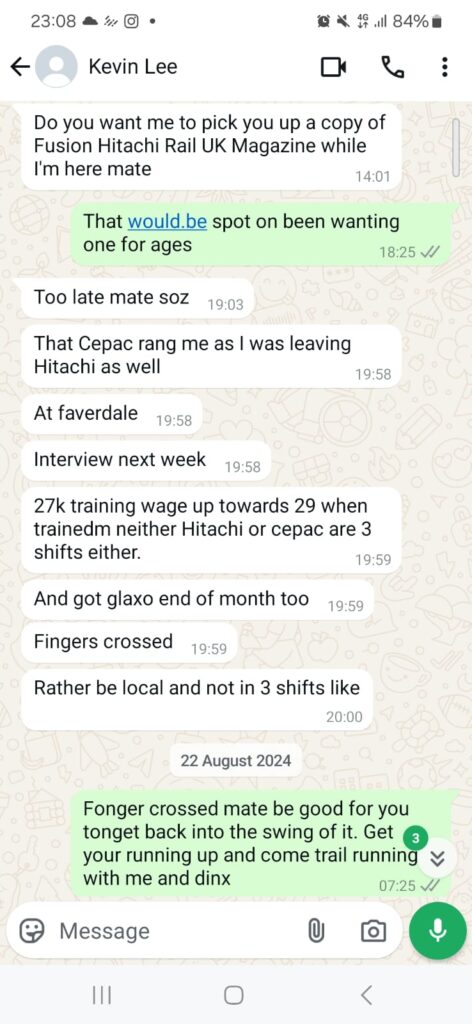
Page’s call log, recruiter notes, candidate status and email trail could test my account. If an interviewer got ahead of a shortlist, those records may show it. If someone changed the decision after receiving health information, they may show that too. The WhatsApp fixes a point in time: before anyone had a legal position to defend, I told someone I had an interview the following week.
Maria Walker Supplies A Different Ending
On 8 October 2024, I complained directly to Cepac about the missing callback and my disclosure. Maria Walker, its HR Business Partner, replied that my CV had reached the recruiting manager but I “was not shortlisted on that occasion”. She said the manager would not have known the mental-health information discussed with Page. In her account, Page should have explained that I had not secured an interview. The difference between that answer and my account became “confusion”.
Walker had not seen the WhatsApp message when she answered. Her email therefore records Cepac’s position at the time; it does not rebut a contemporaneous record she never examined. The questions are who told her that no interview had been offered, what they checked and whether the agency’s underlying records support that version.
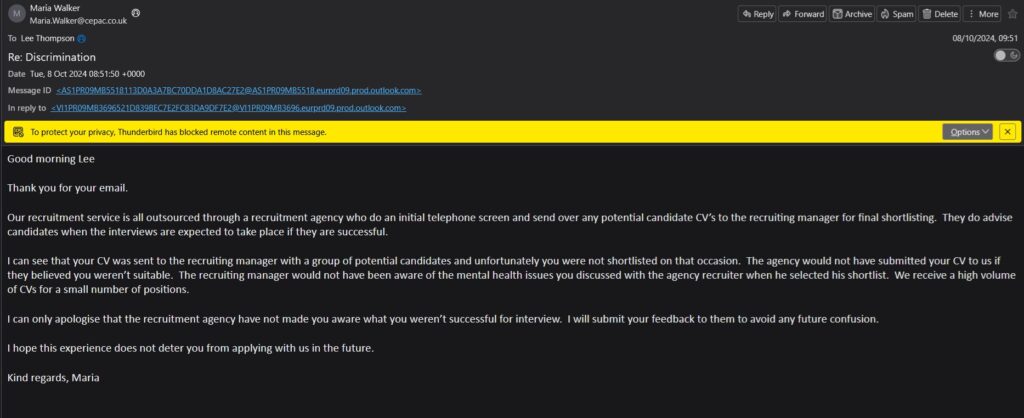
“Confusion” is missing the right train after you read the wrong departure board. An interview discussed for the next week becoming an unsuccessful shortlist after a health disclosure calls for a chronology, not a scented corporate apology. It may have an innocent explanation. The records, rather than anyone’s fondness for the word “miscommunication”, should decide.
Paragraph Fourteen Leaves A Trail
Cepac’s ET3, its response to my tribunal claim, narrows the dispute about knowledge. Paragraph 12 says Cepac did not know the details of my conversation with Page about my health-related employment gap until my October complaint. Paragraph 14 reproduces an email that Page sent to Cepac on 21 August, saying I had been out of work for about twelve months because of health problems and was ready to return.
Those paragraphs can coexist in one limited sense: knowing the full content of an agency conversation differs from receiving a shorter email about health problems. That distinction does not answer who saw the email, when it reached the decision-maker or why Walker gave such a firm assurance in October. Nor does the email, on its own, prove disability knowledge by the manager or a discriminatory decision. The original message, its recipients, the application log and the shortlist are needed to test each step.
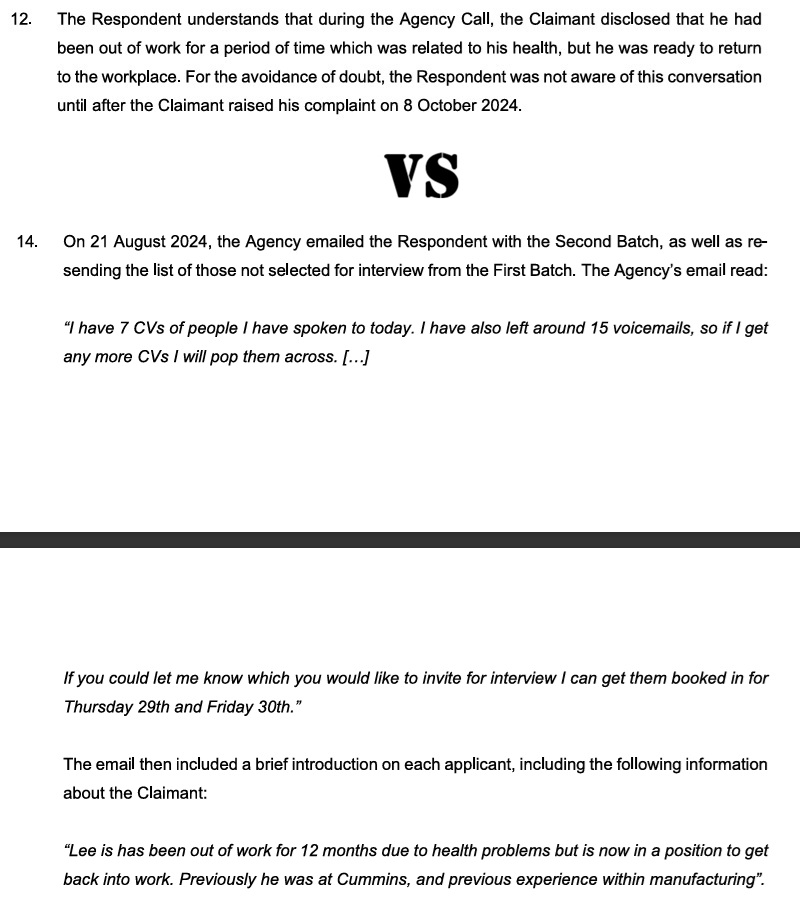
The route is the story. Health information entered the recruitment chain on 21 August. My account says an interview had been discussed that day; Cepac’s later account says no shortlist place existed. Treating the agency as a sealed compartment leaves the only questions worth answering floating in the gap between two inboxes. Treasury’s procurement people have permission to open the bloody doors.
Page’s Black Marker Does Not Answer The Call
Page’s response to my data-access request contained substantial redactions around its internal recruitment and complaint records. As TCAP’s Page investigation reported, the material included discussion of my earlier tribunal history after I complained. Page’s retrospective timeline also asserted that it told me around 23 August I had been unsuccessful. I dispute that the call happened.
There may be proper reasons to redact another person’s information from a disclosure to me. The black marker itself establishes neither a cover-up nor the truth of Page’s retrospective account. It leaves the relevant businesses holding the originals. If Treasury wants an answer, it can ask the parties what calls took place, which candidate-status changes the system logged and what was visible to Cepac when the hiring decision was made. Any disclosure to a customer would, of course, need to respect applicable privacy obligations.
The contrast is hard to miss. Once I complained, there was energy for researching my history. The more basic question, what Page actually said about this Cepac interview, still needs the same attention. A search engine was available; apparently a mirror proved more attractive than a call log.
The Tribunal Decided Conduct, Not Recruitment
The case later moved far from the selection decision. Cepac’s solicitors, Horsfield Menzies, contacted my medical centre about appointment availability and used that information in opposing a postponement. They did not obtain my full medical records through that contact. I regard the intervention and the wider handling of my disability-related distress as bullying. That is my assessment of the case correspondence, not a court’s finding about the solicitors.
At the hearing on 24 April 2026, held without me, the Employment Tribunal found that my conduct of proceedings had been unreasonable, scandalous and vexatious and struck out the claims. It ordered me to pay Cepac £20,000 in costs. Paragraph 116 records combined Cepac costs schedules exceeding £50,000; its representative limited the application to £20,000 to avoid detailed assessment. The judgment is dated 28 April. I dispute the tribunal’s treatment of my disability, participation and conduct; TCAP’s Newcastle investigation explains that criticism. The findings against me remain part of the published record.
The tribunal explicitly recognised that strike-out denied me a merits hearing. It did not decide whether Page offered an interview, why the confirmation disappeared or whether disability affected the recruitment decision. The order tells Treasury something important about the litigation, but it is not a factory certificate stating that every question about recruitment passed inspection. A legal bill can fill a cellar without telling you what went into the fucking bottle.
Put The Risk Assessment On The Table
Treasury’s first question is commercial. Which entity commissioned the 19 Crimes display, which Cepac entity supplied the work, and what assessment and contract terms governed it? The October project credits establish a recent association, not an indefinite supply contract. Treasury can answer that part from its own records, including whether the relationship survived Halloween.
The second question is evidential. Obtain an account of Page’s 21 August call and its records; establish who received the health-related email; identify who made the shortlist decision and what Walker reviewed before answering me. Ask how the WhatsApp and witness statement were assessed, and what the parties say about the alleged 23 August call. Then examine the medical-centre contact and litigation conduct as separate issues, with the tribunal’s adverse findings about me in view rather than quietly edited out.
Finally, Treasury can explain how its published code and 2026 risk process apply. An allegation is not automatically a code breach; silence does not prove that a notification duty was triggered. If a review has already happened, Treasury can say what it reviewed and what it concluded. If it has not, the company can say why a supplier named in a live seasonal promotion required less scrutiny than the prose in its own report appears to promise. Either way, the question is more exacting than demanding somebody sack a cardboard maker on the strength of my article.
The Seasonal Display Has An Afterlife
Treasury’s Australian settlement and my UK strike-out ended different proceedings in different ways. Neither produced a finding that Cepac discriminated against me. Treasury’s history does mean it knows why health information moving through an agency is worth tracing, while its supplier documents set out who can ask and what a review can involve. Cepac’s October display provided the link. The WhatsApp, Walker email and ET3 provide specific points to investigate.
The Halloween shippers may already be gone from Tesco. I am not claiming they remain on shelves in November. But the company names in the October project credit, the published code and the tribunal judgment have longer shelf lives than a promotional cardboard monster. Treasury does not need to accept my whole account to ask its supplier for the documents that would test it.
Nineteen crimes at Cepac HQ would be a slow day. My joke has done its work; the serious question is whether Treasury’s due-diligence machinery runs when the seasonal campaign is over. The Wolf Man has had his night in the aisle. The file is still waiting under the counter.
Lee Thompson – Founder, The Cummins Accountability Project
Source List
- Cepac Ltd : LinkedIn company updates
- 19 Crimes : Universal Monsters 2026 announcement
- United Workers Union : Barossa workers and permanent employment
- Treasury Wine Estates : 2024 Statement on Human Rights and Modern Slavery
- Treasury Wine Estates : Responsible Procurement Code, version 8.0
- Treasury Wine Estates : Cultivating a Brighter Future Report 2026
- Treasury Wine Estates : Supplier information
- Employment Tribunal : Thompson v Cepac Limited and Page Outsourcing UK Limited
- TCAP : Page Partners : Cepac Limited
- TCAP : Newcastle Employment Tribunal : Deep Dive
- TCAP case file: WhatsApp message dated 21 August 2024; recipient witness statement dated 20 February 2025; complaint and Maria Walker reply dated 8 October 2024; Cepac ET3 Grounds of Resistance; Page Outsourcing data-access correspondence; medical-centre correspondence.