
BERICAP publicly named Cepac among its supply partners. Its own code expects business partners to respect human rights, while its website says suppliers agree to a separate ethics code. BERICAP supplier ethics now have a practical test: a recruitment file containing an August health disclosure, an early HR assurance and a disputed rejection call missing from the activity history Page supplied. A closure specialist should appreciate the difference between closing a case and checking its contents.
A Different Kind Of Closure
BERICAP makes caps and closures. It is the sort of business in which a small component has a serious job: keep the contents where they belong, work as intended and give the customer something more dependable than a reassuring noise. If a cap failed inspection, an increasingly confident paragraph would be a piss-poor substitute for checking the thing. That principle travels remarkably well from a production line to a supplier’s recruitment records.
The commercial receipt comes from BERICAP UK itself. In a recent LinkedIn update, it thanked its supply partners for raffle donations to its centenary event, naming Cepac among them. Cepac then reposted the acknowledgement. The fundraiser raised £2,000 for Dove House Hospice; the thank-you also gave us a public supplier connection. However, it does not disclose products, order values, manufacturing sites or the terms of the relationship. BERICAP and Cepac hold those details.
That is enough to ask a specific question. When the supplier of your cardboard has a disputed recruitment explanation, do you test the supporting records, or accept that somebody has screwed the lid on tightly enough? Here is the file I am asking BERICAP to examine.
BERICAP Supplier Ethics Need A Working Standard
BERICAP’s published group Code of Conduct rejects disability discrimination in recruitment and bullying at work. It expects business partners to respect internationally recognised human rights and to treat employees with dignity when taking disciplinary action. Those commitments establish a standard against which to ask about a supplier’s practices. They do not turn BERICAP’s internal employment rules into an automatic judgment against Cepac.
There is also an expressly supplier-facing promise. BERICAP’s corporate-responsibility page says it sources from suppliers who share its commitment and have agreed to its Supplier Code of Conduct. The group code confirms that this is a separate document. TCAP has not obtained its text, so I cannot announce a breach of a clause I have not read. Instead, BERICAP can identify the version governing its relationship with Cepac, the commitments it required and the process for assessing concerns.
That is the first test of BERICAP supplier ethics: produce the working standard, then examine the facts against it. After all, a supplier code should do more than sit under a stock photograph while the difficult questions wait outside. Otherwise it is just a little plastic halo for the purchasing department, with the usual bollocks about values moulded into the rim.
An Interview Before The Black Ink
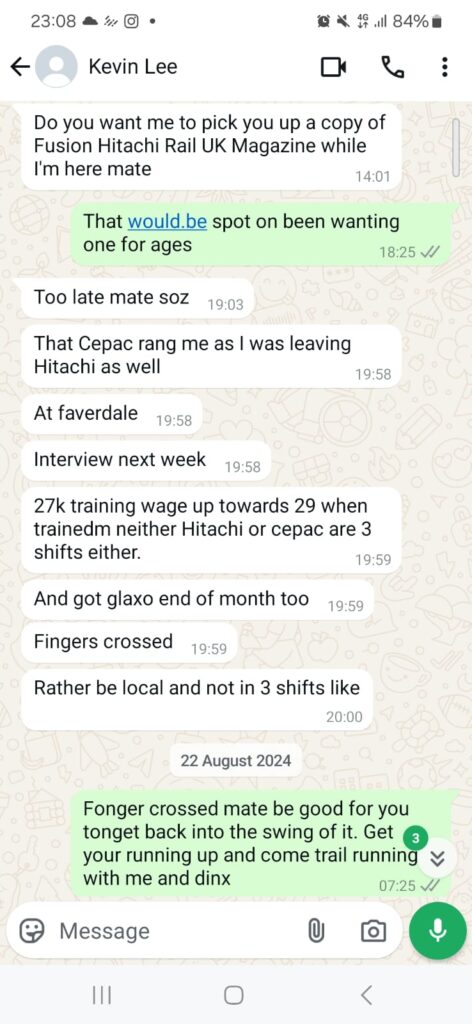
On 21 August 2024, Page Outsourcing called me about a production role at Cepac’s Darlington factory. My account is that the recruiter offered me an interview after the August bank holiday and promised to call the following week to arrange a suitable time. I explained that my employment break had been for health and recovery. The recruiter asked me to elaborate, so I explained that I had been treated for a mental-health condition. I was never called back. That is the sequence I reported to Cepac on 8 October.
That evening, I told a friend on WhatsApp: “Interview next week” and “27k training wage up towards 29”. The recipient later supplied a signed witness statement confirming the messages’ origin and timing. However, it corroborates my contemporaneous account; the friend did not hear the recruiter’s call.
Meanwhile, Page sent Cepac a candidate-introduction email at 17:33 that day, describing my absence as twelve months because of health problems. Cepac’s ET3 later referred to that August communication in paragraph 14. By contrast, paragraph 12 placed knowledge of the fuller agency conversation after my October complaint. Company receipt, a manager’s knowledge and discriminatory motive remain separate questions. The email therefore establishes the first; it does not decide the other two.
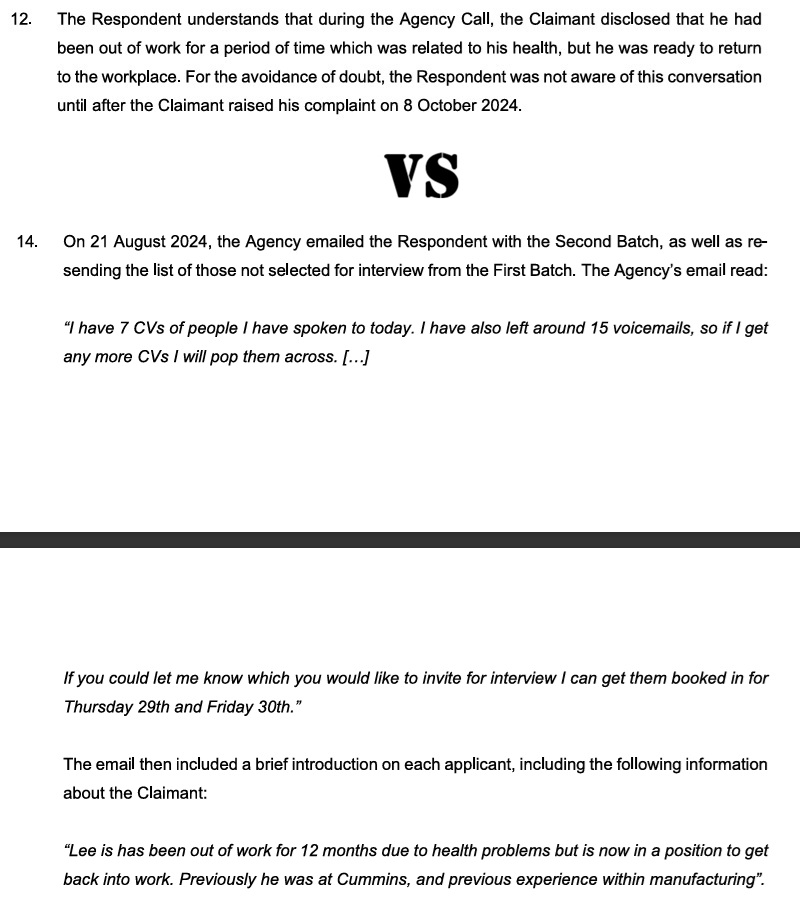
The supplier-review question is therefore who saw that information and what happened to the application afterwards.
Walker Answered At 09:52
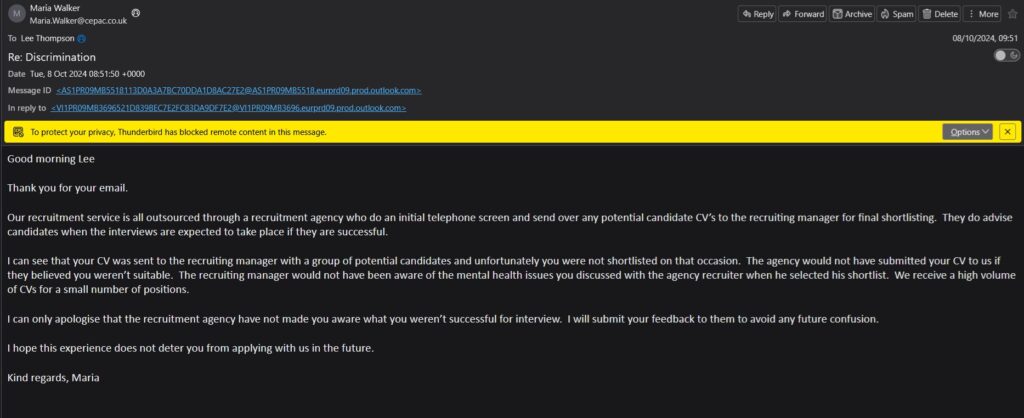
At 04:35 on 8 October, my complaint began: “I was called and offered an interview.” It set out the health-disclosure sequence and asked Cepac to explain what had happened before I explored further legal action. Maria Walker replied at 09:52, saying my CV had reached the recruiting manager but I had not been shortlisted. She said the manager would not have known about the mental-health discussion with Page and apologised because the agency had failed to tell me I had not secured an interview. Walker had not seen the WhatsApp message when she answered.
The disclosed chain then shows Cepac forwarding the complaint to Page at 12:48. That leaves a question about the basis of the earlier answer, not proof that no conversation could have occurred elsewhere. What had Walker checked before apologising for an agency communication failure? Her email preceded the response to that disclosed referral.
At 14:55, a Page email asserted that unsuccessful candidates had been telephoned. The following morning, an internal message said the August rejection was written on its CC recruitment system. So Cepac’s explanation was that Page had failed to tell me; Page’s explanation was that it already had. Somewhere between those positions, a telephone call acquired a very useful job. The alleged conversation could tidy away the complaint, provided nobody asked the bastard to produce its timesheet.
A Status Is Not A Conversation
Page’s April 2025 subject-access disclosure contains a dated Activities table. It records the 21 August recruitment call and an attempted call after my 8 October complaint. Yet there is no matching entry for the rejection call Page’s retrospective chronology places “around 23 August”. Page also said it did not record or retain call transcripts and had included consultants’ application notes.
I deny receiving that rejection call. I suspect the account served as cover for Cepac, but the disclosed gap alone does not prove fabrication. A record might exist in another part of the system, or somebody might have confused marking an application unsuccessful with speaking to the applicant. Either possibility needs an answer from the original history, its timestamps and any surviving telephone metadata. Selecting “rejected” on a screen does not give the mouse a fucking dialling tone.
The recordkeeping problems extend beyond that call. For example, Page’s stored employment history assigns my sabbatical to an employer I last worked for in 2005 and omits my later manufacturing-employment period. Its introduction to Cepac also reduces a break beginning in February 2023 to twelve months in August 2024, roughly six months short. Although those errors do not prove a false call, they make accepting the agency’s account without checking its records rather less attractive.
The full Ghost Call investigation publishes the comparisons and the wider chronology. BERICAP does not need another hundred-page recital here. It needs to understand that the disputed explanation can be tested, and that the version disclosed to me does not supply the decisive call entry.
The Tribunal Did Not Audit Recruitment
After I complained, Page staff discussed my earlier litigation and sought internal advice. Later, the tribunal proceedings became dominated by my communications, publications and conduct. Cepac’s solicitors, Horsfield Menzies, also contacted my medical centre about appointment availability and used the information to oppose a postponement. That contact was not access to my full medical records. I regard it as an intrusive part of the pressure applied to me.
At the hearing on 24 April 2026, held without me, the Employment Tribunal found my conduct unreasonable, scandalous and vexatious. It struck out my claims and ordered me to pay Cepac £20,000. Paragraph 116 records Cepac costs schedules exceeding £50,000 before its representative limited the application to £20,000 to avoid detailed assessment. Although I challenge the outcome in the Employment Appeal Tribunal, the adverse findings about me remain part of the published record.
Crucially, the same judgment expressly recognises that strike-out denied me a hearing on the recruitment merits. It did not decide whether Page offered an interview, whether the later rejection call happened or whether disability influenced the decision. A conduct judgment answers questions about proceedings. Trying to stretch it over every gap in the recruitment file would be using a court order as industrial clingfilm. BERICAP should therefore examine both the findings against me and the questions the hearing never tried.
Put Supplier Ethics In Somebody’s Inbox
BERICAP UK’s February 2026 Modern Slavery Statement assigns day-to-day implementation to HR, Quality and Supply Chain Management, with responsibility above them resting with the managing director, board and site leadership. That policy concerns slavery and trafficking; my disability-discrimination allegation does not become a slavery allegation by appearing beside it. What the statement establishes is that supplier-risk governance has named owners. Someone can identify who handles the separate human-rights and recruitment concerns raised here.
Start with the operative supplier code and the relationship BERICAP publicly acknowledged. Then ask Cepac how it reconciles the August health email, Walker’s answer and Page’s disputed rejection account. Request an explanation grounded in the underlying records, with any necessary confidential inspection protecting other candidates’ information. BERICAP can also establish whether these concerns were assessed before and what any assessment concluded.
A customer may disagree with me after examining the evidence. That would at least involve examining it. By comparison, accepting a supplier’s reassuring summary while leaving every disputed step inside its unopened file achieves very little. Procurement departments exist to do something more demanding than nod professionally at another company’s stationery.
Now Test The Seal
BERICAP’s supplier acknowledgement does not tell us whether it knew of this dispute. However, its public standards make it the right business to ask what happens next. If a review has already resolved these concerns, explain its basis. Otherwise, identify the person who will assess them and the supplier commitments that person will apply. A documented answer would let readers judge whether the principles extend beyond the brochure.
The Closure Company can manufacture a perfectly respectable lid. It now has a supplier question that calls for opening the fucking file.
Sources
- Cepac Ltd : LinkedIn company updates
- BERICAP : Code of Conduct
- BERICAP : Certifications and Corporate Responsibility
- BERICAP UK : Modern Slavery Statement 2026
- Employment Tribunal : Thompson v Cepac Limited and Page Outsourcing UK Limited
- TCAP : The Ghost Call And The Client Alibi
- TCAP : Newcastle Employment Tribunal : Deep Dive
- TCAP case file: Page Outsourcing’s 100-page subject-access disclosure dated 7 April 2025; WhatsApp exchange dated 21 August 2024; recipient’s signed witness statement dated 20 February 2025; Maria Walker correspondence dated 8 October 2024; Cepac ET3; medical-centre correspondence.