
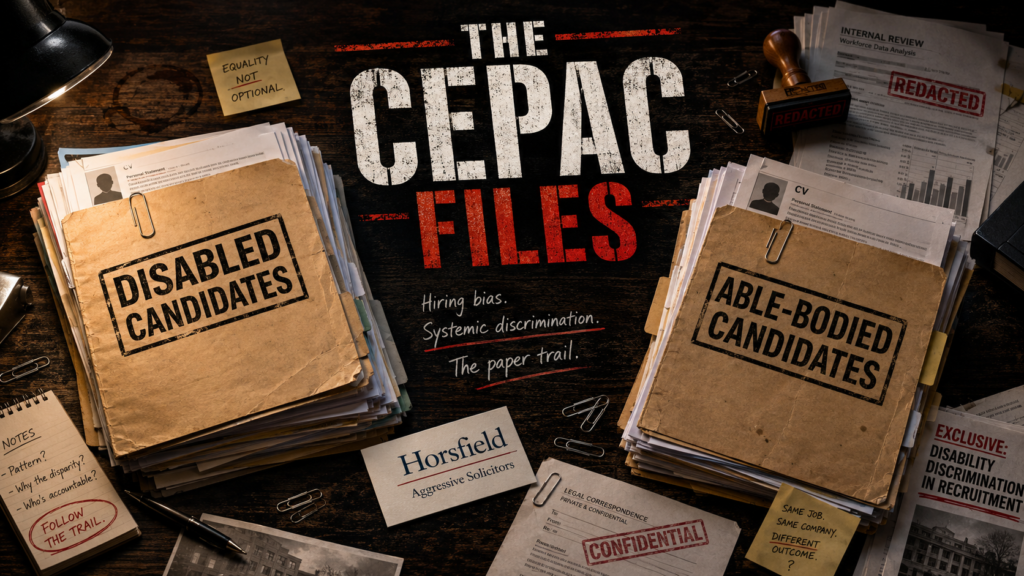
I found Cepac in a piece by Shell Energy UK’s then chief executive, looking marvellous. Four factories, recycled paper, solar panels, electric vehicles. Even the lighting had received attention. By the time I reached the end, I wanted to congratulate somebody on the care lavished upon the electricity. Then I remembered what happened when I tried to become one of the people working underneath it.
The Shell Energy and Cepac partnership has a proper documentary trail. It also offers a useful question for a company selling responsible business: how much of the customer do you examine before turning it into an advertisement? I have some reading for whoever chose this one. It concerns an interview, a missing call record and a complaint that found considerably more employment than its author.
Fourteen Million Units Of Good News
Cepac announced the arrangement on 4 November 2021. Shell Energy would supply 14 GWh of renewable electricity annually, backed by renewable certificates of origin. Cepac’s group accountant and treasurer, Simon Lilley, called it a “true partnership”. Shell’s sales director described continuing support beyond the transaction. This was a relationship both companies were happy to put their names underneath.
Then, on 30 August 2024, an article by Shell Energy UK’s chief executive, Jodie Eaton, used Cepac as its packaging-industry example. The account described Shell helping with renewable electricity and new technology. That is the latest dated confirmation I have verified. The original Cepac announcement remains accessible, but the present contract, covered sites and renewal dates need an answer from the companies.
In the documented arrangement, Cepac was the electricity customer. Shell’s supplier code therefore cannot simply be stapled to Cepac as though the invoice travelled the other way. However, Shell also chose to make its customer part of the sales pitch. That editorial decision belongs to Shell. Nobody made the bloody marketing department do it.
There Are People In The Small Print
Shell’s General Business Principles say its transactions must reflect its standards, and that business decisions should consider social consequences alongside economic and environmental ones. Principle 3 sets expectations for integrity and fairness in dealings with business counterparts. Principle 7 commits Shell to engagement and responsible answers. Meanwhile, its human-rights page identifies discrimination among the workplace issues it considers significant. Somebody has remembered to put people in the bloody document.
Those are Shell’s commitments. They do not make Shell the employer in my case or establish that it knew about the dispute. They do give it a reason to consider the material when deciding how to describe this partnership. Renewable electricity is a worthwhile purchase. It is also a remarkably convenient subject for a testimonial: the meter cannot ask what became of its interview.
So let us put the human paperwork beside the energy paperwork. Nobody needs to pronounce a verdict on an unseen file. The relevant documents are already available, including the company’s explanation, my contemporaneous account and the judgment that ended the proceedings.
The Interview Was Going Rather Well Until It Vanished
On 21 August 2024, Page Outsourcing called me about production work at Cepac’s Darlington factory. It offered me an interview after the bank holiday, with a further call to arrange the time. During the conversation, I explained that my employment break involved treatment for a mental-health condition. The confirmation never came. That is my account of the call; Page and Cepac dispute the interview offer.
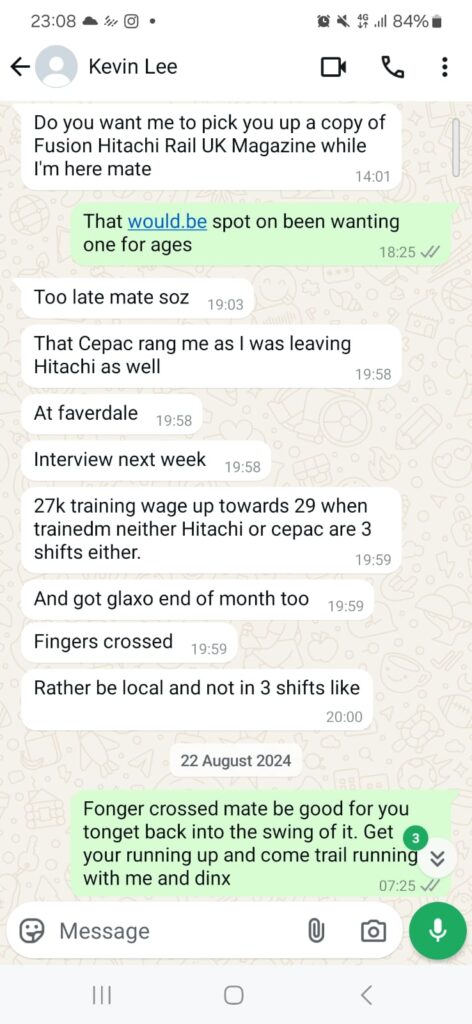
That evening, however, I had already told a friend on WhatsApp: “Interview next week” and “27k training wage up towards 29”. The recipient later supplied a signed statement confirming the messages’ source and timing. This records what I understood when the call had just happened. It is not a recording of the recruiter, but it is a damn sight earlier than the explanations assembled after I complained.
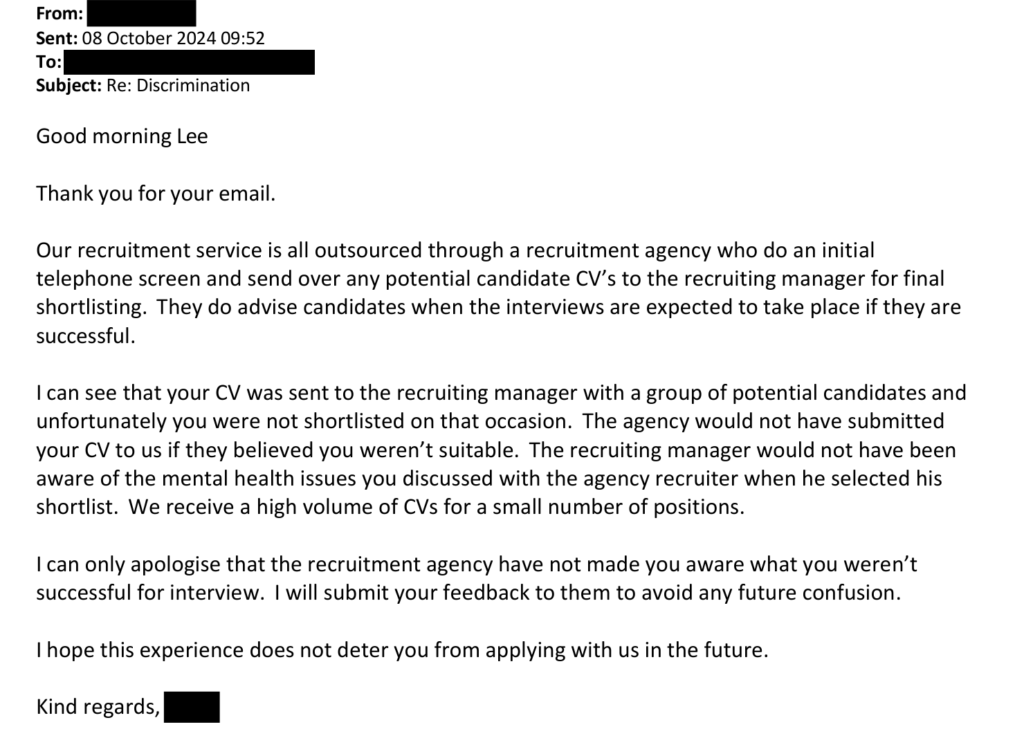
At 04:35 on 8 October, I asked Cepac to explain. Maria Walker replied at 09:52: I had not been shortlisted, the manager would not have known about the mental-health discussion, and Page had failed to tell me I was unsuccessful. Yet the disclosed chain places the forwarding of my complaint to Page at 12:48. What had Walker checked before answering? Her account of the agency’s failure arrived before its response to that forwarded complaint.
The Call That Needs A Reading
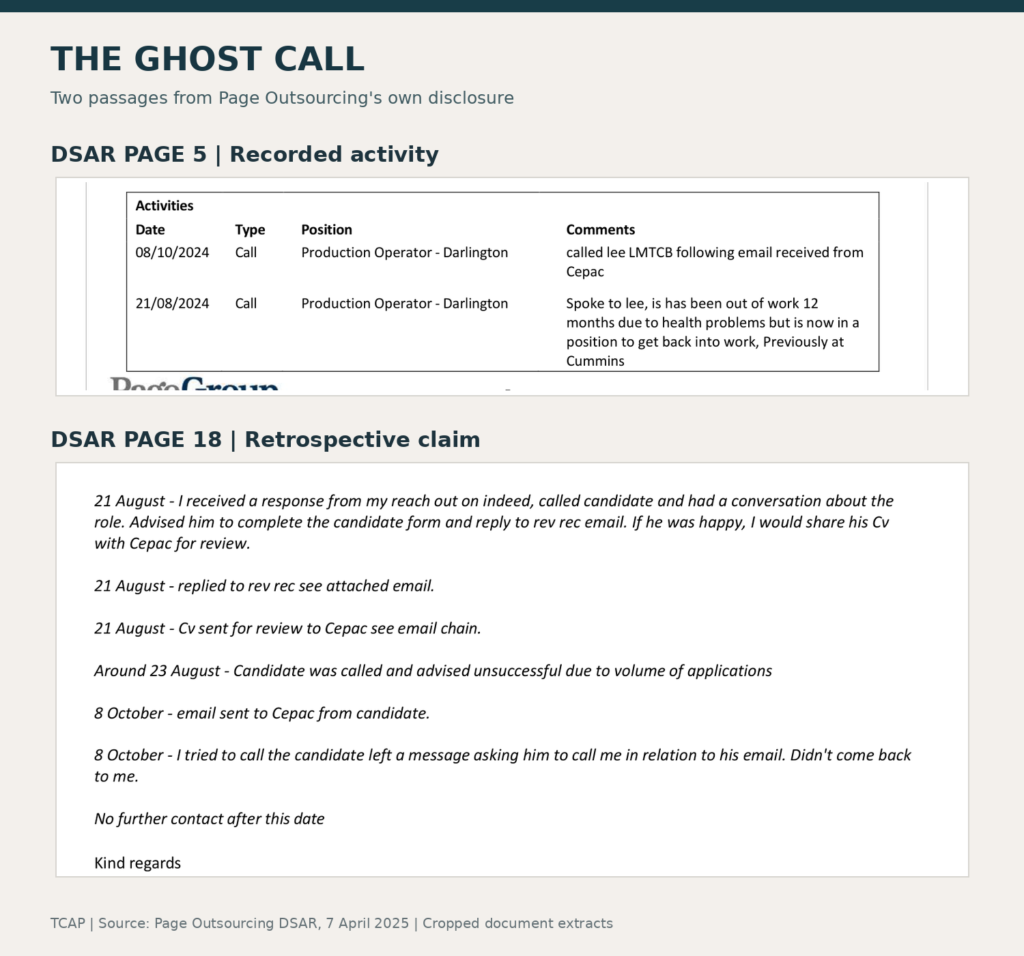
Page’s later chronology says it telephoned to reject me “around 23 August”. Its disclosed activity table records the 21 August conversation and an attempted call on 8 October. It contains no matching rejection-call entry. Page said it did not retain call transcripts; it nevertheless supplied activity records. Those records show other calls. Where is this one?
An entry might exist elsewhere. If so, produce it, with its creation date and any amendments. A rejected status on a candidate screen also needs distinguishing from a conversation with that candidate. Otherwise, we are accepting an estimated reading for an event the person at the other end says never happened. Try that when an energy company wants paying and see how charming it finds the arrangement.
Meanwhile, Page’s August introduction sent Cepac information about my health-related work gap. That does not prove which manager read it or establish discrimination. It does make the route of that information worth tracing. The full Ghost Call investigation contains the documents. This is a specific recordkeeping problem, not an invitation to guess what every black bar in the disclosure conceals.
The Complaint Found A Job
Cepac instructed Horsfield Menzies. Its partner Angus Menzies has written publicly about employers wearing down whistleblowing claims through delay and demands for detail. His 2022 article describes claimants giving up, settling cheaply or running out of money. It also warns employers against retaliation and recommends fair treatment. Read the whole thing: the advice makes a sharper comparison than pretending he published a confession to my case.
My claim concerned disability discrimination in recruitment, not whistleblowing dismissal. Nevertheless, there is a practical example of complaint handling to inspect. In March 2025, I complained to the firm’s partners about contact with my medical centre concerning appointment availability. The firm maintained that the practice disclosed no private information. Daniel Rubin subsequently closed further correspondence about allegations against the firm, while reserving the right to use my emails as evidence of unreasonable conduct. I have received no investigation outcome.
Later, the strike-out material included extracts from my separate report to the Solicitors Regulation Authority. The firm labelled them scandalous, vexatious, unreasonable, disruptive and abusive. These were its classifications, not the regulator’s findings. A versatile little bastard, my complaint: still awaiting an outcome, yet already employed in the case against me. Shell could usefully ask how that squares with the respectful treatment the firm’s own article recommends.
More Than £50,000, And Still No Answer About The Interview
The published judgment records that Cepac incurred more than £50,000 in costs. It also says that the underlying claim would ordinarily have required a two- or three-day merits hearing. Instead, Judge James struck it out following the April 2026 hearing and ordered me to pay £20,000. He blamed my conduct for the escalation and found that my comments about the solicitors lacked a reasonable foundation. I dispute that assessment and have appealed.
Shell should read that judgment alongside the correspondence, including the findings against me. Paragraph 180 expressly acknowledges the consequence: there would be no hearing on the merits. The recruitment question therefore remains unresolved. A successful strike-out is a litigation outcome; it does not supply the missing call entry or identify what the recruiting manager knew.
That distinction matters when assessing a company’s account. Cepac can point to a judgment against my conduct. I can still point to an unanswered question about its recruitment. Both belong in any account of the result. The missing call has not acquired a timestamp simply because the lawyers have acquired a costs order.
The Workers Had Another Bill To Pay
There is another reason to check the age of the success story. The 2024 account described four operating production facilities. Cepac subsequently proposed closing Darlington in September 2026, citing heavy losses and slower-than-expected growth in its Flutepac tray market. It confirmed that production ceased and the first redundancies began on 8 October. For workers who had struck over pay in August 2023, the loss of the site came just over three years later.
Meanwhile, the people leaving Faverdale had a more immediate calculation to make than a carbon conversion: rent, food and the next wage. Sustainable development is an awfully spacious phrase until somebody asks where the workers fit. I would like Shell’s next account of this partnership to say what has changed, rather than leave those four factories forever humming away in 2024.
Shell Can Start With Its Own Words
Shell can establish whether it still supplies Cepac, which sites the relationship covers and whether it still uses the business as a customer example. It can also explain what review applies when documented concerns arise about a company featured in its communications. Those questions concern decisions Shell controls. They do not require it to retry my case or publish somebody else’s confidential employment file.
If the account remains one Shell wants to promote, I would like it to ask Cepac for a response grounded in the records. What supported Walker’s first answer? Where is the alleged rejection-call entry? How did the firm investigate my complaint before correspondence about it became conduct evidence? A reference to the strike-out should come with the passage explaining that the merits went unheard.
The companies were able to explain the energy arrangement in perfectly intelligible English. They found the volume, the technology, the benefits and executives willing to speak. Apply a little of that care to the human question. I wanted a production job. Instead, I have had to assemble a reading list for the electricity company. There is your sodding customer story. Read it.
Lee Thompson – Founder, The Cummins Accountability Project
Source List
- Cepac: Cepac Partners With Shell Energy To Decarbonise UK Operations
- Jodie Eaton, Shell Energy UK: Identifying Opportunities To Help Decarbonise The Packaging Industry
- Shell: General Business Principles
- Shell: Human Rights
- TCAP: Michael Page / Page Outsourcing UK Limited – The Ghost Call And The Client Alibi
- Angus Menzies, Horsfield Menzies: What A Relief!
- TCAP: Gunnercooke – The Fungus Years : Angus Menzies And The Complaint That Became A Conduct Problem
- Employment Tribunal: Thompson v Cepac Limited And Page Outsourcing UK Limited
- Cepac: Proposed Closure Of Darlington Site, 9 September 2026
- Cepac: Statement Confirming Darlington’s Closure From 8 October 2026
- Cepac: Darlington Strike Statement, 14 August 2023