Diageo’s own Human Rights Policy asks whether staff should ignore an informal report about a supplier because they lack proof. Its answer is “No”, followed by an instruction to tell Procurement. Cepac arrives with considerably more than rumour: Page Outsourcing’s interview offer, a same-day WhatsApp receipt, Maria Walker’s later denial and an ET3 that distances Cepac from disability knowledge while carrying health information into its recruitment account. Diageo wrote the rule against looking away. Part Two puts the evidence on its bar.
Part One Left Two Glasses Empty
Part One, The Cepac Files : Diageo, The Dream Team, Dirty Numbers And A Supplier Code On The Rocks, established the public customer trail and put Cepac’s ET3 beside Diageo’s supplier standards. It also examined Diageo’s own adverse disability finding, bribery-control failures, excess shipments, competition settlement, distillery prosecution and Indian product dispute.
That ledger does not need pouring again. Indeed, Part One already showed that corporate policies and actual conduct sometimes occupy opposite ends of the drinks trolley. However, two crucial recruitment documents were absent. Specifically, the article did not show the WhatsApp message created on the day Page Outsourcing offered me an interview. Nor did it show the email in which Cepac HR Business Partner Maria Walker later said no interview had been secured.
Part Two therefore has one disciplined job. It follows the original Page call into the contemporaneous record, through Walker’s 09:52 answer and into the conflicting information inside Cepac’s pleaded defence. Then it applies the instruction Diageo has already given its own people: do not ignore supplier allegations merely because somebody says the proof is incomplete. Tell Procurement and examine them.
Meanwhile, the old scandals can stay behind the optics. This round is about the receipt Diageo has never publicly answered.
The Customer Receipt Is Dated 2023
The public commercial trail remains straightforward. During Cepac’s 2023 pay dispute, Unite identified Diageo among the company’s customers. The union also named Mars, Innocent Drinks, Pernod Ricard, Lidl, Sainsbury’s and other businesses already reached by The Cepac Files.
That evidence establishes the relationship in 2023. However, it does not independently tell the public whether Diageo continued buying from Cepac, changed the arrangement or ended it. Diageo and Cepac hold the purchase orders, supplier approvals and termination dates, so they can provide the current answer without another round of corporate charades.
If the relationship ended, Diageo can identify the date and explain whether the supplier file received any human-rights review. If it continues, Procurement can state the contracts, facilities and supply-chain tier involved. Should Cepac reach Diageo through an intermediary, the company’s supplier-risk systems should trace that route too.
Nevertheless, the date does not remove Diageo from the file. It defines the first question the audit must answer. Indeed, Diageo publicly operated in Cepac’s customer chain, wrote rules for supplier conduct and now possesses a documented reason to establish what happened next.
After all, Procurement spends its life tracing bottles, batches, invoices and counterparties. It can find one cardboard supplier without needing a fucking treasure map.
Diageo Literally Says Do Not Ignore It
Diageo’s July 2024 Human Rights Policy contains a question-and-answer example almost custom-written for this file. An employee hears informally that a supplier faces investigation for a human-rights violation. The supplier has otherwise performed well, and the employee asks: “Should I ignore the rumours since we don’t have any proof?”
Consequently, Diageo’s answer begins with one word: “No.”
The policy directs the employee to inform a manager and the Procurement team so they can determine the next steps. In other words, Diageo rejects the oldest trick in the supplier-compliance drinks cabinet: pretend an allegation does not exist until somebody else has completed the investigation the customer refuses to start.
Moreover, the policy describes a dedicated Responsible Sourcing team, risk assessments, supplier audits, mitigation plans and monitoring of allegation trends, breaches and root causes. Failure to deliver appropriate mitigation can change the commercial relationship and ultimately end trading.
Indeed, the Page and Cepac file clears Diageo’s stated threshold with room to spare. It includes a contemporaneous message, an identified recipient, a supporting witness statement, a dated HR response and a pleaded defence containing health information. No one is asking Procurement to act on bar gossip from a bloke whose fourth Guinness has started offering legal advice.
Diageo says report it. Fine. Here it fucking is.
Page Poured The First Account On 21 August
On 21 August 2024, Page Outsourcing called me about a production role at Cepac. During that conversation, Page offered an interview for the week after the bank holiday and discussed a £27,000 training wage rising towards £29,000. In addition, I explained that treatment for my mental health accounted for the lengthy gap in my employment.
Page said my details would go forward and that another call would confirm an exact, mutually agreeable interview time. The promised confirmation never arrived.
Nevertheless, the first call left a contemporaneous receipt. A WhatsApp exchange created on 21 August, before any complaint, ACAS notification, Employment Tribunal claim or TCAP article existed, preserved two short lines:
“Interview next week”
“27k training wage up towards 29”
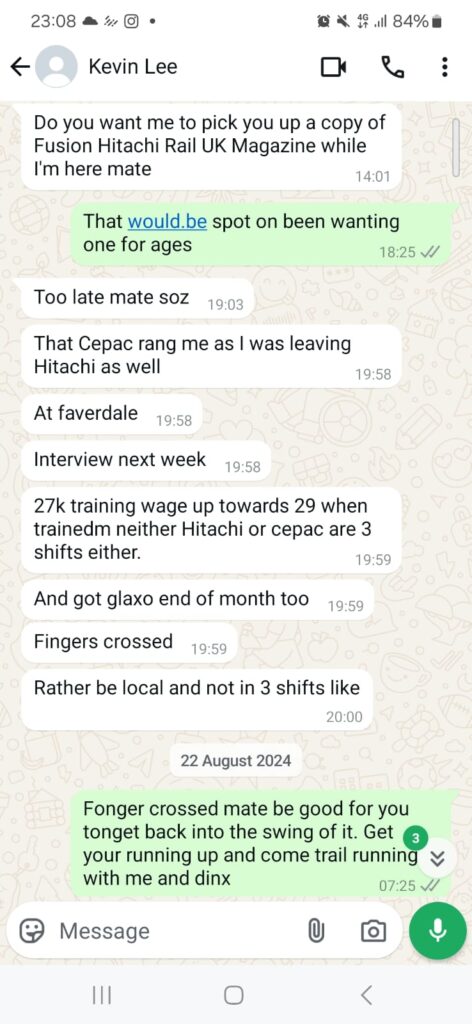
The recipient retained the conversation and later supplied a witness statement dated 20 February 2025 confirming its origin and context. At the time, nobody needed a litigation position. I had received good news and told somebody about it.
That ordinary exchange is precisely what makes it dangerous to the later account. Page discussed the interview and the money. Then it learned about my mental health. Afterward, the confirmation disappeared, but the original order remained on the fucking till roll.
Maria Walker Replaced The Order At 09:52
At 04:35 on 8 October 2024, I complained directly to Cepac. The email described Page’s interview offer, the planned week after the bank holiday, the promised arrangement call, the questions about my employment gap and the disclosure that I had received treatment for a mental-health condition.
Then, five hours and seventeen minutes later, Maria Walker replied. Cepac’s HR Business Partner said Page had conducted an initial telephone screening and sent several potential candidates’ CVs to the company. Afterward, she supplied a different account:
“I can see that your CV was sent to the recruiting manager with a group of potential candidates and unfortunately you were not shortlisted on that occasion.”
Walker maintained that the recruiting manager would not have known about my mental-health information. Her apology concerned Page supposedly failing to tell me that I had not secured an interview. Finally, she promised to send my feedback to the agency “to avoid any future confusion”.
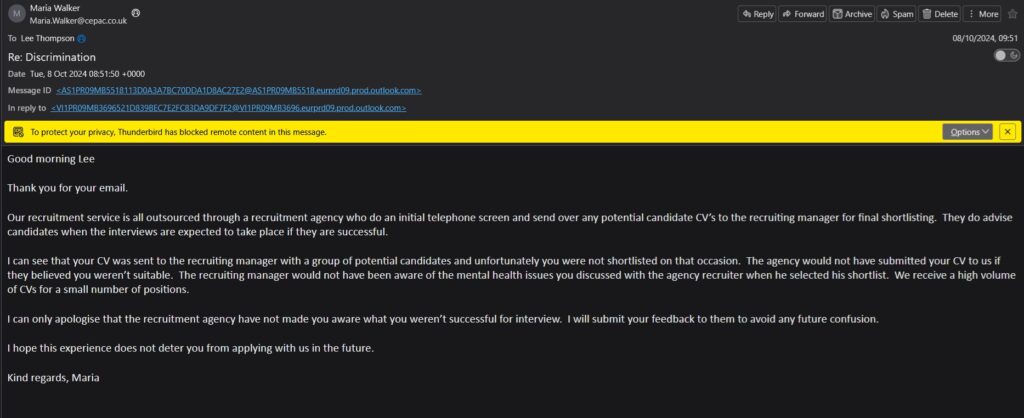
Crucially, Walker had not seen the WhatsApp receipt. Page offered the interview and discussed the salary. I disclosed my mental health. The callback vanished. Cepac later replaced the offered interview with a failure to shortlist before it knew that the original outcome had been recorded that day.
Ultimately, confusion did not produce two accounts. It was merely the polite little cocktail umbrella Cepac stuck into the contradiction.
The ET3 Serves Both Stories
Cepac’s ET3 later made the recruitment account harder to drink. Paragraph 12 distances the company from knowledge of my disability. Paragraph 14 then records recruitment information that I had spent around twelve months out of work because of health problems and felt ready to return.
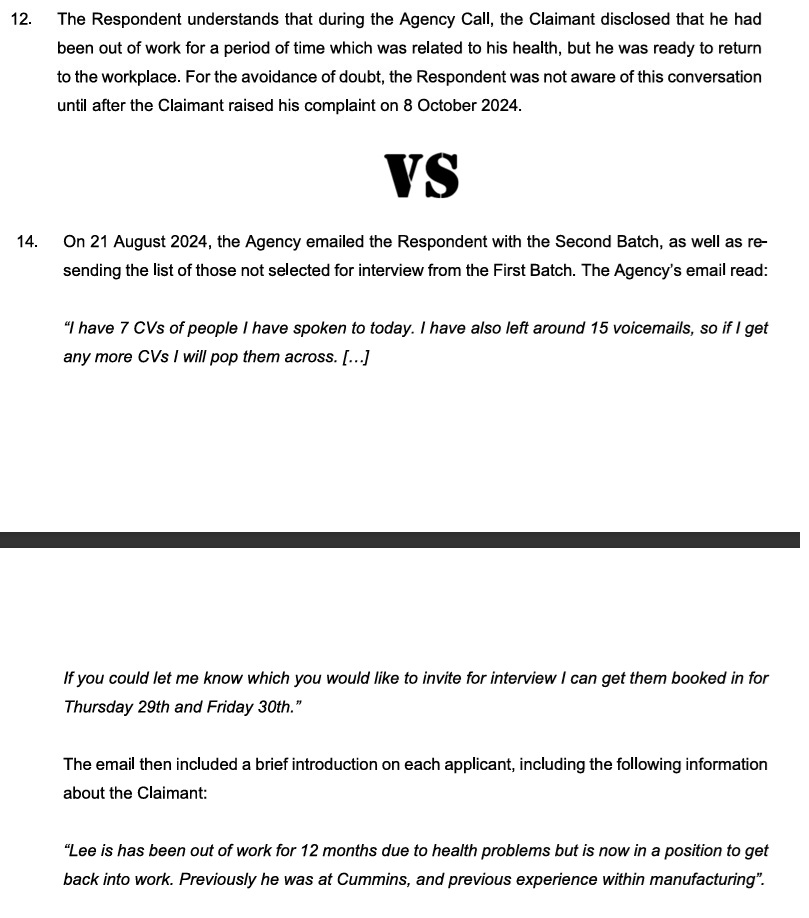
That health information entered the recruitment chain through somebody. Page recorded it, transmitted it or placed it into material that later reached Cepac. Otherwise, Cepac could not have used the information inside its own pleaded explanation of the recruitment process.
Therefore, the questions are ordinary supplier-audit work. What did Page record during the call? Who could access it? When did the candidate status change? What reached Cepac before Walker replied at 09:52? Which document or person supplied the wording in paragraph 14? Why did the promised confirmation disappear after Page learned that my work gap related to mental health?
Indeed, a merits hearing could have tested each point through disclosure and witness evidence. Walker could have explained what she reviewed. Page could have produced its call notes and status history. Instead, the respondents built a route around those records.
Consequently, Diageo’s policy says allegations should reach Procurement even without proof. This one arrives carrying fucking paragraph numbers.
Diageo Promises Access To Remedy
Diageo’s Partnering with Suppliers and Agency Partners standard prohibits disability and health discrimination throughout hiring. It also bans harassment, intimidation, bullying and abuse. Most importantly, suppliers must provide an accessible, trusted, confidential and fair grievance process so workers and communities can obtain timely remedy.
The wider Human Rights Policy removes any room for creative interpretation. Diageo says it does not tolerate threats, intimidation or physical or legal attacks against human-rights defenders. It promises not to impede access to state-based judicial or non-judicial grievance mechanisms. In addition, it says it will work directly with suppliers and customers to remedy human-rights issues once they become known.
Those clauses matter because Cepac did not simply answer my complaint and put the recruitment evidence before a Tribunal. Acting through Horsfield Menzies, it helped turn the complainant into the disputed product. The legal campaign catalogued my correspondence, complaints, articles and reactions while the original Page call remained untested underneath the paperwork.
The inversion was brutally efficient. First, apply pressure to a disabled litigant in person. Preserve the distressed response. Remove the disability, medical deterioration and procedural failures surrounding it. Relabel the reaction as independent conduct. Then use that conduct to argue that the discrimination claim should never reach the evidence stage.
Nevertheless, Diageo promises a fair grievance route and access to remedy. Cepac assembled a roadblock and billed more than £50,000 for the fucking materials.
More Than £50,000 To Avoid The Original Order
In March 2025, Horsfield Menzies estimated Cepac’s costs at £25,000 to £30,000 and offered not to pursue them if the claim disappeared. The firm addressed that pressure to a disabled litigant in person reporting financial hardship, worsening mental health and difficulty participating safely.
The operation then expanded. Cepac’s side gathered correspondence, complaints, TCAP articles and posts on X into a 191-page conduct dossier. Its combined costs schedules eventually exceeded £50,000. Meanwhile, nobody cross-examined Page about the interview, asked Walker to reconcile her denial with the same-day message or traced the health information inside paragraph 14.
Moreover, Horsfield Menzies contacted my medical centre, investigated appointment availability and used the resulting information to resist a postponement. The firm maintained that the centre disclosed no private medical information. That answer leaves the central question untouched: why did Cepac’s solicitors enter the healthcare relationship and treat access to treatment as ammunition against moving the hearing?
Pressure produced reactions. Lawyers collected the reactions, stripped away the medical and procedural context and repackaged them as the reason a fair hearing could not occur. The more the original evidence pointed towards disclosure and cross-examination, the more money flowed towards converting my response into the main case.
Therefore, Diageo says grievance mechanisms must provide remedy and must not face obstruction. Cepac’s strategy turned a vanished interview into a five-figure cover charge for reaching the merits table.
Newcastle Closed The Bar Before Service
The institutional machinery appears in full in Newcastle Employment Tribunal : Deep Dive : Deliberate Maladministration, Disability Shaming, Judicial White Knights, Speed-reader Smith And The Horsfield Menzies Feeding Frenzy. Newcastle’s administration and case management created the conditions in which the conduct dossier could displace the disability-discrimination evidence.
Specifically, correspondence went to the wrong Tribunal office. The contents and visibility of a file approaching two thousand pages remained unclear. Meanwhile, respondent material received rapid attention while claimant applications and medical context disappeared into procedural fog. Employment Judge T. R. Smith said he spent three hours reviewing a 1,941-page file and called me its “principle culprit”. Three days before the decisive hearing, Employment Judge Brain refused the postponement required for safe participation.
On 24 April 2026, Employment Judge James heard the respondents without me. He struck out the claims and later ordered £20,000 in costs. However, the Tribunal never decided whether Page offered the interview, why the confirmation disappeared, what health information moved through the recruitment chain or whether disability influenced the outcome.
Strike-out did not verify Walker’s answer. It did not reconcile paragraphs 12 and 14 or erase the WhatsApp receipt. It closed the bar before anybody served the evidence the claim existed to test.
Consequently, Diageo promises not to impede access to judicial mechanisms. Its supplier benefited from exactly the opposite result.
Procurement Already Has The Order Sheet
Diageo does not need another values workshop. Its policy has already sent the issue to Procurement, and the evidence identifies the records required.
First, obtain Page’s call notes, candidate-status history, any available recording, communications with Cepac and the complete recruitment-system audit trail. Those records should show when Page entered the interview, when anybody changed the status and what information travelled with my CV.
Next, request everything Walker reviewed before replying at 09:52. Cepac should identify the evidence supporting her assertion that I had not been shortlisted, the basis for saying the manager lacked the health information and every internal communication generated after my 04:35 complaint.
Then trace paragraph 14. Diageo can establish the source, author and route of the health-related wording in Cepac’s ET3 before comparing that answer with paragraph 12, Walker’s email and the contemporaneous message.
The legal campaign requires inspection too. Procurement should obtain the March 2025 costs proposal, the schedules exceeding £50,000, the medical-centre correspondence and the 191-page conduct dossier. It should ask who authorised the strategy, what disability and retaliation risks Cepac assessed and whether the supplier notified Diageo of the proceedings.
Finally, establish the commercial position. Which Diageo entities bought from Cepac, when did the relationship begin or end, and what supplier review followed the first TCAP article?
The order is itemised. Procurement only needs to stop polishing the policy long enough to send it.
Diageo Can Pour The Answer
The sequence now fits on one bar receipt. Page called on 21 August 2024, offered an interview, discussed the wage and learned that my employment gap related to mental health. A same-day WhatsApp message preserved the outcome. The promised confirmation never came. When I complained, Maria Walker replaced the interview with a failure to shortlist before she knew that receipt existed.
Meanwhile, Cepac’s ET3 distanced the company from disability knowledge while using health information from the recruitment chain. Instead of testing those facts at trial, the respondents spent more than £50,000 building a conduct case. Horsfield Menzies entered my medical terrain, Newcastle proceeded without me and the underlying discrimination claim never received a merits decision.
Diageo’s rules cover the entire fucking order. No disability discrimination in hiring. No bullying or intimidation. A trusted and fair grievance process. No legal attacks against human-rights defenders. No obstruction of judicial mechanisms. Supplier allegations must reach Procurement even when they arrive without proof.
Most importantly, this allegation arrives with three documents, exact timestamps and the records needed to investigate it. Diageo can identify the current commercial status, open the supplier file, publish its findings and state the remedy. Silence after that is not an evidence problem. It is a decision to leave the compliance bottle unopened because the cardboard kept arriving on time.
Ultimately, Part One put the ET3 on the rocks. Part Two supplies the missing receipt and the HR denial. Diageo wrote “No” beside the option to ignore a supplier allegation.
Time to show whether anybody in Procurement can still read after lunch.
Lee Thompson – Founder, The Cummins Accountability Project
Source List
- Diageo : Partnering With Suppliers And Agency Partners, Updated July 2024
- Diageo : Human Rights Policy, Updated July 2024
- Diageo : Disability Inclusion Guidelines And Disclosure For Employees
- Unite : Darlington Cepac Print Workers Strikes Intensify After Jobs Threat
- TCAP : The Cepac Files : Diageo, The Dream Team, Dirty Numbers And A Supplier Code On The Rocks
- TCAP : Newcastle Employment Tribunal : Deep Dive : Deliberate Maladministration
- Employment Tribunal : Thompson v Cepac Limited And Page Outsourcing UK Limited
- TCAP case file: WhatsApp record dated 21 August 2024; email exchange between Lee Thompson and Cepac HR Business Partner Maria Walker dated 8 October 2024; supporting witness statement dated 20 February 2025; Cepac ET3 Grounds of Resistance; respondent costs schedules, submissions and medical-information correspondence.