
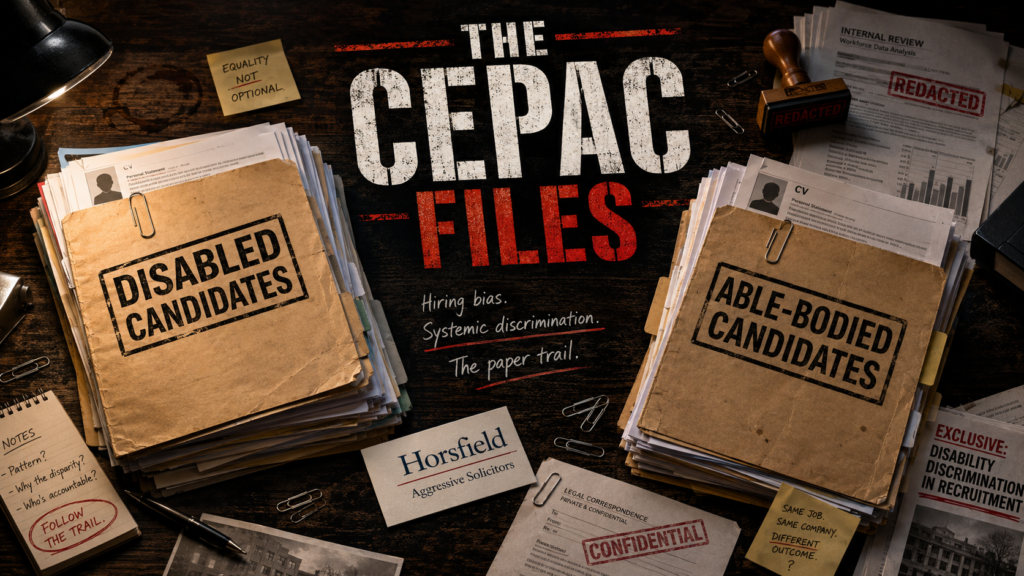
Cepac celebrated an award-winning Absolut display for Tesco. Alongside the trophy sits a less photogenic collection: my same-day WhatsApp, Maria Walker’s no-interview explanation and an ET3 that puts health information inside the recruitment chain. Tesco says campaigners help it identify supply-chain risks. Here comes one with the fucking receipts.
Every Little Helps
Every little helps, unless you’re disabled and apply for a job at their suppliers? Tesco has spent years putting that slogan over the entrance. I would like to know how far it travels in the other direction, past the shelves and into the businesses producing the displays. Because the cardboard in this story reached the shop floor. The recruitment complaint ended in a conduct case, a strike-out and a £20,000 bill.
Part One, Tesco And The Every Little Helps Supply Problem, followed the Cepac connection through C&D Foods. Now there is a named Tesco display, an award organiser’s record and the recruitment evidence that the first article lacked. Cepac has supplied the commercial introduction itself. How thoughtful. Usually somebody has to spend hours following the packaging; this time it arrived wearing a rosette.
The rest of the file needs rather less flattering lighting. Cepac’s later account said I had never secured an interview. However, a message sent on the day of the call preserved what I understood Page had offered. Walker supplied her explanation before seeing that message. Then Cepac’s defence brought an August email into the story. There is plenty here for a retailer that says it wants information about its supply chain.
Tesco On The Trophy
On 22 January 2026, Cepac published its review of 2025. It named an Absolut Warhol freestanding display for Tesco, produced in partnership with Pernod Ricard. Separately, the UK Packaging Awards’ 2025 winners list records Cepac’s Tesco project in its corrugated retail-ready and point-of-sale category. The Tesco Cepac connection therefore rests on a specific piece of work and two published accounts of it.
The trophy identifies the project. Tesco, Pernod and Cepac hold the details of who commissioned it, who paid and whether further orders followed. A 2025 award cannot tell us what sits in an October 2026 order book. Nevertheless, the named project gives Tesco a straightforward place to begin: follow the order and identify the standards that applied to it.
Meanwhile, the Warhol stand has done its job beautifully. It made the bottle visible, gave Cepac something to celebrate and put Tesco’s name in the award record. The recruitment documents offer a different exhibition. No drinks reception, no congratulatory photograph, just dates and accounts that need putting beside each other. Bloody awkward when the less decorative paperwork also deserves an audience.
The Campaigner Has Arrived
Tesco’s 2025/26 Modern Slavery Statement recognises campaigners, whistleblowers, human-rights defenders and activists as sources of information about risk. Its wider human-rights framework also reaches beyond the first supplier in the chain. This file concerns alleged disability discrimination in recruitment. Tesco’s stated willingness to learn from people raising concerns gives it a way to examine that file.
Good. The campaigner has arrived. He has the WhatsApp, the HR reply and the employer’s pleaded defence. There is also a record of what happened after he complained. Presumably the invitation extends to information that makes a supplier uncomfortable. Otherwise, Tesco has advertised for a smoke alarm and will accept only applicants prepared to describe the fire as seasonal warmth.
Its Code of Business Conduct tells colleagues to consider suppliers’ values alongside price and quality. The human-rights section directs concerns to Responsible Sourcing and includes goods not for resale and services. Tesco also rejects disability discrimination in its own recruitment. Those employment rules govern Tesco’s hiring; the question for this series is what Tesco expects from the companies producing work for its stores. Fairness becomes a pretty shabby principle if it expires at the edge of the payroll.
The Interview Before The Lawyers
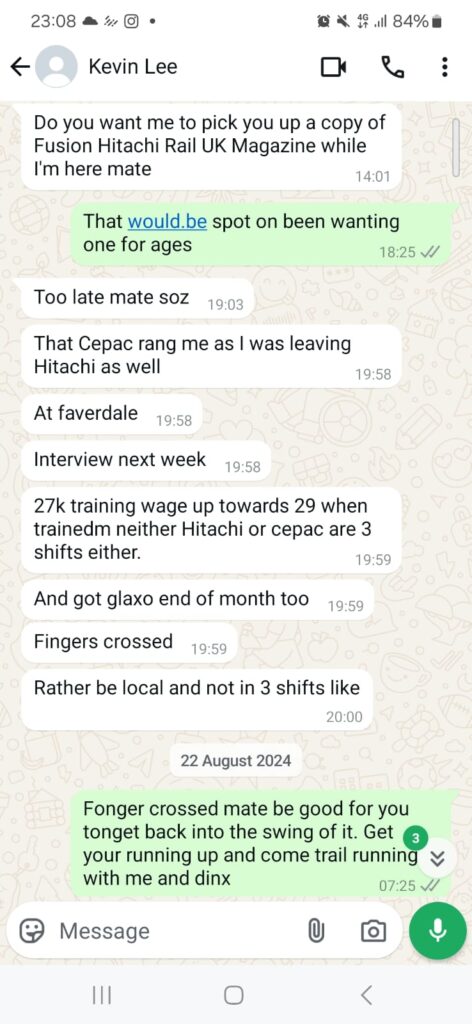
On 21 August 2024, Page Outsourcing called me about a production job at Cepac. During the call, we discussed an interview for the week after the bank holiday. The training wage was £27,000, rising towards £29,000. I explained that my employment gap involved treatment for mental-health problems. Page would call again to agree the exact interview time. That call never came.
Later the same day, I messaged a friend: “Interview next week” and “27k training wage up towards 29”. Two ordinary lines about a possible return to work. At that point, there was no complaint, no ET3 and no legal bill. I was telling somebody about the call I had just had, complete with the money and the expected interview timing.
The recipient kept the exchange and later supplied a supporting witness statement dated 20 February 2025. The screenshot records my account of Page’s call. Its value is the timing and the detail, preserved before the dispute began. Page’s call notes, any retained recording and its candidate-status history would allow that account to be checked against the agency’s records. Somewhere in that sequence, an interview discussed for the following week became an application that supposedly never reached the shortlist.
Maria Walker Calls It Confusion
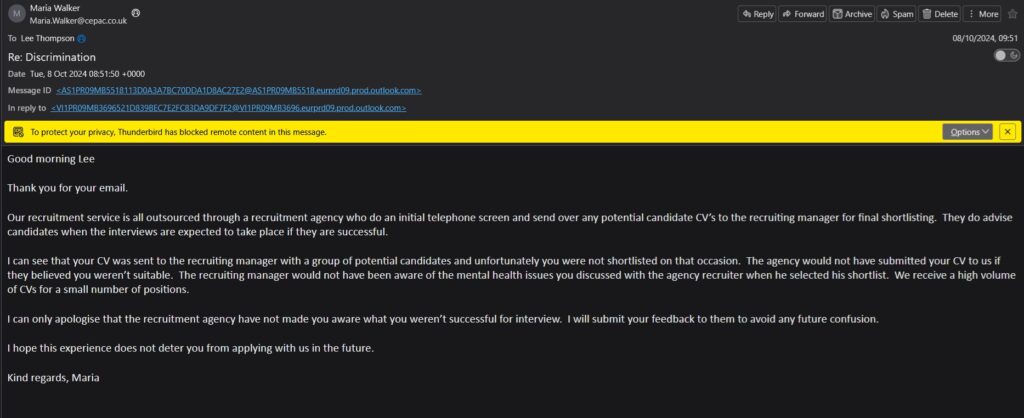
At 04:35 on 8 October 2024, I emailed Cepac about the missing interview confirmation and the mental-health disclosure. Its HR Business Partner, Maria Walker, replied at 09:51. She described Page’s screening process and the referral of CVs to the recruiting manager. According to her reply, I had not reached the shortlist. She also maintained that the manager would not have known about the mental-health discussion.
Walker attributed the problem to Page failing to explain that I had not secured an interview. So the interview I had reported to my friend became a failure to shortlist, followed by an apology for confusion. She had not seen the WhatsApp when she wrote that reply. Meanwhile, the message was sitting there with the interview timing and the salary, doing the inconvenient thing that dated records do: remaining exactly where the chronology put them.
What did Walker check before answering? Page’s records should show whether its caller spoke prematurely, whether the candidate status changed and when the manager made the decision. Her explanation needs those records behind it. An HR signature cannot perform their job. “Confusion” is a useful word for finding your car on the wrong supermarket level. It is a piss-poor stopping point for a complaint about an interview disappearing after a health disclosure.
Paragraph Fourteen Has Other Ideas
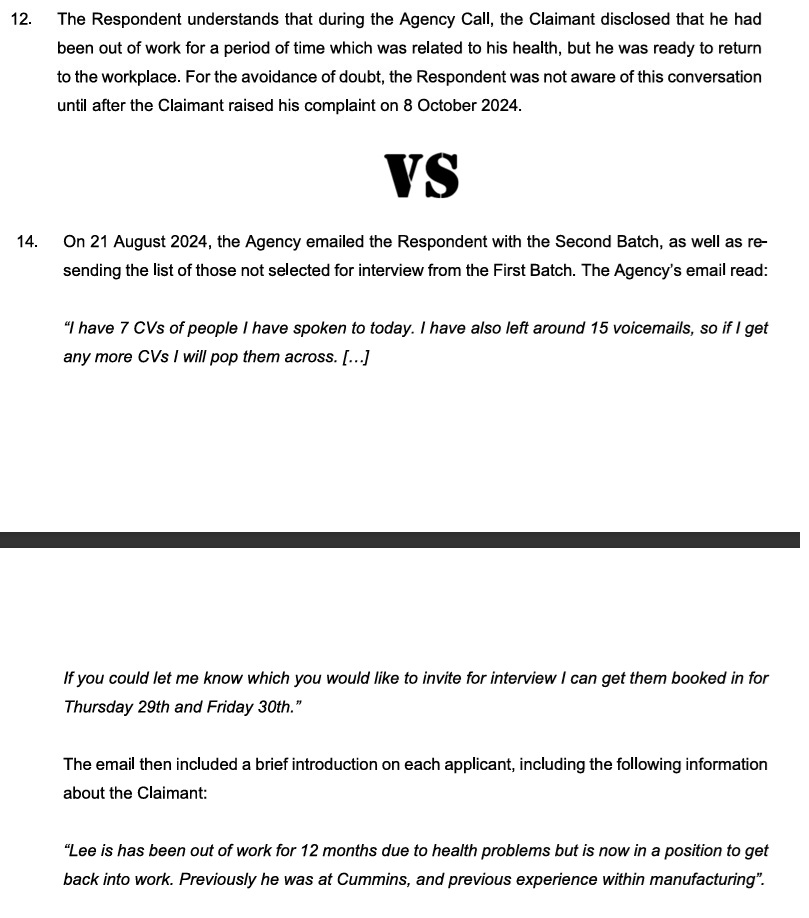
Cepac’s ET3 adds another document to the conveyor belt. Paragraph 12 places the company’s awareness of the detailed agency conversation about my health-related employment gap after the October complaint. However, paragraph 14 records an email Page sent Cepac on 21 August. That email described around twelve months out of work because of health problems and my readiness to return.
Knowing the details of the telephone conversation and receiving an email about health problems are different things. Nevertheless, the August email puts health information inside Cepac during recruitment. Who received it? Its onward route, access history and timing against the selection decision matter. The manager’s knowledge needs establishing from that trail, rather than assuming either that everyone knew everything or that information stopped dead at the company entrance.
Put paragraph 14 beside Walker’s reply and ask for the email. Then identify its recipients and the person who decided against the application. This is the point at which the reassuring account needs an actual record behind it. Corporate bollocks usually enjoys considerable room to manoeuvre. Timestamps make the room smaller.
Michael Page And The Black Marker
Page’s data-access disclosure makes following that route harder. Names and passages appeared under redactions, with third-party information cited as the reason. The Page Partners article examines the disclosure. Here, the problem is practical: the questions concern who handled the application, what they recorded and where they sent it. Blacked-out connections cannot explain themselves.
Protecting unrelated personal information still leaves the recruitment decisions needing an answer. An investigator needs sufficient access to identify the people involved and compare their records. Otherwise, the applicant receives a file that resembles a crossword after somebody has confiscated the clues. Page conducted the call and passed information to Cepac. Its part in the story needs examining alongside Walker’s reply, however enthusiastically the marker pen has fucked with the reading experience.
Horsfield Menzies At The Surgery Door
By the time Horsfield Menzies contacted my medical centre about appointment availability, this dispute had travelled a considerable distance from a production-job interview. The firm used the resulting information to oppose a postponement. Its enquiries concerned access to an appointment. That specific intervention brought my healthcare arrangements into the argument over whether the proceedings should go ahead.
Think about the journey. First came questions about a recruitment call and a health disclosure. Later, solicitors were checking appointment availability while opposing more time. Meanwhile, correspondence, complaints and publications supplied material for the case about my conduct. The pressure surrounding those reactions belongs in the same account. Cut it away and the resulting presentation can make distress look as though it wandered into the proceedings entirely on its own.
That is the objection Tesco needs to understand when examining the later conduct. It should read the medical correspondence alongside the account of my reactions and the reasons for seeking postponement. A neat bundle can still contain a thoroughly ugly sequence. Arranging the pages professionally does not remove what happened between them, however much the resulting bill suggests that somebody has polished the shit to a remarkable finish.
The £50,000 Detour
The respondents submitted combined costs schedules exceeding £50,000. Following the hearing on 24 April 2026, which proceeded in my absence, Employment Judge James struck out the claims and ordered me to pay Cepac £20,000. His written judgment is dated 28 April. Those are different figures: the costs presented by the respondents and the amount the Tribunal ordered me to pay.
The Tribunal found my conduct of the proceedings unreasonable, scandalous and vexatious. Its published judgment explains those findings. However, it did not determine the recruitment discrimination allegations at a merits hearing. The call, the missing confirmation, Walker’s explanation and the health-information trail therefore did not receive that examination.
I challenge the way the proceedings handled my disability and the surrounding pressure in TCAP’s Newcastle Employment Tribunal investigation. Tesco can read that account, the judgment and the documents together. Cepac secured a strike-out and a costs order. Neither supplies the missing account of who made the recruitment decision, when they made it or what information they used.
Yet that is where the danger sits for a retailer accepting the outcome as an answer to everything. Feed an unresolved recruitment complaint through a conduct ruling and it can emerge looking as though somebody cleared the supplier on recruitment. What a useful little machine. Unfortunately, the paper at the other end still says what the Tribunal decided. It cannot bear an acquittal sticker for questions the hearing never tried.
The Cardboard Still Counts
Tesco’s 2025/26 statement sets out a 2026/27 focus on adding minimum requirements to contracts for goods and services not for resale. It also describes further checks based on risk. That is work in progress, which makes the contractual history of this display worth establishing. Tesco should identify the requirements that actually applied when the work took place, alongside those it expects for any continuing relationship.
Was the stand a Tesco purchase, a Pernod-funded promotion or another arrangement? The answer identifies who commissioned the work and which company holds the relevant terms. Pernod’s place in the chain also gives Tesco somebody specific to ask. However, handing the question across a purchasing desk cannot be the whole enquiry. Somebody must follow it through to the producer.
The stand exists to sell vodka. Its commercial purpose survived every handover required to design, print and deliver it. A concern about its producer ought to be capable of travelling the same route. Otherwise, we have a supply chain wonderfully efficient at moving bottles and apparently incapable of moving an email. That would be an impressive logistical achievement in the field of arse-covering.
Give The File To Somebody
Tesco identifies Responsible Sourcing as a destination for supply-chain concerns and describes work on grievance mechanisms, including its Protector Line. There is therefore a route for this material. The useful next step is a named team taking responsibility for examining it, obtaining the relevant records and explaining what follows. A reporting channel earns its keep through the work behind it.
Start with the Tesco project and the present commercial relationship. Then obtain Page’s recruitment records, the August email and its recipients, and the material Walker reviewed before answering. Compare the WhatsApp chronology with that record. The medical-centre contact and the later litigation need their own examination alongside the original recruitment complaint. Cepac and Page can explain the discrepancies; I can respond to those explanations and identify anything they leave out.
After that, Tesco can state what it established and what action its findings require. Corrections, changes to recruitment practice or commercial consequences should follow the evidence. Simply passing my complaint back to its subjects would leave Tesco dependent on the account it needs to examine. We already have an HR explanation. Another copy with a retailer’s forwarding header would add bugger all.
Unexpected Evidence In The Bagging Area
Cepac’s Tesco display won attention and an award. Now the less marketable part of the file is here too: a same-day interview message, Walker’s later explanation, an August email mentioned in the defence and a recruitment dispute that ended without a merits hearing. Together, those documents give Tesco specific questions to ask. None requires a new values campaign before somebody can pick up the phone.
The retailer says it wants information from campaigners. Its code also tells colleagues to consider suppliers’ values. Fine. Here is a named project and the material about its producer. Tesco can establish the commercial route, examine the complaint and explain the result. The invitation has reached somebody with evidence to bring. This is where we find out what happens after the welcoming paragraph.
An unexpected item in the bagging area stops a checkout until somebody attends to it. Perhaps the supplier file could receive the same fucking consideration. The WhatsApp is still there, Walker’s email still needs comparing with it, and paragraph 14 still contains that August message. Tesco knows how to summon assistance when a bag of shopping refuses to balance. Who attends when the paperwork does?
Lee Thompson – Founder, The Cummins Accountability Project
Sources
- Cepac: Reflecting On 2025
- UK Packaging Awards: 2025 Winners
- Tesco PLC: Modern Slavery Statement 2025/26
- Tesco PLC: Code Of Business Conduct
- TCAP: Tesco And The Every Little Helps Supply Problem
- TCAP: KFC II, Maria Walker And The Interview Receipt
- TCAP: Page Partners, Redactions, Panic Calls And The Disabled Candidate They Googled
- TCAP: Newcastle Employment Tribunal, Deliberate Maladministration
- Employment Tribunal: Thompson v Cepac Limited And Page Outsourcing UK Limited
- Primary case material: WhatsApp exchange of 21 August 2024; witness statement of 20 February 2025; complaint and Walker reply of 8 October 2024; Cepac’s ET3; Page’s data-access disclosure; medical-centre correspondence; respondents’ costs schedules.