
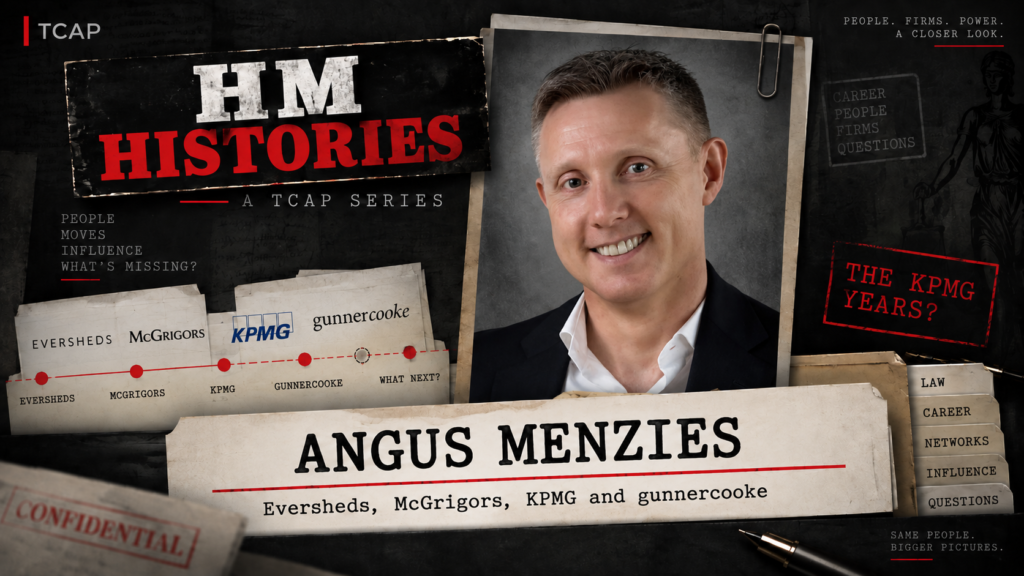
Angus Menzies at Gunnercooke ought to be an easy assignment. Nevertheless, I am slightly aggrieved at having to research it. Usually, the goblin saves TCAP the trouble by publishing his own character reference. His articles can be so blunt about litigation pressure that an investigator mostly needs quotation marks and a functioning copy button. Now the selfish little bastard has made me open the professional archive. Some consideration for the independent press would have been nice.
Regular readers will understand the grievance. In “What a Relief!”, Angus described claimants giving up, settling cheaply or exhausting their money, and employers regarding that as a “decent result.” His article also praised employers who handle whistleblowing properly. However, its account of attrition hardly required TCAP to bring a fucking decoder ring. This time, HM Histories follows his career from McGrigors and KPMG to Gunnercooke, where another solicitor’s handling of the client account supplies the institutional story.
Angus Menzies At Gunnercooke: The Paper Trail
A settlement agreement dated 14 September 2018 provides a particularly solid career marker. Published in a US Securities and Exchange Commission filing, it identifies Angus Menzies of Gunnercooke as the employee’s independent adviser. His signed endorsement sits at the end. Meanwhile, Gunnercooke’s own website advertised him that November as the employment partner hosting a webinar about defending whistleblowing claims. The connection comes from contemporary records, rather than somebody squinting at a recycled biography.
We have already visited Gunnercooke through Simon Horsfield. That chapter examined Eliot Lopian’s forged signatures in a property transaction. Now Angus brings us back to the same firm through a different door. The case concerns consultant Paul Corren and client-account transactions between December 2020 and May 2022, followed by a regulatory settlement in January 2025. The decision identifies no involvement by Angus. His career supplies the route into the institution; Corren’s admitted misconduct supplies this chapter’s subject.
Ten Thousand Hours, And A Rather Basic Expectation
Gunnercooke’s archived Angus brochure announced: “We don’t believe in law as usual”. It said every Gunnercooke lawyer had at least 10,000 hours of practising experience. Moreover, it presented flexibility, transparency and freedom as guiding principles, with clients benefiting from the removal of time recording and billable hours. The proposition was experienced lawyers freed from familiar restrictions. Presumably, the Accounts Rules still travelled with the furniture.
That promise gives the reader a reasonable expectation. A firm selling accumulated judgment should manage the distinction between providing legal services and providing somewhere convenient to move money. After all, nobody needs 10,000 hours to appreciate that an account operated by solicitors carries a particular kind of trust. The professional name helps reassure people that somebody competent understands what is happening. Otherwise, the impressive biography becomes a very expensive fucking label on the stationery.
There is nothing especially rebellious about obeying a basic financial safeguard. Yet this is where the challenger-brand patter meets the dull work that keeps a profession credible. Freedom makes attractive recruitment copy. A payment control has to work on an ordinary Tuesday, when somebody wants something processed and nobody gets an award for asking an awkward question.
Nearly A Million Pounds Enters The Client Account
The SRA’s agreed decision records that Corren requested and authorised receipts totalling £951,945 and payments totalling £578,233 for one individual and three companies. It found no evidence of a meaningful connection between those transactions and the firm’s regulated services. Corren admitted allowing the client account to function as a banking facility. Consequently, the regulator found breaches of the accounts rule and the principle requiring solicitors to uphold public trust and confidence.
Those figures require care. Receipts and payments describe separate movements; they do not establish a pot of missing money. What makes the record ugly is the absence of a meaningful connection to the legal work. A client account comes with a professional purpose. Here, substantial sums passed through it without the connection the regulator required. The letterhead remained suitably reassuring while the underlying justification fell short.
Nor did the SRA describe a solitary administrative wobble. It called the sustained activity across four clients a “pattern of misconduct.” That is considerably harder to squeeze into the comforting little drawer marked occasional cock-up. Repetition matters because every new transaction presents another occasion to ask why the money belongs there. Apparently, the question needed considerably more professional attention than it received.
This Rule Had Been Around Since 2004
According to the decision, the restriction dated back to March 2004. The SRA first issued its warning notice in December 2014 and updated it in November 2019. Corren had qualified in 1993. Therefore, this was an experienced solicitor dealing with a long-established restriction, supported by warnings published before the misconduct began. The regulator expressly said he should have known the rule.
Christ, the profession does enjoy making ordinary obligations sound like an expedition. Here, the destination was already on the map. Nobody needed to discover a new principle, reconcile competing jurisdictions or wait for a brave appellate court to explain the obvious. The instruction concerned what solicitors could do with their client account. An experienced practitioner had ample opportunity to become acquainted with it before arranging substantial receipts and payments.
That makes the brochure’s expertise pitch particularly irritating. Years in practice should improve the judgment brought to routine decisions. Instead, the regulatory record gives us a veteran practitioner breaching an established boundary over a sustained period. All that accumulated experience, and the regulator still had to explain where the bloody banking service ended and the legal practice began.
Why The Solicitor’s Name Matters
The SRA’s warning explains the concern in plain terms. Moving money through a solicitor’s account can lend transactions professional credibility. Furthermore, banking facilities provided through law firms can evade controls that banks apply. The rule requires a proper connection with regulated services; simply having a client relationship does not provide permission to process money freely. A client’s convenience cannot supply the missing justification.
Think about what the professional name contributes. People understand that solicitors handle transactions, hold money and answer to a regulator. Consequently, the name can make an arrangement feel safer before anyone has examined the arrangement itself. That confidence is valuable. It also creates an obligation to check that the service actually warrants it. You cannot keep selling the reassuring wrapper while treating the contents as somebody else’s tedious little problem.
The Corren decision records no actual harm and makes no finding of money laundering. The breach concerns a safeguard against risks, including laundering. That distinction explains why the rule matters before disaster arrives. A preventive control does its useful work while someone can still stop the transaction. Waiting for a victim would make a piss-poor substitute for professional judgment.
The Fine, The Discount And The Firm’s Response
On 8 January 2025, Corren agreed to a £14,116 fine and £1,350 investigation costs. The penalty reflected a reduction for his cooperation. Legal Futures subsequently reported Gunnercooke’s response: “No finding was made against this firm.” The firm also said it had strengthened controls over client-account payments before the investigation began and considered its procedures fully compliant.
Those changes deserve inclusion. Stronger controls can prevent a repetition, and cooperation gives a regulator a better chance of establishing what happened. However, neither makes the earlier record disappear. The transactions still occurred through the firm’s account. Its consultant still admitted misconduct. A corrective response should improve what happens next; it cannot retrospectively supply the missing connection between earlier money movements and legal services.
The institutional question therefore survives the carefully drawn distinction between the practitioner and the firm. What practical checks govern money passing through the account? How readily can somebody stop a transaction and demand an explanation? Gunnercooke’s response says the controls increased. That is useful information, but readers can reasonably expect the promotional enthusiasm for professional excellence to leave room for the regulatory history too. The brochure cannot have sole custody of the fucking reputation.
A Different File In The Same Professional Archive
Our previous Gunnercooke chapter concerned forged signatures used to repair a property-transfer mistake. This one concerns a client account used as a banking facility. The misconduct differs, and so do the people responsible. Nevertheless, both records test the reassurance attached to a solicitor’s name. A signature must represent the person who supposedly supplied it. Money passing through a professional account needs the proper professional basis. Neither expectation seems outrageously demanding.
This is precisely why HM Histories opens the employers behind the biographies. A CV can supply an impressive name without explaining the institution’s less flattering record. Meanwhile, the marketing department has every incentive to keep the reader moving towards the enquiry form. TCAP is quite happy to interrupt that journey. Before anyone buys the prestige, they can inspect the parts that never acquired a celebratory press release.
Angus Menzies at Gunnercooke gives us another documented career connection and another reason to examine what professional experience is supposed to guarantee. The promise involves judgment, restraint and the confidence to refuse work that falls outside the rules. When those qualities fail, an impressive number of hours becomes a surprisingly unhelpful unit of measurement.
Fungus Can Have His Copy Button Back
Angus normally makes this work easier. His public writing describes the pressures inside employment litigation with a candour that leaves TCAP looking mildly redundant. However, this chapter required a trip beyond his commentary and into a former firm’s regulatory record. There we found substantial client-account movements, an admitted breach and a fine. The expertise brochure and the disciplinary decision make instructive reading together.
The criticism is straightforward. A profession that sells trust should be especially good at protecting the mechanisms through which that trust operates. If a client account acquires the function of a bank account, the professional safeguard has already gone wrong. Correcting the controls matters. Remembering why they needed attention matters as well.
So there is the next entry in Angus’s career map: Gunnercooke, its promise of experienced judgment, and a consultant fined for a sustained breach of an elementary restriction. The goblin may now resume his usual service of explaining the litigation machinery himself. Meanwhile, his former firm’s brochure can keep its talk of freedom. The client account still needs someone prepared to say no. Ten thousand hours should be plenty of time to learn that fucking word.
Lee Thompson – Founder, The Cummins Accountability Project
Sources
- HM Histories: Angus Menzies – McGrigors, The KPMG Divorce And The Pinsent Wedding
- HM Histories: Angus Menzies At KPMG – Silentnight And The Burning Bullshit
- HM Histories: Simon Horsfield – Gunnercooke, Eliot Lopian And The Three Forged Signatures
- Gunnercooke: Angus Menzies – Archived Professional Brochure
- SEC: Richard Davies Settlement Agreement And Angus Menzies’s Independent Adviser Endorsement, 14 September 2018
- Gunnercooke: Whistleblowing Claims And How To Defend Them, 22 November 2018
- Horsfield Menzies: Angus Menzies – What A Relief!
- SRA: Paul Corren – Regulatory Settlement Agreement, 8 January 2025
- SRA: Improper Use Of Client Account As A Banking Facility – Warning Notice
- Legal Futures: Fee-Share Partner Fined For Using Client Account As Banking Facility, 15 January 2025