
Scottish Shellfish helped Cepac design a box that could keep a mussel alive. Its welfare policy says what to do about damaged stock: check the batch and tell the farm. Cepac put more than £50,000 in legal costs on its schedules. I’m still waiting for somebody to check a phone call.
Somebody Tells The Farm
There’s a line about eider ducks in Scottish Shellfish’s Mussel Health & Welfare Policy. Staff can discourage them humanely where practical. Mostly, though, there are so many that you record the sighting and leave the duck to its business. A bird can turn up uninvited for lunch off the Scottish coast and leave a better paper trail than the call Page Outsourcing says it made to reject me for a job.
The useful bit comes further down. When a batch arrives, the co-operative says it samples mussels from several bags, checks for cracked or broken shells and sends the assessment back to the farm. That way, somebody can work out whether the damage happened at harvest or in transit and change what happens next time. It’s a sensible policy. Nobody asks whether the mussel has become rather unpleasant about the journey.
Scottish Shellfish Marketing Group has a reason to recognise the name at the top of my file. In 2020 its supply-chain manager, Greg Farquhar, described working directly with Cepac on its Chiller Pack. The Rawcliffe team developed a corrugated box with a waterproof liner that lets excess water drain away. The mussels travel alive without sitting in meltwater. It won an Aquaculture Award. Fair play: keeping wet shellfish alive in a cardboard box is a bloody good bit of engineering.
Two Packs, Six Years Apart
This April, Scottish Shellfish and Asda launched mussels with chorizo in tomato and Rioja cream. The Marine Stewardship Council identifies the co-operative and the retailer, right down to the recyclable bowl and its peelable lid. It doesn’t name Cepac. A bowl for the microwave and a box for transporting live mussels are different purchases. Anyone joining those two bits of packaging with a felt-tip pen will have drawn precisely one felt-tip line.
So the first question for the buyers in Bellshill is straightforward: did that project lead to production orders? If so, when was the last one and what did it cover? If Cepac packaging still travels into Asda’s supply chain, the retailer’s July 2026 supplier standards matter. They reach beyond direct suppliers. In particular, they prohibit screening people out over medical history. They also require suppliers to report certain labour allegations at current or proposed production sites. That’s a reason to check the orders before reaching for the code.
The Reply Came Before The Referral
On 21 August 2024, Page Outsourcing rang me about a production job at Cepac’s Darlington factory. In my complaint I said exactly what I meant: “I was called and offered an interview.” The recruiter said it would be after the bank holiday and promised to ring the following week to fix a time. Asked about my break from work, I explained that I’d had treatment for a mental-health condition. I believe that disclosure cost me the interview.
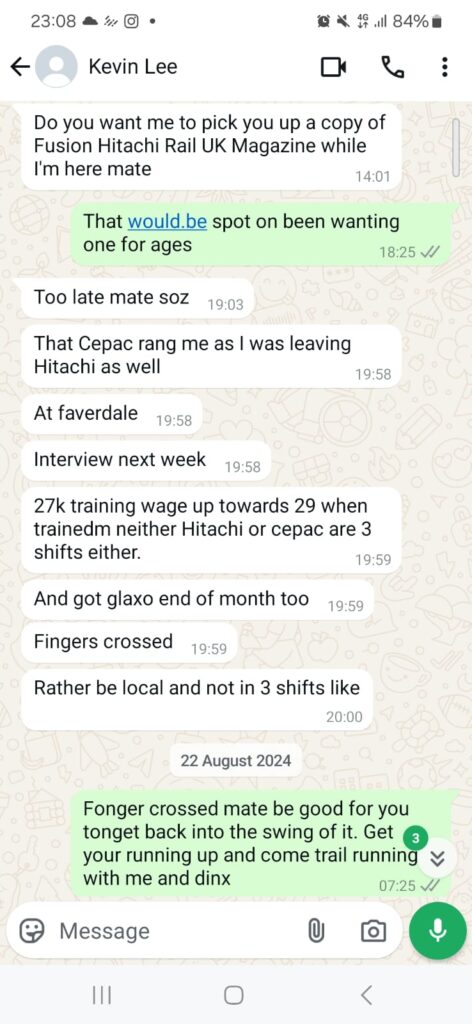
That evening I wrote to a friend: “Interview next week” and “27k training wage up towards 29”. Just above that, we’re talking about picking up a magazine. A few lines later I’m weighing up the shifts and how close the job is to home. My friend later signed a statement confirming the exchange. Who the hell expects to need a witness to their own good news?
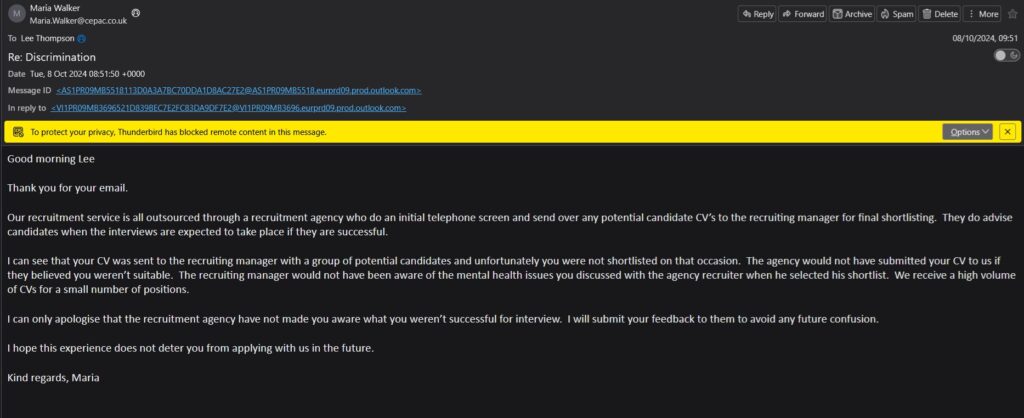
The confirmation never came. At 04:35 on 8 October I asked Cepac what had happened. At 09:52 Maria Walker, its HR Business Partner, said the manager hadn’t shortlisted me and wouldn’t have known about the mental-health discussion. She apologised for Page failing to tell me I hadn’t got an interview. I hadn’t shown her the WhatsApp. At 12:48 Cepac forwarded my complaint to Page. Walker may have checked something else that morning. What she didn’t have at 09:52 was Page’s answer to an email Cepac would send nearly three hours later.
The Phone Call With No Matching Entry
Start with Cepac’s own tribunal defence.
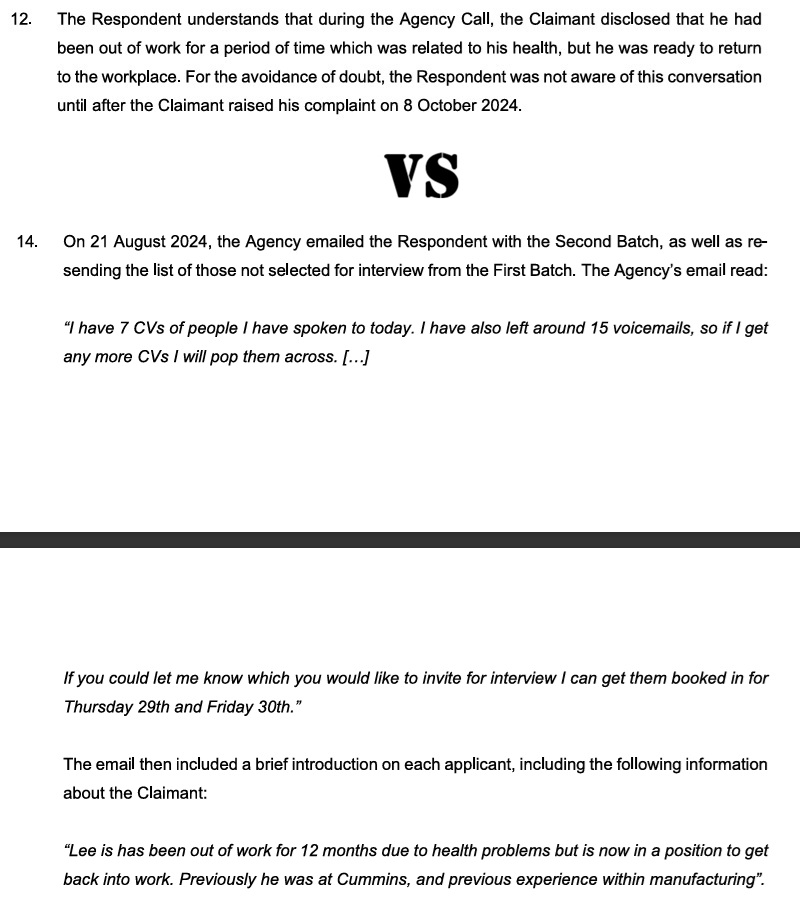
Paragraph 12 says it didn’t know about the conversation until my October complaint. Yet paragraph 14 reproduces Page’s August email telling Cepac that I’d been out of work for health reasons. An employer can receive the gist without knowing the whole conversation or my diagnosis. So which version reached the person drawing up the shortlist?
Page’s account makes Walker’s apology stranger still. She said the agency hadn’t told me. Page said it had. An internal email said the August call was on its recruitment system, “CC”. By December, a chronology placed the rejection call “around 23 August”. By contrast, the activity table Page sent me lists the original 21 August call and an attempted call on 8 October. Look for an August rejection, however, and there’s no entry to match.
Those are activity records, not recordings. Page told me it didn’t record or retain call transcripts. I dispute receiving that rejection call. Even so, a gap in the table doesn’t prove invention. What would help is the original CC entry: when someone created it, whether anyone edited it and what the recruiter actually recorded about speaking to me. The Ghost Call And The Client Alibi puts the extracts side by side. A reader can make the comparison in less time than it takes to leave a voicemail.
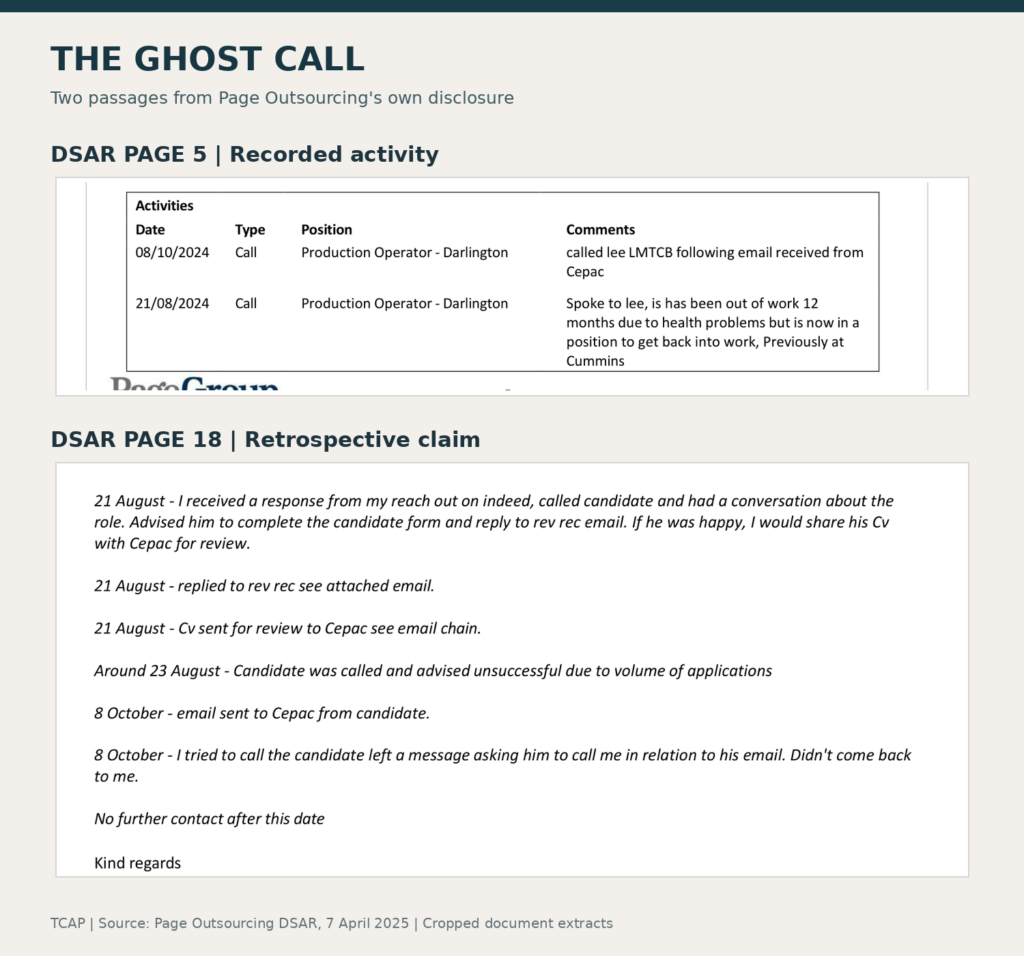
Horsfield Menzies Had A Column For That
Cepac hired Horsfield Menzies. For a feel for its approach, listen to partner Angus Menzies at 37:32 in his gunnercooke webinar. He explains how an employer defending a whistleblowing dismissal can distinguish a disclosure from the way the worker subsequently pursued it. In his later article What a Relief! he also describes why delay can suit the party still drawing an income, while warning employers to investigate concerns fairly. My case was about recruitment, not dismissal. The recording tells you what Angus taught; the documents in my case tell you what his firm did.
On 23 March 2025 I asked the partners why their firm had contacted my medical centre about appointment availability and used the answer to oppose a postponement. The firm maintained that the practice had disclosed no private information. Two days later Daniel Rubin closed the correspondence and reserved the right to use my emails as evidence of unreasonable conduct. I received no investigation outcome. My complaint, on the other hand, found gainful employment.
In February 2026 Rubin sent Cepac’s strike-out material to the Tribunal. Entry 46 included extracts from my separate report to the Solicitors Regulation Authority. Beside it were the firm’s labels, including “Vexatious” and “Abusive”. Entry 47 included my request for the Tribunal to make Cepac specify the allegations I had to answer. Beside that: “Disruptive”. In other words, those labels came from Cepac’s side. The regulator didn’t write them. The latest Fungus piece gives the page numbers. If you buy from Cepac, read the request with your thumb over the next column. Then lift it and see whose opinion you nearly mistook for a fact.
What The £50,000 Established
After the hearing on 24 April 2026, Employment Judge Andrew James struck out my claims. He found my conduct of the proceedings unreasonable, scandalous and vexatious. My correspondence and public posts both figured in his reasons. At paragraph 162 he also found that my comments about the solicitors lacked reasonable foundation. Those are findings against me and they belong in any account I ask a customer to read.
Paragraph 116 of the judgment puts Cepac’s combined costs schedules above £50,000. Cepac limited its application to £20,000 to avoid a detailed assessment. In the end, the judge found the costs reasonable and ordered me to pay Cepac that £20,000. The larger number is what Cepac put on its schedules, not a receipt for a transfer to Horsfield Menzies. Now read paragraph 180: the strike-out meant no hearing on the merits. Fifty grand bought an extraordinary amount of argument about my behaviour. It still can’t tell a buyer whether anybody made that second August call.
Faverdale, Offers Over £6 Million
Meanwhile, the place I applied to work is up for sale. HTA Real Estate invites offers over £6 million for the former Cepac premises at Faverdale. For instance, if you’re wondering whether the electrics are up to scratch, the particulars give the power supply as 6.5 MVA. At that sort of money I’d also want to know if the bloody phone works.
Darlington workers went on strike over pay and conditions on 14 August 2023. Unite said an 8% pay offer came with longer hours and worse overtime terms. When jobs came under threat, general secretary Sharon Graham called Cepac’s actions “despicable”. My September account of the dispute also quotes her description of the company’s approach as “bullyboy tactics”. Cepac told a different story: its managing director said the stoppage had cost it print capacity and customers.
On 9 September 2026 Cepac proposed closure, citing heavy losses and slower growth than it had expected for its Flutepac trays. On 8 October 2026 it confirmed the factory would close with immediate effect after agreement with the workforce. That’s three years and just under two months after the walkout. The dates don’t establish that the strike caused the closure. The sale particulars tell you what the building is worth to its owner. For what the people who worked there were trying to keep, you need the terms they went on strike over.
Back To Bellshill
Scottish Shellfish, I’d welcome a short answer. Is Cepac on your supplier list today? If so, which standards do you apply to the people who make your packaging, and who will compare Walker’s email with Page’s call history? If an Asda line is involved, will you take those two documents to the buyer responsible for it? I’d publish the answer. If the work ended years ago, give me the date and I’ll put that on the record too.
Your mussel policy gets one thing gloriously right. The person who spots a cracked shell sends word back to the people who can explain how it got there. Nobody would dream of invoicing them twenty grand for spoiling the fucking chowder. I’d settle for the first part: take the discrepancy back to source and tell me what you find.
Lee Thompson – Founder, The Cummins Accountability Project
Sources
- Scottish Shellfish Marketing Group: Mussel Health & Welfare Policy
- Cepac: Chiller Pack Wins Innovation Award
- Marine Stewardship Council: Asda Works With Scottish Shellfish Producer
- Asda: Standards For Suppliers
- TCAP: The Ghost Call And The Client Alibi
- Gunnercooke: Whistleblowing Claims And How To Defend Them
- Horsfield Menzies: What A Relief!
- The Fungus Years: Angus Menzies Trains The Other Fucking Side
- The Fungus Years: Angus Menzies And The Complaint That Became A Conduct Problem
- Employment Tribunal: Mr L Thompson v Cepac Limited And Page Outsourcing UK Limited
- Cepac: Darlington, 14 August 2023
- Food Manufacture : Packaging Firm Cepac Threatened With Legal Action By Unite
- Cepac : Proposed Closure Of Darlington Site
- Cepac : Confirmation Of Darlington Closure
- HTA Real Estate : Former Cepac Premises, Faverdale Industrial Estate