
The Huhtamaki supplier code tells business partners to report suspected breaches without delay. Contemporary reporting named HBCP as a Cepac customer, supplying some of Britain’s familiar food chains. Now the WhatsApp, Maria Walker email and ET3 ask a question that cannot fit inside a reassuring slogan: what information travelled through that relationship, and who checked it?
The Company Between The Boxes And The Brands
Somewhere between a cardboard factory and your lunch sits a business whose name rarely makes the wrapper. It buys, manufactures, converts and supplies the packaging that lets more familiar brands get on with selling things. Consequently, it occupies a rather useful position. Information about the supplier can travel through the same commercial relationship as the boxes. Whether anybody wants that information is another matter.
On 11 September 2023, Prolific North named HBCP among Cepac’s customers. It identified Greggs, Costa, Subway and Pret A Manger among HBCP’s customers. Huhtamaki had acquired the Blackburn business, BCP Fluted Packaging, in November 2013 and announced its renaming as Huhtamaki BCP. There is a documented route here, with an intermediary whose own standards deserve attention.
That reporting establishes the relationship in 2023. Its current purchasing status needs confirmation from the companies. An old customer reference cannot prove a live 2026 contract, so Huhtamaki should supply the relevant dates and explain whether the route continued. The distinction belongs on the page, before anybody starts constructing a cathedral out of a delivery note.
Meanwhile, the company has given us an unusually convenient moment to ask. On 21 October 2026, Huhtamaki promoted updated environmental and human-rights policies. Fresh promises, fresh paperwork, and an older recruitment file that still needs an answer. The policy has arrived. Let us see whether the bastard thing works.
The Huhtamaki Supplier Code Has A Clock
Huhtamaki’s values are Care, Dare, Deliver. Its supplier code covers business partners providing goods or services, prohibits disability discrimination in employment decisions, rejects bullying and intimidation, and addresses privacy and complaints without retaliation. Version 3.0 dates from 20 November 2023, before my recruitment; the document records a review without changes in October 2025.
Then comes the useful bit. Suppliers must report actual or suspected breaches to Huhtamaki “without delay”. They must retain compliance records. Huhtamaki can request supporting documents, assessments and audits, while failures to take corrective action can end the relationship.
The awkward little bastard in that sentence is “suspected”. A concern can warrant examination before a court has determined it. Otherwise, the reporting clause would sit patiently in its little cardigan while the disputed conduct completed another lap of the factory. By the time a final judgment arrived, somebody could have retired, somebody else could have shredded the emails, and the cardigan could have achieved heritage status.
Therefore, the Huhtamaki supplier code creates a practical line of inquiry. Did Cepac report this complaint as a suspected compliance issue? What assessment supported reporting it, or deciding against doing so? Where a notification exists, what happened next? The answer should have dates and records attached. Corporate confidence, however beautifully embossed, remains a piss-poor filing system.
An Interview Before There Was A Case
Before the legal shitshow, there was an ordinary recruitment call. On 21 August 2024, Page Outsourcing called me about a production role at Cepac. The caller offered an interview for the week after the bank holiday. We discussed a £27,000 training wage rising towards £29,000. During that conversation, I explained that mental-health problems accounted for my employment gap. Page said a further call would arrange a mutually suitable interview time. That confirmation never came.
Meanwhile, I had sent a friend a WhatsApp message about the call. It recorded “Interview next week” and “27k training wage up towards 29”. These were my words to the recipient, rather than a written offer from the recruiter. However, they preserve my account on the day, before a complaint, tribunal claim or legal strategy existed.
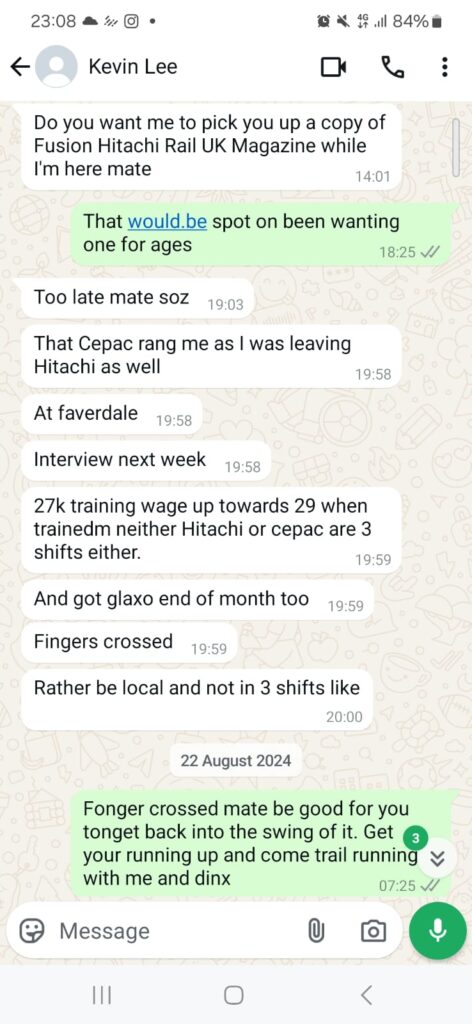
The recipient’s statement, dated 20 February 2025, supports the exchange’s origin and context. Together, they provide material to compare with Page’s recruitment records. What did the recruiter offer, and what happened afterwards? A contemporaneous message does not answer every question. Nevertheless, it is a stubborn little object for an investigation to encounter. Nobody had told it which corporate explanation it would eventually inconvenience.
Maria Walker Finds The Confusion Department
At 04:35 on 8 October 2024, I complained directly to Cepac. My email described the interview offer, the promised follow-up, the employment-gap discussion and the mental-health disclosure. Maria Walker, Cepac’s HR Business Partner, replied at 09:51. She said my CV had reached the recruiting manager but that I was “not shortlisted on that occasion”.
According to Walker, the manager would not have known about the mental-health information discussed with Page. Her explanation also said the agency had failed to tell me that I had not secured an interview. Thus, the two accounts differ at the central event. I described an offered interview awaiting confirmation; Walker described an unsuccessful shortlisting process.
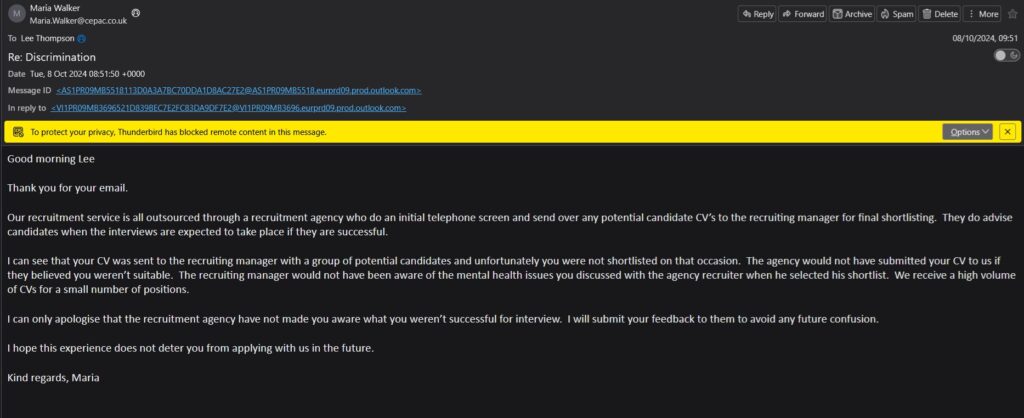
Walker supplied that explanation before seeing the message. Consequently, a review needs to establish what she checked and who supplied her account. The KFC II article sets out the earlier presentation of this trail.
Confusion has an impressive career in this sort of corporate bullshit. It arrives without qualifications, never takes responsibility and somehow gets promoted whenever two accounts collide. Here, however, an investigator can inspect the underlying records. Establish the candidate’s status and any changes to it. An apology for confusion still leaves the sequence unexplained.
Paragraph Fourteen Has Entered The Building
Cepac’s ET3, its formal response to the tribunal claim, adds a further problem. Paragraph 12 says Cepac did not know about the agency conversation concerning my health-related employment gap until after my October complaint. Yet paragraph 14 reproduces an email from Page to Cepac on 21 August. It reported that I had spent twelve months out of work because of health problems and was ready to return.
The distinction matters. Receipt by the company does not establish which decision-maker read the email or what that person understood about disability. Nevertheless, the pleaded account puts health information inside the recruitment chain on the day of the call. Walker’s assurance about the recruiting manager therefore needs checking against recipients, access and the decision record.
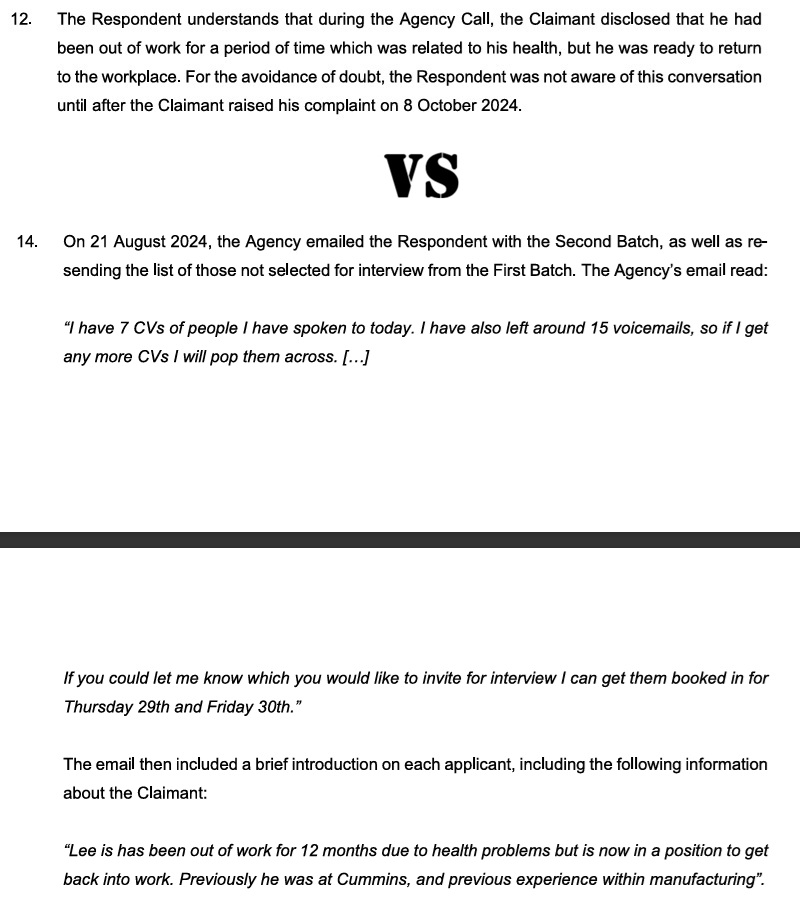
Start with that email. Then establish who received it, where it went and what happened to my application. Compare the result with the WhatsApp and Walker’s reply. Those steps would turn a disagreement into something an investigator can test.
Instead, the documents currently leave a gap where an explanation should sit. Paragraph fourteen has walked into the room carrying the information. Somebody now needs to explain its route. There is no need to summon a philosophical committee to debate whether a company can know something while its inbox wears a false moustache.
Michael Page Brings The Black Marker
Page’s data-subject-access response belongs in that review too. It contained redacted names and passages, with third-party information given as the reason. The disclosed material also concerned enquiries into my tribunal history after I complained. TCAP covered that record in Page Partners : Cepac Limited – Redactions, Panic Calls And The Disabled Candidate They Googled.
Some redaction can protect other people’s information. However, it leaves an obvious practical question for the companies holding the originals: can their records explain the recruitment decision? The blacked-out version cannot do that work for them. Nor does investigating the applicant’s history reconstruct the call in which the interview arose.
Once I complained, my background attracted attention. Enter Inspector Bollocks, armed with a search engine while the promised confirmation remains absent. A useful supplier review would bring that curiosity back to the application itself. Otherwise, the exercise becomes a detective story in which everyone searches the complainant’s wardrobe while the central event sits under a black rectangle. The companies still need to explain what happened to the interview.
Horsfield Menzies Takes An Interest In My Surgery
The later conduct deserves examination alongside the recruitment. Horsfield Menzies, acting for Cepac, contacted my medical centre about appointment availability and used the information to oppose a postponement. This concerned appointments, rather than access to my full medical records. Even so, the opposing solicitors had turned my route to medical support into another point to deploy against me.
At the same time, correspondence, complaints, blog material and social posts fed the case about my conduct. I was a disabled litigant in person. My emotional dysregulation in stressful situations arises from disability, which makes the surrounding pressure part of the explanation. Cutting that context away produces an account with the cause missing and the reaction under a spotlight.
I regard the medical enquiry and the wider handling as bullying. That assessment rests on identifiable acts which Huhtamaki can examine through the correspondence, medical context and submissions. It does not require procurement to adopt my adjectives. It requires someone to read the sequence before accepting the respondents’ account of it.
Otherwise, distressed reactions become wonderfully convenient exhibits. The pressure disappears behind a professional letterhead, while the response acquires a label and a page number. A supplier review that accepts that arrangement would resemble a fire investigation conducted entirely through complaints about the noise of the alarm.
The New Policy Starts With The Affected Person
Huhtamaki’s new Group Human Rights Policy, version 3.0 dated 16 October 2026, provides a current standard for that review. It extends its approach across the value chain and directs suppliers to the supplier code. Where potential or actual harm arises at a supplier, it says the response starts with affected people and appropriate remedies. Its process includes supplier risk screening, further assessment and corrective action where needed.
That emphasis changes the questions on the desk. How did the conduct affect the person raising the complaint? What role did disability play in the events and the response? Which measures could address the harm and prevent recurrence? Those questions begin with an individual’s experience, rather than the amount of inconvenience his correspondence creates for a purchasing department.
Of course a company can investigate an allegation and reject it. However, the investigation must engage with what the documents show. Treating distress as a reason to stop examining the complaint would make the affected-person language absurd. The policy would become a hospital sign pointing towards a room where staff assess how annoying the patient sounds.
Huhtamaki has just promoted this framework publicly. Here is a concrete opportunity to demonstrate it. The evidence already has dates, named participants and competing accounts. Procurement does not need another inspirational workshop. It needs somebody willing to read an uncomfortable file without reaching for the corporate sick bucket.
A Strike-Out Is Not A Recruitment Audit
Cepac’s combined costs schedules exceeded £50,000. Its representative limited the costs application to £20,000 to avoid a detailed assessment. After the hearing on 24 April 2026, which proceeded without me, the tribunal struck out my claims and ordered me to pay Cepac £20,000.
The findings went against me. The tribunal characterised my conduct as unreasonable, scandalous and vexatious, and concluded that a fair trial was no longer possible. It also rejected the foundation of my comments about the solicitors. Those conclusions form part of the record; my objection is that the assessment failed to deal fairly with disability, pressure and participation.
The Newcastle maladministration article develops that criticism. Crucially, the strike-out did not decide whether disability discrimination occurred in recruitment. The interview account, missing confirmation and health-information route never received a merits determination.
Consequently, Huhtamaki should read the judgment for what it decided. A conduct finding cannot supply the missing recruitment records. Nor can a costs order explain what Page offered or what Walker checked. Anyone presenting it as that answer has performed a rather grubby substitution: the complainant’s procedural defeat goes into the machine, and a certificate of impeccable recruitment comes out. The machine has no such setting. Somebody has drawn it on with a fucking marker pen.
Speak Up Must Lead Somewhere
Huhtamaki’s ethics programme invites employees, suppliers, customers and other stakeholders to raise concerns. It offers a Speak Up channel and prohibits retaliation over good-faith reports. The organisation therefore has a published route through which an external concern can reach people responsible for examining it.
Whether Huhtamaki has already received this material remains a question for the company. Publication and tagging do not establish receipt by an investigator. However, the evidence now provides a clear basis for a response: confirm the relationship, identify the responsible team and explain how the concern will be assessed.
A meaningful process would also test the supplier’s answer against the underlying records. Simply forwarding a complaint to its subject and filing the reply would leave the central disagreement untouched. That is a particularly comfortable arrangement for everyone except the person asking for scrutiny. The complaint gets a reference number, the supplier gets the last word, and accountability goes round the building on a trolley until somebody loses it.
Therefore, the Huhtamaki supplier code needs an investigator capable of following a contradiction beyond the first reassuring email. A report should emerge with an explanation of what happened and why the evidence supports the conclusion. An acknowledgement alone would merely prove that the stationery department survived the encounter.
The Quiet Mancunian And Paragraph 110
There is also a separate, serious allegation concerning Cepac’s wider corporate group. HSA’s own directory lists Cepac and Longulf. Anthony C Heaford, who publishes as The Quiet Mancunian, makes allegations involving Longulf and Dirhem Abdo Saeed. The corporate relationship is documented; his allegations require a separate evidential assessment.
In a report dated 15 May 2023, Heaford alleges that Dirhem financed and hosted Khalid Sheikh Mohammed in 1997. He connects this to machinery purchased through Longulf and a subsequent installation trip to Yemen. During that trip, he says, he met the man he identifies as Mohammed inside HSA’s headquarters compound in Taiz.
These are Heaford’s allegations, which I have not independently verified. His report acknowledges that official documents concerning Mohammed or 9/11 do not name Dirhem. Neither the report’s existence nor the corporate connection proves criminal conduct by Cepac, HSA, Longulf or any individual.
Paragraph 110 of the tribunal judgment records my post alleging a link between Cepac and 9/11 funding. However, it does not examine Heaford’s underlying account. Readers can inspect that source alongside TCAP’s earlier discussion. Judicial disapproval is not a fucking fact-check. The source remains open to examination and challenge; the judgment’s characterisation cannot stand in for that work.
Care, Dare, Deliver The Records
Huhtamaki can begin with a straightforward account of its commercial relationship with Cepac: the relevant entity, dates, products and current status. Next comes the reporting question. Did anybody raise this complaint within that relationship, and what review followed? If there was no review, the company can explain how it will assess the material now.
The evidence gives that assessment a practical order. Obtain the August recruitment trail and establish what Page offered. Trace the health-related email, the candidate-status changes and the basis of Walker’s reply. Then examine the medical-centre correspondence, the conduct submissions and the judgment. The separate Heaford allegations require their own source assessment; they cannot stand in for proof of the recruitment complaint.
Finally, explain the outcome and any action. Protecting personal information need not prevent a company from stating what it examined, what it concluded and how its standards informed the decision. A reasoned rejection would at least engage with the evidence. An untested reassurance would leave the same questions sitting there, wearing a new company’s logo.
The Huhtamaki supplier code has supplied the words. The people holding the records can supply the answer. Care should survive contact with an actual disabled complainant. Dare should stretch to an awkward question for a supplier. Deliver ought to involve something more substantial than a PDF congratulating itself on the journey. Get the file onto the desk and open the bloody thing.
Lee Thompson – Founder, The Cummins Accountability Project
Sources
- Prolific North: Unite Union Threatens Legal Action In Pay Dispute At Greggs And Asda Packaging Supplier
- Huhtamaki: Acquisition Of BCP Fluted Packaging
- Companies House: Huhtamaki BCP Limited
- Huhtamaki: Code Of Conduct For Suppliers
- Updated Environmental And Human Rights Policies: Huhtamaki
- Group Human Rights Policy, October 2026: Huhtamaki
- Huhtamaki: Ethics And Compliance
- TCAP: The Cepac Files: KFC II – Maria Walker And The Interview Receipt
- Page Partners: Cepac Limited – Redactions, Panic Calls And The Disabled Candidate They Googled
- TCAP: Newcastle Employment Tribunal : Deep Dive : Deliberate Maladministration
- Employment Tribunal: Thompson v Cepac Limited And Page Outsourcing UK Limited
- HSA Group: Our Companies
- The Quiet Mancunian: Khalid Sheikh Mohammed’s Hosts & Financiers
- TCAP: The Cepac Files : Why I Believe The Quiet Mancunian